

Best overall: a timber round coffee table for everyday living. Best for a statement room: marble; best for a textured neutral interior: travertine; best for visual lightness: glass; best for a changing layout: nesting tables. This 2026 guide from Elegante compares the materials, proportions and practical compromises that should decide your choice.
- Elegante’s round coffee table verdict: choose timber for everyday living, marble for a statement, or travertine for natural texture.
- Glass coffee tables suit visually busy rooms, but transparent tops still need clear walking space.
- Nesting coffee tables offer separate surfaces; check the footprint when every table is extended.
- Choose your coffee table material around care requirements, sofa proportions and how you actually use the room.
Why this matters
A round coffee table removes projecting tabletop corners, but its diameter still occupies valuable floor space. A broad pedestal or splayed legs can also obstruct the route around your seating.
The best round coffee table is the one that fits your daily routine, not simply your colour palette. Choose a surface you are prepared to maintain, then check its height, footprint and reach from each seat. That order prevents an elegant centrepiece becoming an everyday inconvenience.
What makes the best round coffee table?
Use these criteria to assess your 2026 shortlist before comparing finishes:
- Room fit: judge the complete footprint, including the base, against your sofa, chairs and walking routes.
- Useful height: compare the tabletop with your sofa seat so drinks and books remain comfortable to reach.
- Surface care: understand the finish, cleaning instructions and protection required for everyday use.
- Base position: check where feet, knees and the vacuum cleaner need to go, not just how the top looks.
- Material clarity: distinguish solid timber, veneer, natural stone, glass and stone-look surfaces in the specifications.
- Visual balance: consider how much pattern, reflection and texture the room already contains.
Round coffee tables at a glance
These rankings compare table types rather than individual products. Each option has a distinct role, and the limitations matter as much as the appearance.
| Rank and option | Best for | Standout quality | Key limitation |
|---|---|---|---|
| 1. Timber round coffee table | Everyday living | Grain and finish bring warmth without requiring a stone focal point | Resistance to marks depends on the finish |
| 2. Marble round coffee table | A statement interior | Natural veining gives the surface a strong decorative role | Acidic spills can etch marble |
| 3. Travertine round coffee table | Textured neutral rooms | Natural pores and tonal variation add depth | Filled and unfilled surfaces have different care needs |
| 4. Glass round coffee table | Visually busy rooms | A transparent top leaves more of the rug visible | Fingerprints and reflections remain noticeable |
| 5. Round nesting coffee tables | Flexible seating arrangements | Separate surfaces can serve different seats | The extended arrangement needs its own space |
1. Timber: best round coffee table for everyday living
A timber round coffee table is the strongest default when your living room serves several purposes. Choose it for a space that needs to feel inviting during the day and considered when you entertain.
Timber is not a single specification. Solid timber and timber veneer are different constructions, and neither label alone tells you how a finished tabletop will tolerate water, heat or scratches. Read the care instructions alongside the material description.
Timber round coffee table pros:
- Grain adds interest without introducing another strongly patterned stone surface.
- A choice of timber tones helps connect existing furniture.
- Round forms work with both tailored and relaxed seating.
Timber round coffee table cons:
- Water and heat can mark some finishes.
- Repair options differ between solid timber and veneer.
- A dark, substantial base can look heavy beside a compact sofa.
Best for: a living room used for conversation, reading and everyday relaxation.
For your 2026 shortlist, prioritise finish information over broad descriptions such as “natural”. Ask what touches the floor and what protects the tabletop.
Verdict: Buy timber when everyday use takes priority over a dramatic stone statement.
2. Marble: best round coffee table for a statement interior
A marble round coffee table gives the centre of the room a distinct decorative presence. Natural veining supplies pattern, so you can keep surrounding accessories quieter.
The compromise is care. Marble is a calcareous stone, and acidic substances can etch its surface; a sealer does not make it acid-proof. Use coasters and follow the specified cleaning instructions rather than treating the top like an impervious work surface.
Marble round coffee table pros:
- Natural veining gives each stone surface individual character.
- A stone top can carry the room’s decorative focus.
- Marble pairs readily with timber, upholstery and metal finishes.
Marble round coffee table cons:
- Acidic spills can leave dull etch marks.
- Natural variation means a photograph is not a promise of identical veining.
- Moving requirements depend on the table’s construction and weight.
Best for: a carefully styled sitting room where you are comfortable protecting natural stone.
Keep the rest of the setting disciplined. If the tabletop has expressive veining, choose accessories that repeat its colours rather than competing with its pattern.
Verdict: Buy marble for a deliberate focal point; skip it if surface protection feels like a chore.
3. Travertine: best round coffee table for neutral texture
A travertine round coffee table suits an interior built around linen, timber and restrained colour. Its attraction is texture and variation rather than a perfectly uniform finish.
Travertine naturally contains cavities. These can be filled during manufacture or remain part of the surface, so check the actual finish before deciding how you will use and clean the table.
Travertine round coffee table pros:
- Natural texture adds depth to a limited colour palette.
- Tonal variation creates interest beside plain upholstery.
- A rounded silhouette complements the stone’s organic character.
Travertine round coffee table cons:
- Unfilled cavities complicate wiping up crumbs and spills.
- Acidic cleaners and spills can damage calcareous stone.
- The word travertine does not establish whether a piece is solid stone or another construction.
Best for: a neutral living room where material texture is the main decorative feature.
In 2026, assess the finish as closely as the colour. A smooth filled top and an open-textured top are different everyday propositions, even when their tones look similar online.
Verdict: Buy travertine for natural texture; hold until the surface finish and care requirements are clear.
4. Glass: best round coffee table for visual lightness
A glass round coffee table keeps more of the rug and surrounding floor visible. That makes it a useful design choice when upholstered furniture, patterned textiles or substantial joinery already occupy much of the room’s visual space.
Transparency does not reduce the table’s physical footprint. Inspect the edge, base and glass specification, then test the same walking routes you would for an opaque table.
Glass round coffee table pros:
- A transparent top leaves rug patterns visible.
- The base can become the principal decorative feature.
- Glass introduces contrast beside textured upholstery and timber.
Glass round coffee table cons:
- Fingerprints and smudges are visible.
- Reflections can compete with nearby lighting.
- An unobtrusive edge still needs to be easy to notice when walking past.
Best for: a room that needs a central surface without another opaque block of furniture.
Choose the base with particular care. A visually open top loses much of its effect if the structure underneath is broad and densely detailed.
Verdict: Buy glass for visual openness; skip it if visible fingerprints will frustrate you.
5. Nesting tables: best round coffee tables for flexible seating
Round nesting coffee tables give you separate surfaces to position around your seating. They suit a room where an occasional chair moves into the conversation area or guests need somewhere to place a drink.
Nesting describes the arrangement, not the material. You still need to evaluate each top and base, and confirm how the tables overlap.
Round nesting coffee table pros:
- Separate tops can serve different seats.
- Overlapping forms create a layered centrepiece.
- You can change the arrangement without replacing the furniture.
Round nesting coffee table cons:
- An extended arrangement occupies more space than the nested footprint.
- Some designs need lifting rather than sliding to reposition.
- Multiple bases can interrupt foot space.
Best for: a living room with changing seating arrangements.
Elegante’s Solstice Ivory Cloud Marble Coffee Tables Set of 2 - Oak illustrates a related distinction: its description specifies organically shaped marble tops, not round tops. Choose it for that organic nesting format, not as a substitute for a verified circular design.
Verdict: Buy round nesting tables for separate serving surfaces; hold if only the nested dimensions are clear.
How the ranking works
This 2026 ranking prioritises everyday usefulness, room fit, surface care and clear material specifications. Timber takes the default position because it suits a broad everyday brief; marble, travertine, glass and nesting designs win their more specific roles.
The ranking is not a claim that every timber table outperforms every stone table. Construction, finish and dimensions decide whether an individual piece deserves a place in your home.
Check the footprint before you choose the finish
Make a full-size floor template before committing to a round coffee table. As an illustrative planning exercise, mark a 90 cm diameter circle, then leave a 40 cm gap from the sofa and compare it with a 45 cm gap. These are trial measurements, not product specifications or fixed clearance rules.
Sit down, stand up and walk around the template carrying a tray. Test access from every seat, including the chair that only comes out when you entertain.
- Mark the top: show the complete circular footprint on the floor.
- Check the base: mark any legs or supports that extend beyond it.
- Test the reach: sit normally and check where your hand lands.
- Walk the route: test the path between seating and adjoining rooms.
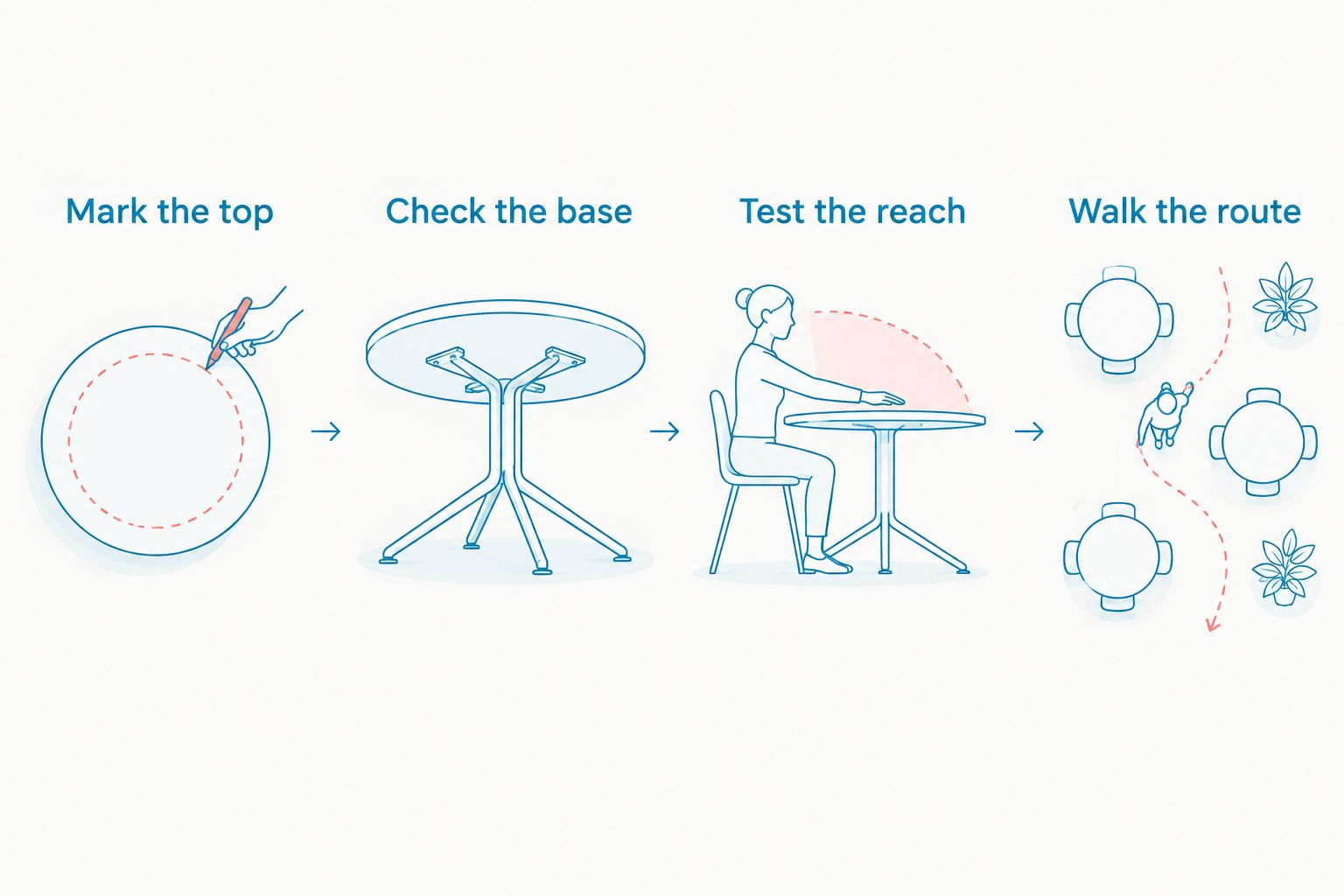
A floor template also exposes a common mistake: choosing a smaller top while overlooking an awkward base. Measure the usable arrangement, not just the advertised diameter.
Pair the table with the rug and sofa
A round coffee table does not require a round rug. The rug should first make sense of the seating arrangement, while the table supplies a useful surface within it.
The choice between round or rectangular rugs should follow the furniture grouping: a rectangular rug can organise a long sofa arrangement, while a round rug can echo a compact circular conversation area. Avoid choosing either shape solely to match the tabletop.
For a calm composition, repeat a material or colour already present in the room. A timber table can relate to shelving; a marble top can pick up a pale tone in the upholstery without requiring matching stone elsewhere.
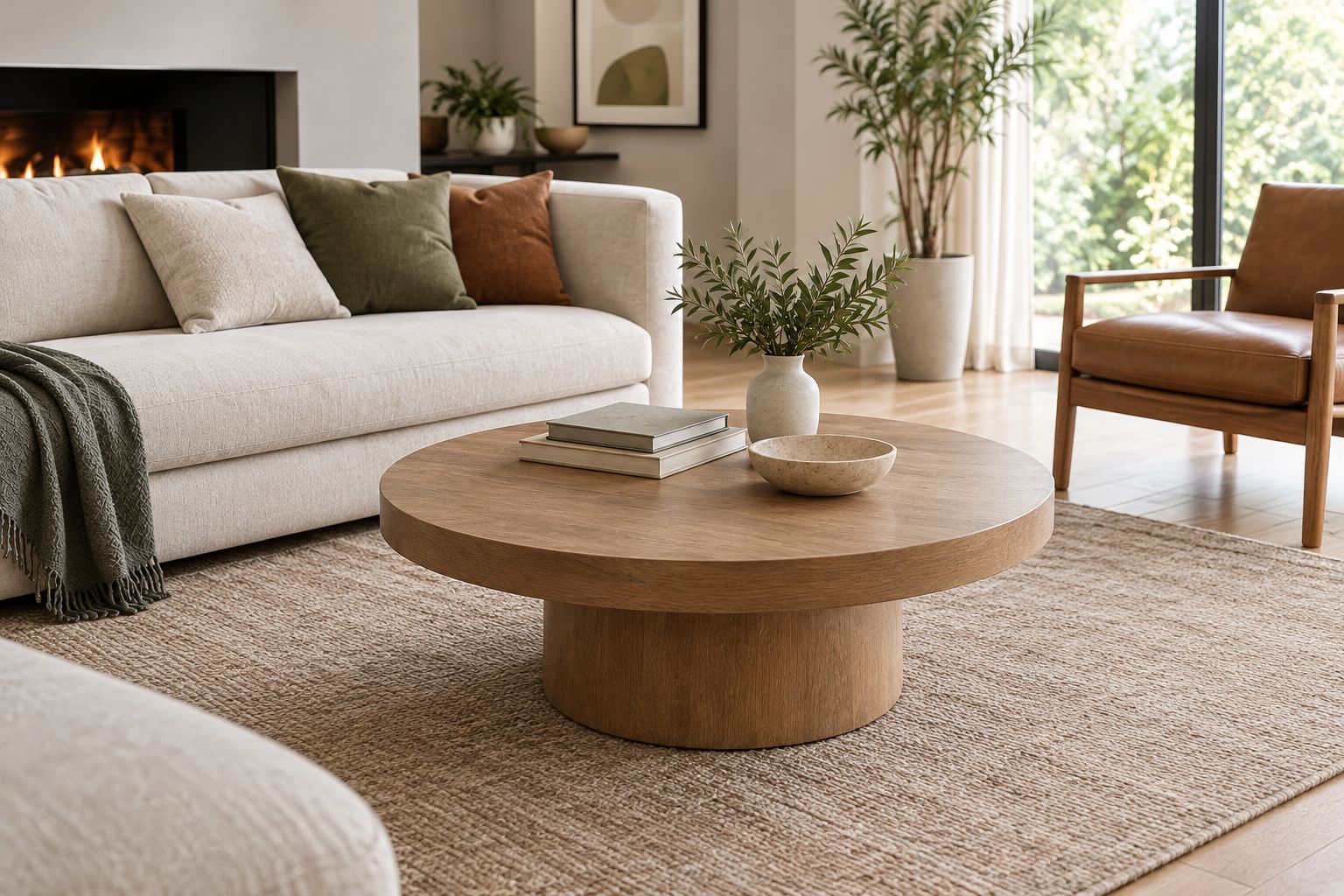
Keep accessories subordinate to the surface. One low arrangement leaves room for actual use and lets the table’s grain, veining or texture remain visible.
Which round coffee table should you choose?
Elegante’s round coffee table recommendation is timber for buyers who want warmth and an everyday living-room centrepiece. Start there unless you have a specific reason to choose another material.
Choose marble when veining should be the focal point, travertine when texture matters most, and glass when you want to preserve sightlines to the rug. Choose nesting tables when separate surfaces solve a genuine seating problem.
For your final 2026 check, compare the care instructions with your habits. A beautiful surface that needs attention you will not give it is the wrong choice, regardless of how well it matches the sofa.
FAQ
What’s the best round coffee table material for everyday use?
Timber is the best default in this guide for everyday living, provided its finish suits your routine. Elegante recommends checking the construction and care instructions rather than assuming every timber surface performs alike.
Is a marble round coffee table hard to maintain?
Marble requires protection from acidic spills and unsuitable cleaners. Use coasters, clean spills promptly and follow the table’s care instructions; sealing does not prevent acid etching.
Is travertine better than marble for a coffee table?
Travertine is better for a textured neutral look, while marble suits a veined statement surface. Both require appropriate stone care, and the travertine’s filled or unfilled finish affects everyday cleaning.
Does a round coffee table make a small room look bigger?
A round coffee table changes the outline of the furniture, not the room’s dimensions. Diameter, base size, material and clear walking routes matter more than the shape alone.
Can I use a round coffee table on a rectangular rug?
Yes, a round coffee table can sit on a rectangular rug. Choose the rug to organise the seating arrangement rather than requiring every shape in the room to match.
Are nesting coffee tables better for small living rooms?
Nesting coffee tables are better when separate surfaces help your seating layout. Check the extended footprint as well as the nested footprint before treating them as a space-saving solution.
Are the Solstice Ivory Cloud Marble Coffee Tables round?
The supplied description identifies the Solstice Ivory Cloud Marble Coffee Tables Set of 2 - Oak as organically shaped, not round. Choose a design explicitly described as circular if a true round tabletop is essential.
One last thing
Check the underside before you fall in love with the top. A circular surface can sit above a base that obstructs feet, complicates cleaning or projects into your walking route.
Keep the full-size template down while you use the room normally. The route you take without thinking is a better test than a carefully composed photograph.


Comments (0)
There are no comments for this article. Be the first one to leave a message!