

Best overall: round open-frame nesting coffee tables. Best for narrow rooms: rectangular nesting tables. Best for a lighter-looking interior: glass-top nesting tables. This 2026 guide ranks design types by how they work in a small living room, helping you choose a configuration rather than assume that matching tables will nest together.
- Round open-frame nesting coffee tables are the default choice for compact living rooms with several seating positions.
- Rectangular nesting tables suit narrow layouts; glass tops preserve views of the rug beneath.
- Timber tops suit material-led interiors; stone tops suit a decorative centrepiece that stays mostly in place.
- Check the nested and extended footprints, underside clearance and base geometry before choosing a set.
Why this matters
Nesting coffee tables give you separate surfaces that tuck together when you do not need them. Their advantage depends on the whole arrangement, not simply the diameter of the larger table. A smaller table that barely slides underneath still occupies floor space.
For Elegante readers furnishing a small living room, round open-frame nesting coffee tables are the default choice. Start with the layout, then choose the finish. If transparency is your priority, Elegante’s guide to glass coffee tables for a glamorous living room explores that styling direction in more detail.
What makes the best nesting coffee tables?
A useful nesting set earns its place through these criteria:
- Nested footprint: Judge the floor area occupied by the complete set when tucked together, including projecting legs.
- Extended footprint: Check where every table sits when separated, especially beside doors, chairs and the sofa.
- Nesting clearance: The smaller tabletop and base must pass beneath the larger table without obstruction.
- Independent usefulness: Each table needs a practical role when separated, rather than becoming an awkward spare surface.
- Handling and care: Choose materials and construction that suit how often you move the tables and how you use them.
- Visual balance: Consider the tops, legs and overlap together. A modest tabletop does not cancel out a bulky base.
For your 2026 shortlist, treat true nesting as a requirement, not a style description. Different heights alone do not establish that tables slide together. Look for an explicit nesting description and dimensions that explain the fit.
Nesting coffee tables at a glance
These recommendations rank configurations, not individual retail products. Shape, base construction and tabletop material often overlap, so use your main room constraint to choose a starting point.
| Rank and configuration | Best for | Standout feature | Key limitation |
|---|---|---|---|
| 1. Round open-frame nesting tables | Flexible seating layouts | Curved edges and space beneath the larger top | Circular tops do not follow a long sofa edge |
| 2. Rectangular nesting tables | Narrow living rooms | Straight edges align with the sofa | Corners need attention beside walking routes |
| 3. Glass-top nesting tables | Showing a rug beneath the tables | Transparent tops preserve the view below | Fingerprints and objects underneath remain visible |
| 4. Timber-top nesting tables | Warm, material-led interiors | Opaque surfaces provide a calm styling base | Broad tops and solid bases add visual weight |
| 5. Stone-top nesting tables | A decorative focal point | Natural surface pattern supplies visual interest | Weight and material care need checking |
1. Round open-frame tables: best for flexible seating
Round open-frame nesting coffee tables are the strongest starting point when your sofa and chairs face the centre from different angles. Their curved edges avoid introducing tabletop corners into that arrangement. An open base also leaves visible space beneath the top, although its geometry must still allow the smaller table to tuck in.
Picture the larger table in front of the sofa and the smaller table beside an occasional chair. When the extra surface is unnecessary, return it underneath rather than leaving it in the room’s main walking route.
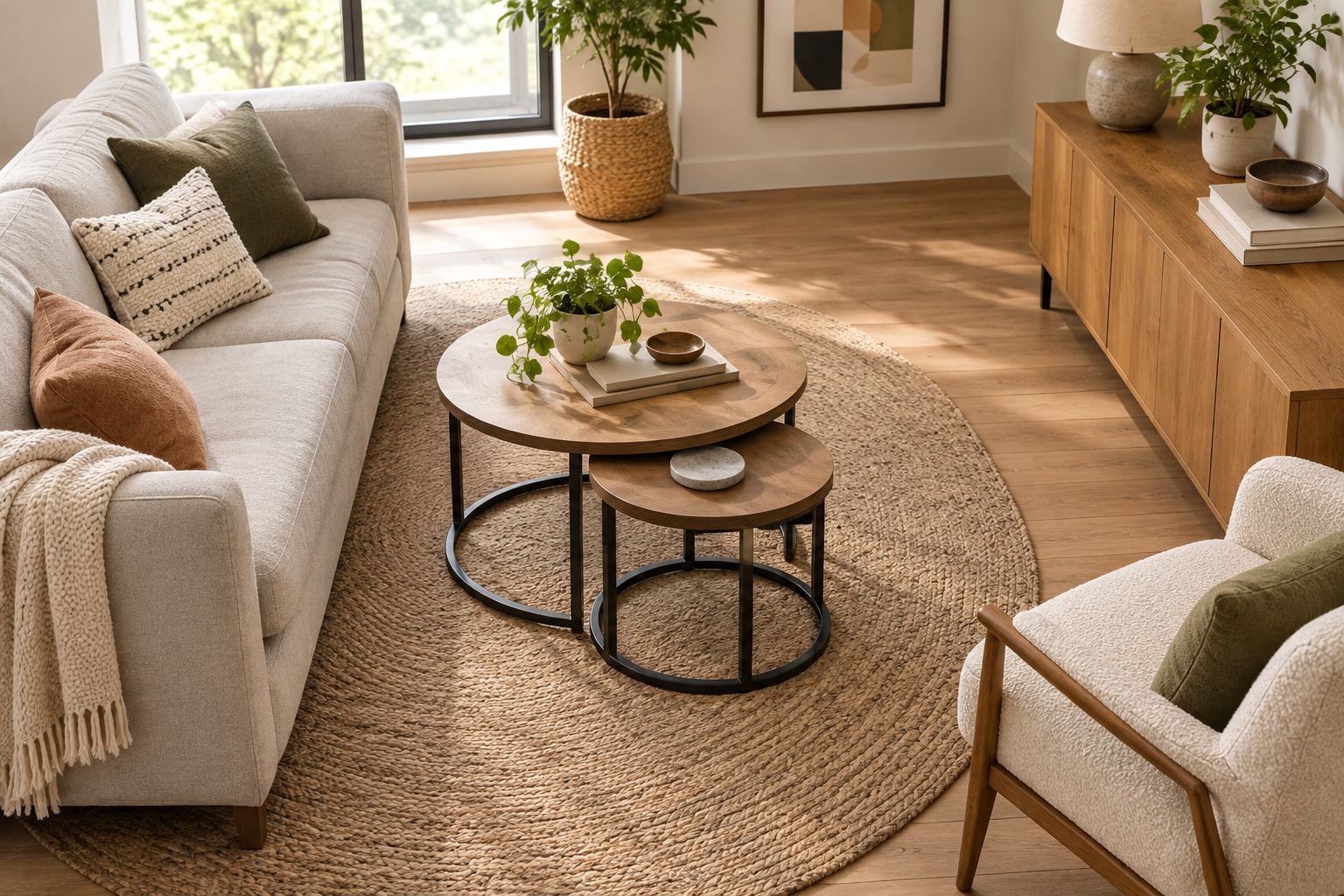
Round open-frame table pros:
- Curved tabletop edges suit seating approached from several directions.
- Separate circular surfaces work beside different seats.
- An open base reveals more of the floor than an enclosed base.
Round open-frame table cons:
- Circular tops leave gaps when placed along a straight sofa edge.
- A closed ring or cross-brace can obstruct nesting despite the open appearance.
Best for: A compact room where the smaller table moves between the sofa and an armchair.
Verdict: Buy this configuration if both tables tuck together properly and work independently.
2. Rectangular tables: best for narrow living rooms
Rectangular nesting coffee tables follow the straight line of a sofa and suit layouts with limited depth between seating and the opposite wall. Their useful feature is alignment: a long edge can sit parallel to the sofa rather than extending equally in every direction.
Choose the depth before the length. A rectangular set that looks neatly proportioned from the front still fails if its nested arrangement pushes into your route through the room.
Rectangular table pros:
- Straight edges align with a sofa and rectangular rug.
- An elongated surface serves seats along the sofa.
- A smaller rectangular table can provide a separate surface beside seating.
Rectangular table cons:
- Tabletop corners need careful placement near walking routes.
- A wide lower table can project beyond the larger table when nested.
Best for: A narrow living room with a straight sofa and a defined route alongside it.
For a 2026 room refresh, mark the base as well as the tabletop on your floor plan. Legs positioned outside the top’s edge determine the real footprint.
Verdict: Buy for a narrow layout only after checking the complete nested depth.
3. Glass-top tables: best for keeping a rug visible
Glass-top nesting coffee tables let you see the rug and floor through the tabletop. That makes them a useful option when the rug is an important part of your living-room scheme. Transparency changes the view, not the physical space occupied by the furniture.
Frame design matters as much as glass. Several overlapping rails remain visible through clear tops, so inspect the set both nested and separated rather than judging a single table in isolation.
Glass-top table pros:
- Transparent tops retain a view of the rug below.
- Objects on the tabletop remain visually distinct from the floor.
- Glass combines with timber or metal frames for different interior styles.
Glass-top table cons:
- Fingerprints and smudges require cleaning to maintain the clear appearance.
- Overlapping frames and anything underneath remain visible.
Best for: A small living room with a rug you want to show rather than conceal.
Check the glass specification, edge treatment and care instructions for the actual set. Do not assume that every glass tabletop has the same construction simply because the designs look similar.
Verdict: Buy if transparency is your priority; skip if visible marks will frustrate you.
4. Timber-top tables: best for a warm interior
Timber-top nesting coffee tables provide an opaque surface that works with upholstered seating, woven textiles and other timber furniture. They suit a room where you want the table to contribute warmth rather than disappear into the background.
Keep the distinction between material and finish clear. Solid timber, timber veneer and a timber-look surface are different constructions; the product description should identify what you are choosing.
Timber-top table pros:
- Opaque tops provide a defined background for decorative objects.
- Grain introduces pattern without adding another accessory.
- Timber tones connect the table with other furniture in the room.
Timber-top table cons:
- Broad tops and enclosed bases create a more substantial appearance.
- Finish-specific care instructions still matter for spills and hot objects.
Best for: A compact living room built around warm materials and restrained decoration.
For Elegante’s nesting coffee tables guide, the practical recommendation is simple: choose the timber tone after establishing the footprint. A finish that coordinates beautifully with your shelving cannot correct a set that blocks the sofa.
Verdict: Buy for warmth, but favour a base that leaves the nesting space clear.
5. Stone-top tables: best for a decorative focal point
Stone-top nesting coffee tables suit a room where the central surface is intended to be a feature. Natural marble and travertine introduce their own pattern, so the tabletop can carry the decorative scheme without a crowded collection of accessories.
This is a material-led choice, not the default for frequent rearranging. Check the actual table weight, whether the top is solid stone or another construction, and the recommended care before deciding how the set will work.
Stone-top table pros:
- Natural stone provides variation in pattern and colour.
- A patterned top supplies interest with minimal decoration.
- Stone pairs with timber or metal bases for different styling directions.
Stone-top table cons:
- Moving the tables requires attention to their stated weight and handling instructions.
- Natural marble and travertine need protection from acidic spills.
Best for: A small formal living room where the tables stay mostly in their planned positions.
In 2026, choose stone for its material character, not because it automatically makes a nesting set more practical. A broad pedestal base can prevent the overlap you need.
Verdict: Hold until the nesting geometry, weight and care requirements are clear.
Check the fit before choosing a set
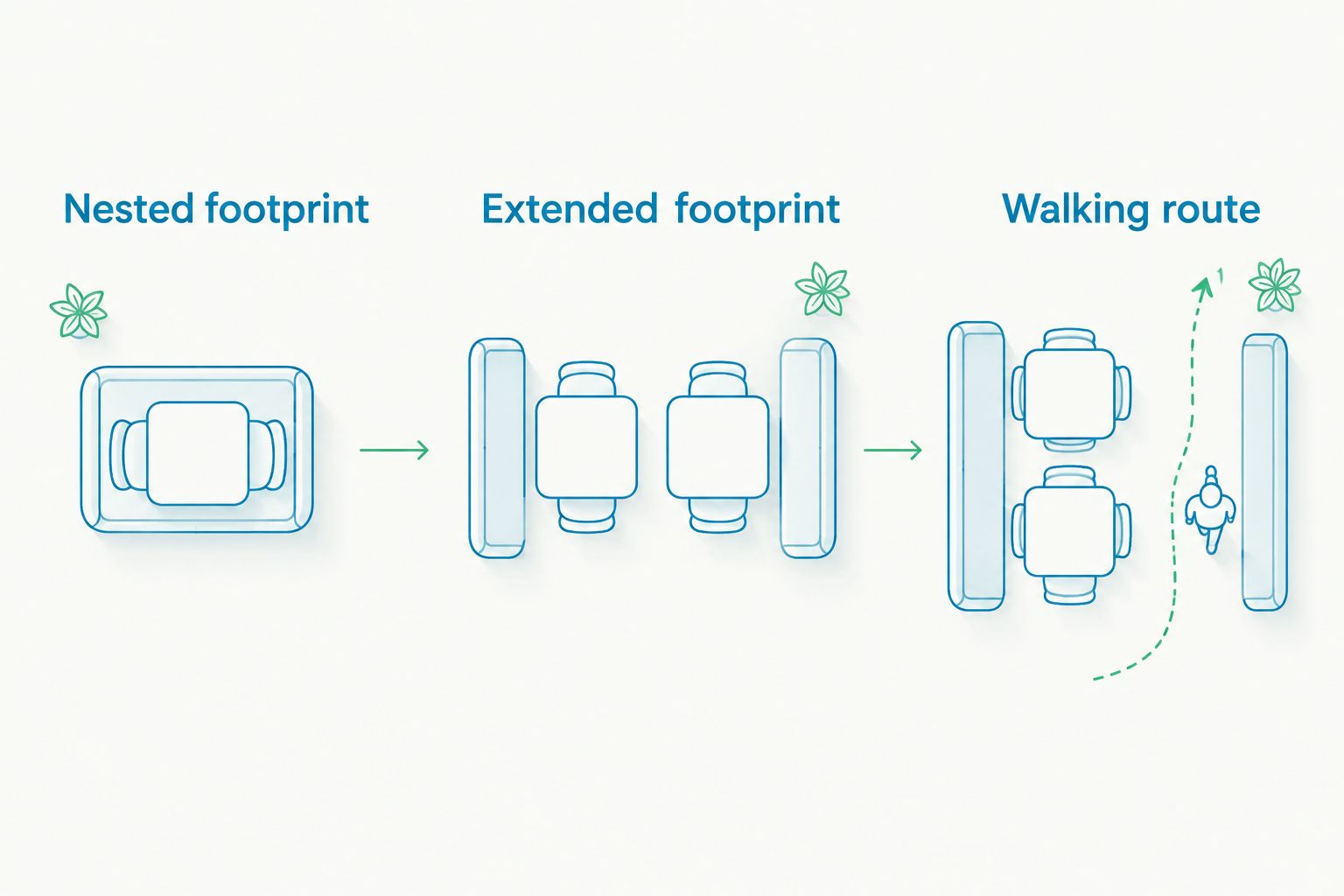
Test the arrangement in your own room before committing to a finish. Use removable floor markers suitable for your flooring, or paper templates, to represent the dimensions supplied for the tables.
- Nested footprint: Mark 2 floor outlines for a pair, including any base that projects beyond its tabletop.
- Extended footprint: Check 3 table positions: tucked together, partly extended and fully separated.
- Walking route: Preserve 1 clear route through the room in every arrangement you plan to use.
These are layout checks, not universal furniture dimensions. Your sofa, door swing, seating positions and daily movements determine whether the arrangement works.
Sit down in each seat and check where a drink would go. Then stand up, move around the tables and test any reclining mechanism. A set that works only when nobody moves is the wrong fit.
Also inspect the underside. An apron, brace or pedestal can stop the smaller table sliding underneath even when the listed heights seem compatible.
How the configurations are ranked
This 2026 ranking prioritises nesting clearance, practical footprints and independent usefulness before material or decorative impact. Round open-frame tables take the default position because they suit flexible seating; rectangular tables address a narrower layout constraint.
Glass, timber and stone then answer different styling priorities. No product-specific testing or nesting compatibility is implied by this design ranking. A matching finish or shared collection name does not establish that separate retail tables form a nesting set.
Which nesting coffee tables should you choose?
Choose round open-frame nesting coffee tables if you are undecided. They are the starting point for a compact living room where seating surrounds the tables and the smaller surface needs to move.
Choose rectangular tables when room depth is the main constraint. Select glass to retain the view of your rug, timber for an opaque warm surface, or stone for a material-led focal point that stays mostly in place.
Elegante’s nesting coffee tables recommendation puts everyday use ahead of the styled photograph. Keep the larger surface useful, give the smaller table a defined role, and reject any set that cannot preserve your walking route.
FAQ
What are the best nesting coffee tables for a small living room?
Round open-frame nesting coffee tables are the default choice for flexible seating layouts. Rectangular nesting tables are the better starting point when limited room depth is the main constraint.
Do nesting coffee tables actually save space?
Nesting coffee tables reduce their combined footprint when the smaller table tucks beneath the larger one. The saving depends on the actual overlap, including the legs and base, rather than different tabletop heights alone.
Are round nesting tables better than rectangular ones?
Round nesting tables suit seating approached from several directions, while rectangular tables align with a straight sofa. Choose according to the room layout rather than treating either shape as universally better.
Can I combine two matching coffee tables to make a nesting set?
Matching coffee tables are not automatically a nesting set. Check the smaller table’s overall height and width against the larger table’s underside clearance, including braces, aprons and legs.
Are glass nesting coffee tables good for small rooms?
Glass nesting coffee tables suit small rooms when you want to retain a view of the rug beneath them. Their transparent tops do not reduce the floor space they occupy, and marks and overlapping frames remain visible.
Are marble nesting coffee tables easy to move?
Ease of movement depends on the actual table weight and construction. Check those details and the handling instructions before choosing marble tables for frequent rearranging.
How should I style nesting coffee tables without clutter?
Keep the smaller nesting table clear if you regularly tuck it beneath the larger table. Place decoration on the larger surface without covering the area you use for drinks or everyday objects.
One last thing
The most useful styling decision happens underneath the tabletop. If the smaller surface carries a vase that prevents it sliding back into place, you have turned flexible furniture into a permanent spread.
Keep the smaller table ready to tuck away. Let the larger table hold the decorative arrangement, and leave space for the room to function.


Comments (0)
There are no comments for this article. Be the first one to leave a message!