

Warm living room coffee-table planning is the process of selecting a round walnut coffee table with the aim of creating a softer, warmer centre for the seating area. In 2026, Elegante’s guide prioritises measured proportions, visible timber grain and finishes that complement linen, wool, brass and other warm materials.
- A round walnut coffee table suits warm living rooms that need softer lines, natural grain and an accessible central surface.
- Elegante’s verdict favours solid walnut for repairability and walnut veneer when lower weight matters more.
- Allow 40–45 cm between the table and sofa so people can sit, reach and move comfortably.
- Keep the tabletop within 5 cm of the sofa seat height for comfortable everyday use.
Why a round walnut coffee table matters for warm living rooms
The Elegante approach to designer furniture starts with the room rather than an isolated object. A coffee table occupies the visual centre of most seating arrangements, so its shape and finish affect how the sofa, rug, armchairs and lighting read together in 2026.
A circular top removes projecting corners from the main path between seats. This is useful in compact rooms, open-plan spaces and layouts where people regularly walk between the sofa and television. The curved outline also contrasts with the straight edges of sofas, rugs and media units without introducing another colour or decorative pattern.
Walnut brings a brown base with darker grain and, depending on the board, reddish or purplish variation. That natural variation works particularly well beside cream upholstery, warm white walls, wool rugs, aged brass and black metal. It also gives the room depth when an entirely pale palette starts to look flat.
American black walnut has a commonly published Janka hardness rating of approximately 1,010 lbf. Red oak is approximately 1,290 lbf, while hard maple is approximately 1,450 lbf. Walnut is therefore softer than those timbers, but it remains suitable for furniture when spills, direct heat and abrasive objects are managed properly.
How to choose a round walnut coffee table
A successful 2026 selection process has six connected decisions: room measurement, construction, proportion, finish, styling and care. Complete them in that order so an attractive table does not become an obstacle once it enters the room.
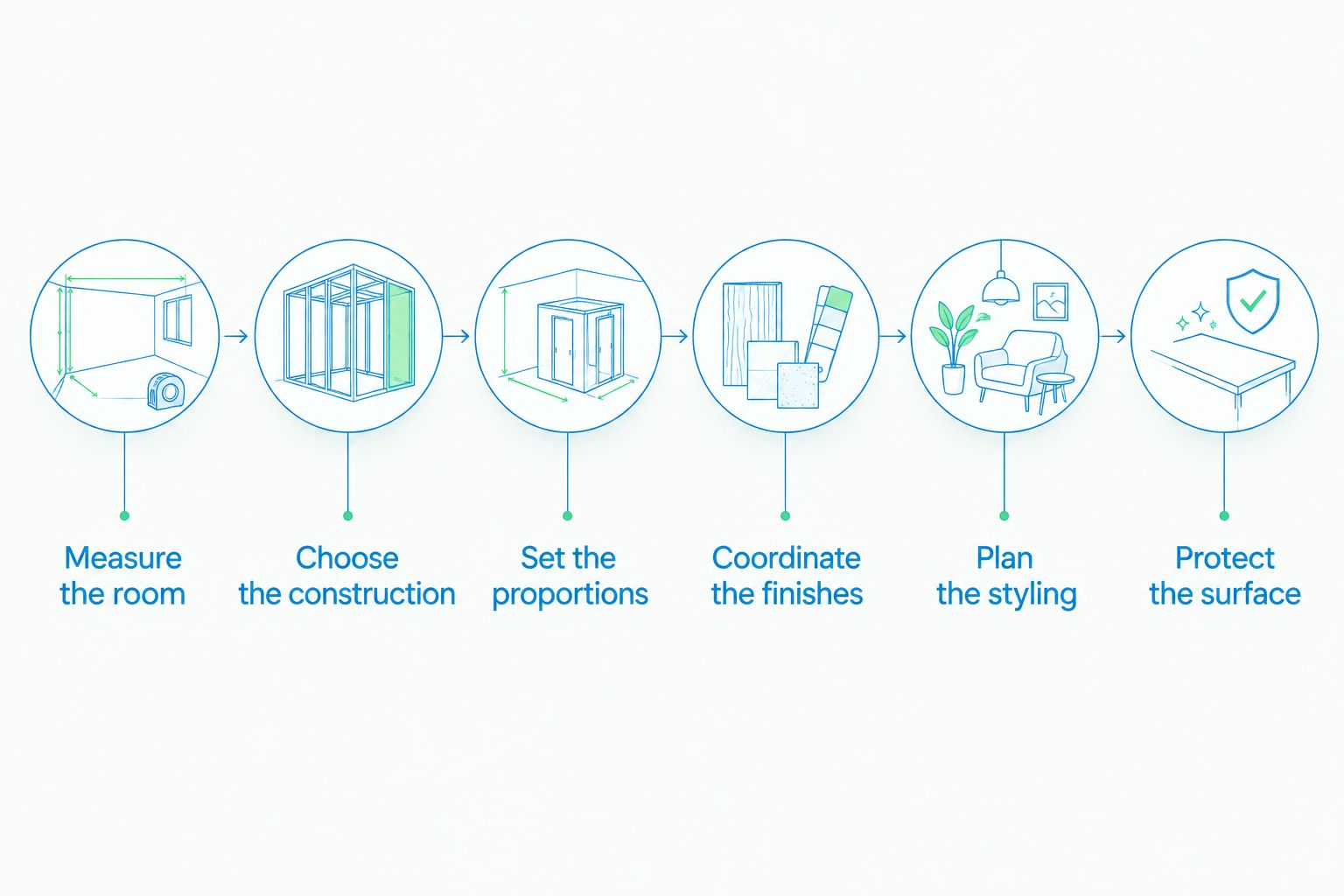
Measure the room
Start with the available floor area, not a product photograph. Mark the proposed circumference with painter’s tape or arrange sheets of newspaper into a circle. This free test shows whether the table blocks a doorway, interrupts a direct walking route or leaves one seat too far away to use the surface.
Allow around 40–45 cm between the table edge and the sofa. That range gives a seated person access to the surface while preserving space for knees and movement. Check every side because a round table can have suitable clearance at the sofa but still crowd an armchair or side passage.
- Mark the full circumference on the floor with removable tape
- Open nearby doors and drawers to check their travel
- Walk through the room using the normal route between seats
- Sit in every chair and test whether the marked surface is reachable
- Confirm that the circle remains centred on the rug and seating group
Choose the construction
Solid walnut and walnut veneer can create a similar first impression, but they age differently. Solid timber can usually be lightly sanded and refinished when the surface becomes worn. Veneer uses a thin layer of walnut over a stable core, reducing weight while limiting how deeply the surface can be repaired.
Read the material description rather than relying on a brown finish or a product title. Terms such as walnut colour, walnut look or walnut finish do not necessarily mean the table contains walnut. Elegante’s designer-furniture selection can provide a faster visual reference, but the listed construction remains the deciding information.
- Look for solid walnut or walnut veneer in the material field
- Ask what material sits beneath the veneer when it is not stated
- Inspect edge photographs for uninterrupted grain or visible joins
- Check whether the care instructions permit oiling or refinishing
- Avoid assuming that a dark brown stain identifies the timber species
Set the proportions
Coffee-table diameter should respond to the entire seating arrangement, not only the sofa length. A large sectional needs a broader central surface, while a compact sofa and one armchair can work with a smaller circle. Repeat the taped-floor test whenever the seating position changes.
Height matters just as much. Keep the top level with the sofa seat or no more than about 5 cm lower. A table that sits much higher can feel intrusive, while a very low design makes drinks and books harder to reach from deep seating.
- Compare the diameter with the full width of the seating group
- Keep 40–45 cm of clearance around the principal seating edge
- Measure sofa seat height with the cushion occupied
- Select a tabletop height within 5 cm of that seat height
- Check that decorative objects will not block the television sightline
Coordinate the finishes
Walnut does not require every other timber in the room to match exactly. A more convincing scheme repeats the undertone rather than the species: warm oak, rattan, tan leather and aged brass can sit beside walnut because each carries warmth. Pale grey timber and polished chrome pull the room in a cooler direction.
Contrast can still work when it is deliberate. Black metal creates a defined base beneath walnut, while stone introduces a cooler, harder surface. If you are deciding between timber and stone, the Carrara marble coffee table guide explains how marble changes the mood and maintenance needs of a modern living room.
- Repeat one walnut undertone in the rug, upholstery or artwork
- Choose black metal for crisp contrast without adding another timber
- Use aged brass when the room already contains warm metallic details
- Limit competing wood finishes to a small, coordinated palette
- Compare finish samples in both daylight and evening lamplight
Plan the styling
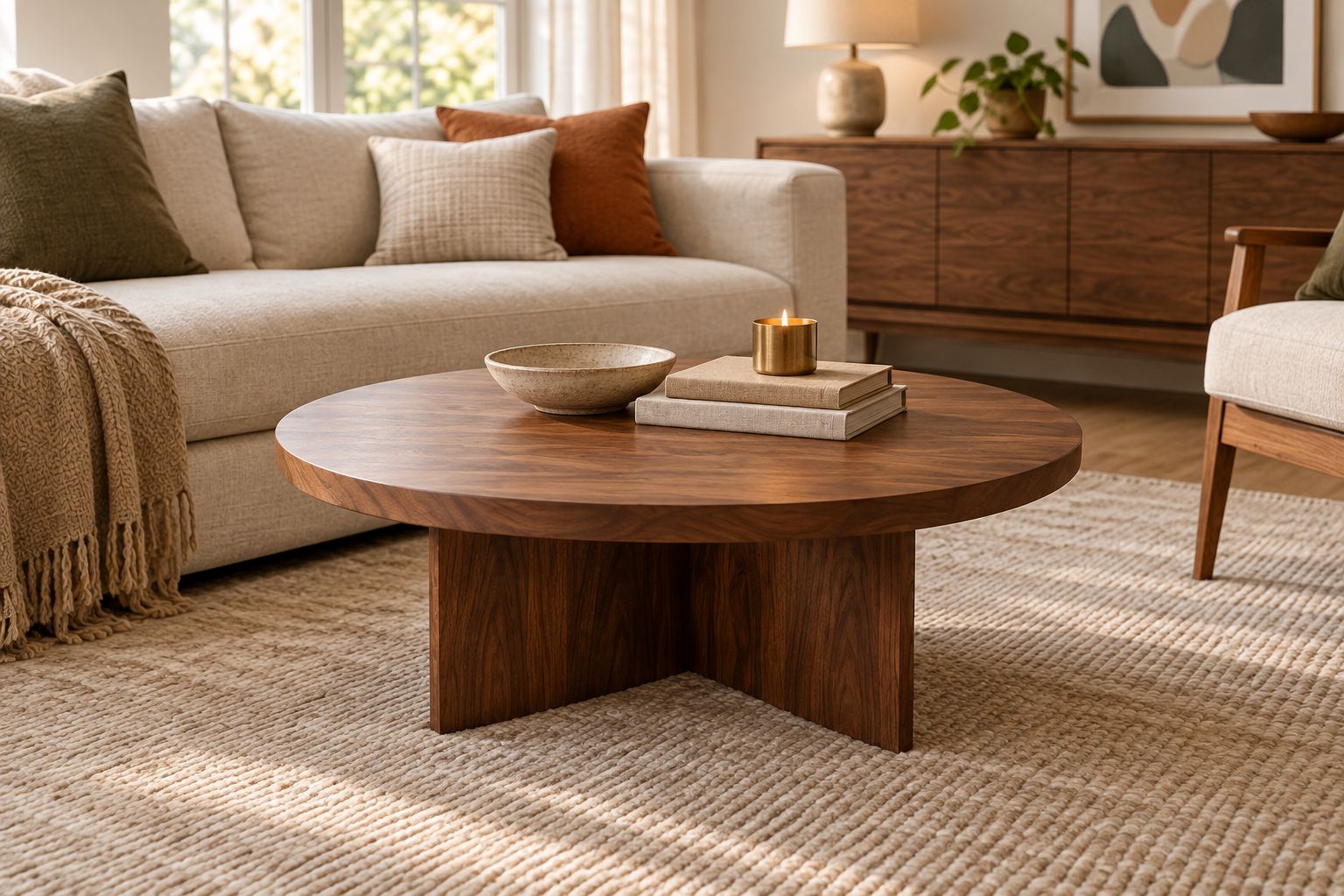
A round surface benefits from an arrangement that follows its shape. Start with one low tray or bowl, then add a short stack of books and one taller object. The different heights create rhythm, while the repeated circular outline keeps the grouping visually connected to the table.
Leave a generous section empty. A coffee table must still hold a cup, reading material or serving tray, and the walnut grain deserves to remain visible. In a smaller room, one bowl and one book stack can be enough.
- Begin with objects already owned before buying new accessories
- Group a low bowl, book stack and one taller accent
- Repeat the table’s curve through a tray, vessel or candle holder
- Keep tall objects away from the main television sightline
- Leave part of the surface clear for normal daily use
Protect the surface
Walnut needs protection from water, heat, abrasion and uneven sunlight. Coasters and felt pads are inexpensive, while placemats or trays provide a barrier beneath serving pieces. Follow the table maker’s care instructions because oil, wax and lacquer finishes require different maintenance.
Sunlight can change timber colour unevenly when one area remains covered. Move decorative objects periodically and rotate movable tables if one side receives substantially more light. Never apply a generic furniture polish before confirming that it suits the existing finish.
- Use coasters beneath hot, cold and damp drinkware
- Fit felt pads beneath ceramics, trays and decorative objects
- Blot spills promptly with a soft, dry cloth
- Move books and accessories periodically to prevent uneven exposure
- Follow the stated care method for oil, wax or lacquer
- Test any approved cleaner on a concealed area first
Round walnut coffee table options compared
The best construction depends on how often the table moves, how much surface wear it receives and whether future refinishing matters. No option removes the need for coasters, careful cleaning and protection from direct heat.
| Option | Best for | Main strength | Key limitation |
|---|---|---|---|
| Solid walnut | Long-term living rooms and owners who value repairability | Can generally be lightly sanded and refinished | Heavier and more vulnerable to dents than harder timbers |
| Walnut veneer | Apartments and rooms where easier movement matters | Provides real walnut grain over a stable core | Deep scratches can expose the material beneath |
| Walnut top with metal base | Contemporary rooms needing stronger contrast | Separates the warm top from a visually lighter base | The metal finish must coordinate with nearby lighting and hardware |
| Walnut-finished timber | Rooms seeking the colour rather than the species | Can reproduce a walnut-inspired palette | It does not provide genuine walnut grain or walnut’s material qualities |
Elegante’s verdict: a solid or well-made walnut-veneer round table is best for warm living rooms that need softened circulation and visible natural grain. Solid walnut wins when refinishing matters; veneer wins when reduced weight and dimensional stability take priority in 2026.
Common mistakes warm-living-room owners make
Buying from photographs alone
Wide-angle photography can make a table appear smaller than it is. Use the listed dimensions and recreate the footprint on your floor before ordering. A few minutes with painter’s tape is more reliable than judging scale from a styled room image.
Matching every timber exactly
Perfect timber matching is difficult because natural boards vary. Instead, coordinate undertones and separate similar-but-not-identical pieces with a rug, upholstery or black metal detail. This creates intentional layering rather than an unsuccessful imitation of a furniture suite.
Ignoring the base footprint
A pedestal can restrict foot space even when the tabletop diameter looks correct. Splayed legs can extend close to the outer edge and become a trip point. Check base dimensions independently from the top, especially when chairs sit near the table.
Covering the walnut grain
Large trays, books and decorative objects can hide the material that made walnut appealing. Keep enough of the surface visible to show variation across the boards. Restrained styling also leaves the table useful during everyday living and entertaining.
Mixing warm and cool metals without a plan
Chrome, brass and blackened steel can coexist, but equal amounts of all three weaken the palette. Choose one dominant finish and use another sparingly. For a warm 2026 scheme, aged brass or black metal usually integrates more easily with walnut than highly polished chrome.
FAQ
What is the best size for a round walnut coffee table?
The best size preserves around 40–45 cm between the table and principal seating while remaining reachable from each seat. Mark the proposed diameter on the floor because sofa length alone does not account for armchairs and walking routes.
Is solid walnut better than walnut veneer?
Solid walnut is better when future sanding and refinishing matter, while walnut veneer is better when lower weight and a stable core matter more. Both require protection from moisture, heat and abrasive objects.
How high should a round walnut coffee table be?
Keep the tabletop level with the sofa seat or no more than about 5 cm lower. Measure the occupied cushion height because a soft seat compresses when someone sits down.
Does walnut work with a cream sofa?
Walnut works particularly well with cream upholstery because the dark grain adds definition without introducing a cool surface. Repeat the warmth through wool, rattan, aged brass or warm-toned artwork.
Can a round walnut coffee table work in a small room?
Yes, a round walnut coffee table can work in a small room when its taped footprint preserves the main walking route. Its lack of projecting corners is useful where circulation passes close to the seating area.
How should I style a round walnut coffee table in 2026?
Style it with a low bowl or tray, a short book stack and one taller object while leaving part of the surface empty. The restrained arrangement preserves daily function and keeps the walnut grain visible.
How do I care for a walnut coffee table?
Use coasters and felt pads, blot spills promptly and follow the finish-specific instructions supplied with the table. Do not apply oil, wax or polish unless the care guidance confirms it is compatible.
Who is Elegante’s round walnut coffee table guide best for?
Elegante’s round walnut coffee table guide is best for people creating a warm living room around natural timber, soft upholstery and measured circulation. It covers sizing, construction, finish coordination, styling and surface care.
One last thing
Before finalising a 2026 shortlist, photograph the taped table outline from the doorway and each main seat. The doorway view reveals whether the circle anchors the room, while the seated views expose reach and sightline problems. This simple check often matters more than choosing between two similar shades of walnut.


Comments (0)
There are no comments for this article. Be the first one to leave a message!