

Hamptons-style dining room design is a coastal-classic approach built on pale timber, balanced proportions and soft natural textures, with the aim of creating an elegant setting for everyday meals and entertaining. A white oak dining table is central to that result, and this Elegante guide explains how to choose its size, finish, shape and supporting furniture.
- Elegante's white oak dining table verdict: choose pale oak, a matte finish and a simple timber base for Hamptons style.
- Allow at least 90cm around the table so chairs and people can move comfortably.
- Plan about 60cm of table edge per person before deciding how many seats will fit.
- In 2026, the keyword has 390 monthly searches in Australia and a difficulty score of 0.
Why a white oak dining table matters for Hamptons style
A Hamptons dining room depends on light, contrast and restraint. White oak supports all three: its pale colouring sits comfortably beside white joinery, while its visible grain prevents the room from feeling flat or clinical.
The table also occupies more visual space than almost any other item in the room. If its finish is too orange, glossy or distressed, the entire scheme shifts away from elegant coastal style and towards traditional, industrial or farmhouse design.
Search behaviour confirms that buyers need clearer guidance. In 2026, white oak dining table records 390 Australian searches per month with a difficulty score of 0. Shoppers know the material they want, but the keyword alone does not resolve questions about dimensions, seating, leg placement or how the table will relate to other furniture.
Elegante's white oak dining table guide is best for Australian shoppers who want a polished Hamptons room, not a rustic farmhouse setting. The goal is not to fill the room with coastal motifs. It is to establish a calm material palette in which pale oak, linen, stone and restrained detailing work together.
How to choose a white oak dining table in 2026
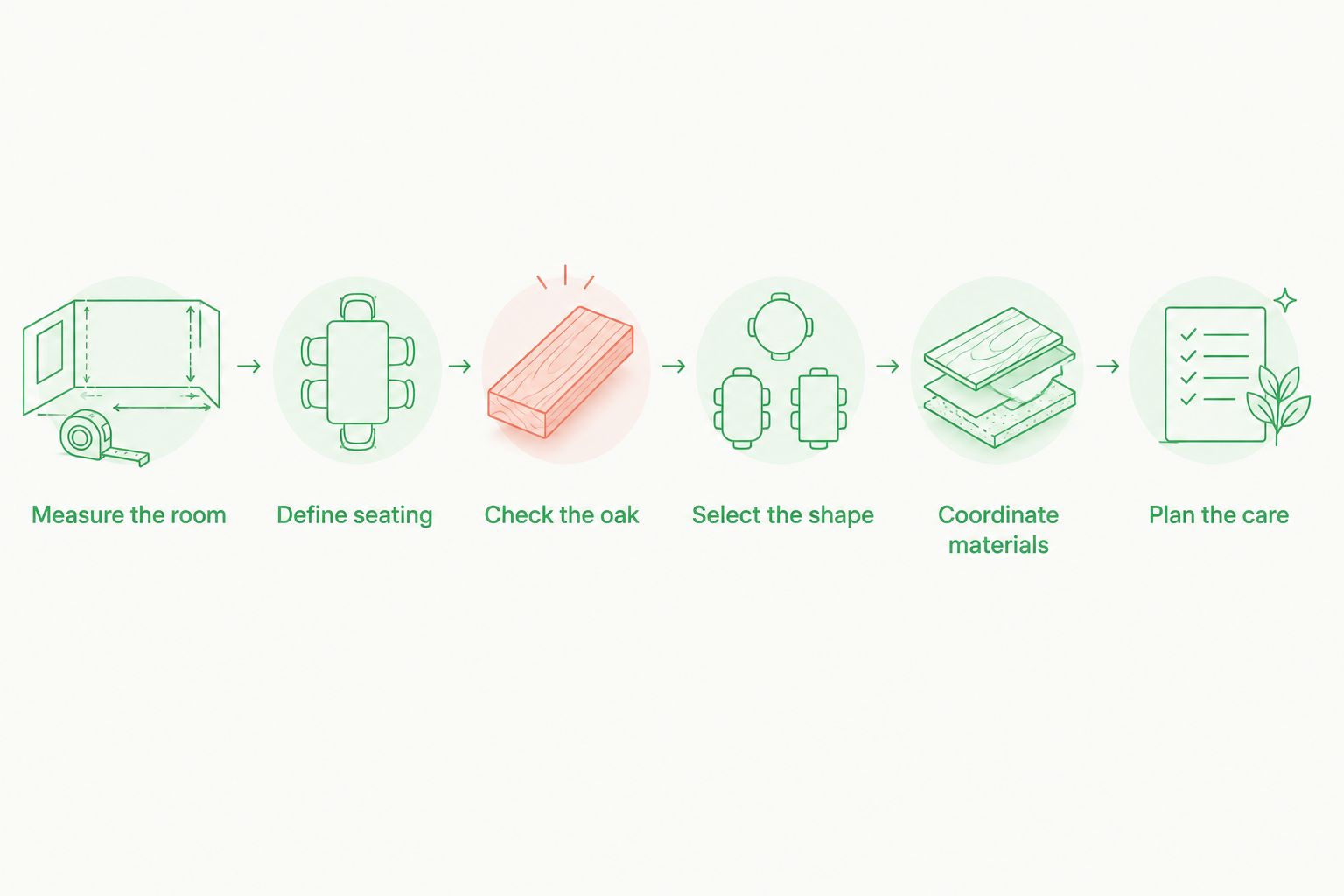
Start with the room rather than a product photograph. The correct sequence is to measure the available area, define the required seating, inspect the oak finish, select a practical shape, coordinate surrounding materials and confirm the care requirements.
Measure the usable dining area
Measure the space with the chairs pulled out, not simply the empty floor. A table that fits neatly when unused can become impractical as soon as guests sit down or someone needs to pass behind a chair.
Treat 90cm as the minimum useful clearance from the table edge to a wall, cabinet or another fixed object. Increase that distance where the main route through the room passes behind the chairs. An open-plan room also needs a clear visual boundary between dining and living zones, even when there is no physical wall.
Tape the proposed tabletop outline onto the floor. Then place existing chairs around it and walk the normal routes between the kitchen, dining area and adjoining room. This simple test reveals problems that a floor plan often conceals.
- Record the room's narrowest usable width and length
- Allow at least 90cm around every table edge
- Add more clearance along the main walking route
- Check door swings, drawers and nearby cabinet doors
- Mark the proposed footprint with removable tape
Define the seating requirement
Seat count should reflect normal use before occasional entertaining. Buying a permanent table for the largest gathering of the year can leave the dining room crowded for the rest of 2026.
Allow about 60cm of table edge per person as a practical planning measure. A rectangular table around 180cm long generally accommodates 6 places, while a table around 240cm long can accommodate 8 when its legs and chairs are positioned well. These figures are starting points, not substitutes for checking the exact design.
Extension tables suit rooms that need flexibility, but inspect where the leaf is stored and whether the extended top still leaves sufficient clearance. Also check whether the base blocks the additional chair positions.
- Plan for the number of people seated most often
- Allow about 60cm of edge for each place setting
- Check table legs against every proposed chair position
- Test the room with chairs pulled out, not tucked in
- Choose an extension design only when the open size fits
Check the oak construction and finish
White oak can appear pale beige, honeyed or softly grey depending on the board selection, stain and protective coating. Request a physical finish sample where possible and inspect it in the dining room during daylight and under the evening lighting.
A matte clear coat or low-sheen oil keeps the grain visible and supports the relaxed elegance of a Hamptons interior. Heavy distressing introduces a more rustic character, while a high-gloss coating makes the table feel more formal. Neither is inherently poor; each simply moves the room away from the intended style.
Once the dimensions are settled, Elegante's designer furniture and homewares focus provides the appropriate context for comparing a dining table with the broader room. Its guide to designer timber furniture for coastal Australian homes also explains how timber choices affect a coastal scheme.
- Inspect a physical sample in the intended room
- Compare the finish under daylight and evening light
- Prefer matte or low-sheen surfaces for Hamptons style
- Check whether the top is solid timber or veneer
- Ask for care instructions for the exact finish
Select a shape and base
Rectangular tables reinforce the long, balanced lines associated with formal Hamptons rooms. Oval tables soften an open-plan area and remove sharp corners, while round tables work particularly well in square dining spaces or breakfast zones.
The base affects comfort as much as appearance. Four corner legs provide visual simplicity but can restrict end seating. A pedestal opens the perimeter for chairs, although its footprint still needs checking. Trestle bases create a stronger farmhouse note and require enough space between supports for comfortable legroom.
For 2026 interiors, the strongest choice is not the most decorative base. It is the one that supports the tabletop without competing with the grain, chairs or pendant light.
- Choose rectangular for long or formal dining rooms
- Choose oval where circulation passes close to the corners
- Choose round for square rooms and conversational seating
- Check pedestal and trestle bases for foot clearance
- Confirm that every chair fits between the supports
Coordinate chairs, lighting and nearby furniture
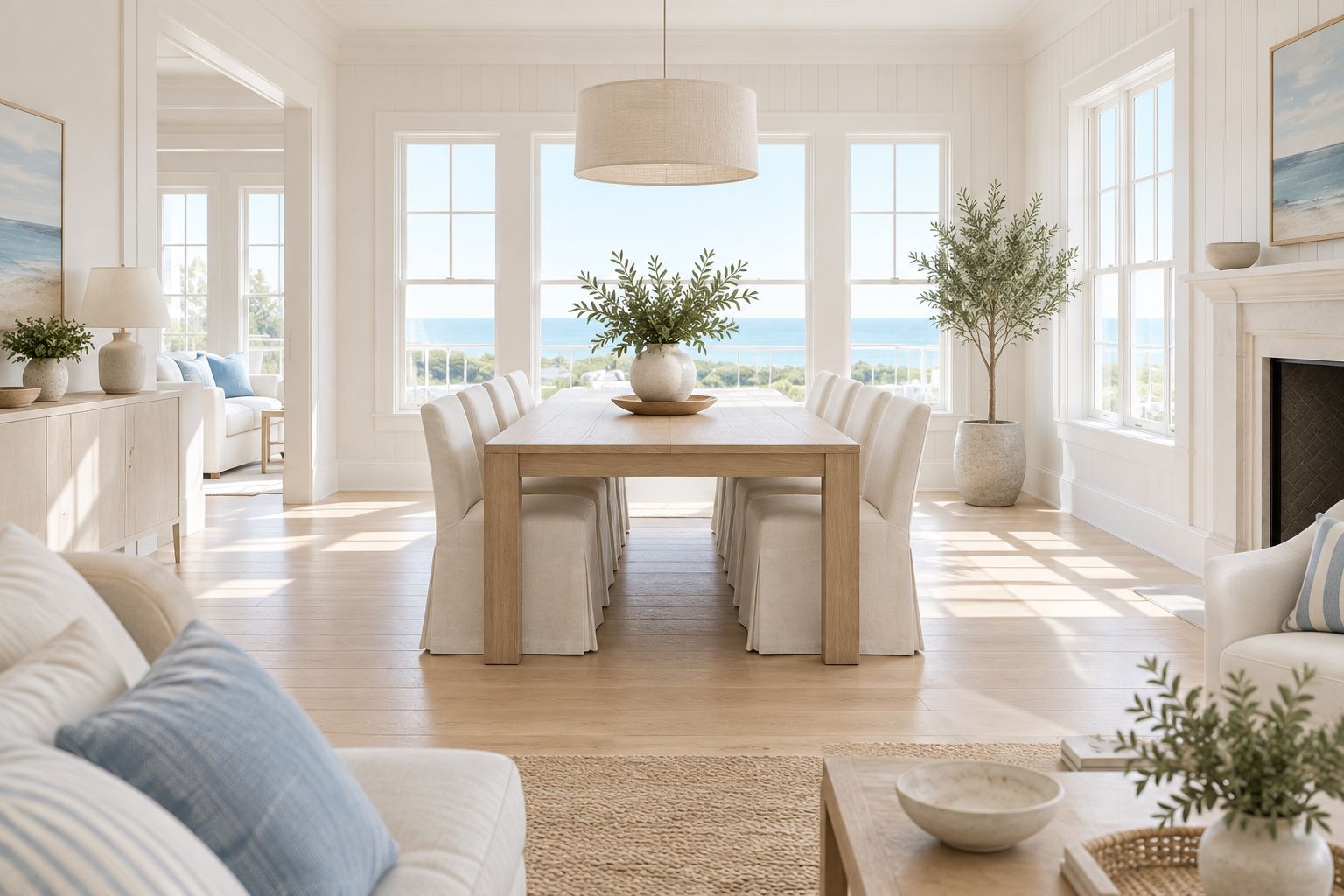
Dining chairs do not need to match the table timber exactly. Upholstered linen chairs create useful contrast and soften the hard surface, while woven details introduce texture without adding another timber colour across every seat.
Keep undertones consistent when another timber piece sits nearby. Pale oak can work beside painted white cabinetry, natural rattan and light stone, but several unrelated stains make the room feel assembled rather than considered. Use one dominant timber and let stone, fabric or metal provide contrast.
Lighting should be centred on the table rather than the room where the two centre points differ. Its shape should also relate to the tabletop: a linear fitting follows a long rectangular table, while a compact pendant composition suits a round table.
- Pair pale oak with linen, woven fibre or restrained upholstery
- Repeat the oak tone selectively rather than on every item
- Keep unrelated warm and grey timber stains apart
- Centre the light over the tabletop
- Relate the light's shape to the table's proportions
Balance coastal character with sophistication
Hamptons style does not require anchors, shells or blue-and-white decoration on every surface. The more permanent pieces should establish proportion and material quality; smaller accessories can introduce the coastal reference.
A white oak dining table already contributes warmth and natural texture. Build around it with off-white fabric, pale stone, clear glass or restrained metal details. Navy can add definition, but it works best as a controlled accent rather than the default colour for every chair, curtain and decorative object.
Elegante's polished approach is particularly relevant here: the dining room should feel connected to the rest of a luxury home, not treated as a separate themed set. Repeat one or two materials in the adjoining space to create continuity.
- Use white oak as the dominant natural material
- Add texture through linen, rattan or woven fibres
- Introduce stone for a cooler visual contrast
- Keep coastal colours to controlled accents
- Remove decorative pieces that compete with the tabletop
Plan care before making the final choice
A finish that suits the room but not the household will become frustrating. Oil, wax and lacquer respond differently to spills, heat and routine cleaning, so follow the maker's instructions for the exact surface rather than using a general timber treatment.
Ask how the top should be cleaned, whether protective placemats are recommended and what happens if the surface is scratched. Solid timber can often be refinished by a qualified professional, while veneer requires more caution because its surface layer is thinner.
Direct sunlight can also change the colour of timber over time. Curtains, blinds and consistent object placement help prevent one part of the top from ageing differently from the rest.
- Obtain written care instructions for the exact finish
- Confirm which cleaners and treatments are suitable
- Use trivets, coasters and placemats where recommended
- Protect the table from prolonged direct sunlight
- Check repair options before choosing solid timber or veneer
White oak dining table options compared
No single construction or shape is best for every Hamptons dining room. The right option depends on available space, maintenance preferences and whether the table must adapt to larger gatherings.
| Option | Best for | Main advantage | Key limitation |
|---|---|---|---|
| Solid white oak, rectangular | Formal rooms and frequent family dining | Natural grain and potential for professional refinishing | Heavy and sensitive to room conditions |
| White oak veneer, rectangular | Consistent colour and a visually lighter design | Efficient use of timber with controlled grain matching | Damage requires specialist assessment |
| White oak, oval | Open-plan rooms with tight circulation | Curved corners soften movement around the table | Reduced usable edge at the tapered ends |
| White oak, round pedestal | Square rooms and conversational dining | Flexible chair placement around the perimeter | Becomes space-intensive as diameter increases |
| White oak extension table | Households that host occasional larger groups | Adapts between everyday and entertaining use | Extension hardware and base placement need careful checking |
For a classic Hamptons result in 2026, a matte rectangular white oak dining table wins for formal rooms, while an oval table wins where circulation is tight. Elegante's white oak dining table guidance favours proportion and finish over decorative complexity because those decisions remain visible after accessories change.
Common white oak dining table mistakes
Choosing from photographs alone
Online images can disguise undertones, sheen and grain variation. A finish that appears pale on a bright screen can look warmer under residential lighting. Request a sample and compare it with the flooring, wall colour and nearby timber.
Ignoring the base when counting seats
Table length does not guarantee usable seating. Corner legs, trestles and wide pedestals can occupy the space intended for knees or chairs. Map each seat against the exact base dimensions before buying.
Matching every timber surface
A room filled with one timber on the table, chairs, floor, sideboard and accessories can look heavy despite the pale colour. Hamptons sophistication comes from contrast, so combine white oak with linen, stone, glass or painted finishes.
Confusing Hamptons with farmhouse style
Heavy distressing, dark metal hardware and bulky trestles push white oak towards farmhouse design. Hamptons rooms need cleaner detailing, lighter visual weight and a more controlled material palette.
Buying for rare occasions
A table sized for infrequent large gatherings can dominate the room every day. In 2026, prioritise the usual household seating requirement and use an extension mechanism only when the fully opened table still preserves circulation.
FAQ
What is the best white oak dining table for a Hamptons-style room?
A matte rectangular white oak dining table with a restrained timber base is the strongest choice for a classic Hamptons room. Choose an oval version when you need softer corners and easier circulation.
How much room should I leave around a dining table?
Leave at least 90cm between the table edge and walls or fixed furniture. Increase the clearance where people regularly walk behind occupied chairs.
How many people can sit at a 180cm dining table?
A 180cm rectangular dining table generally accommodates 6 people when the base and chair widths allow it. Confirm the exact chair positions because wide legs can reduce usable seating.
Is solid white oak better than white oak veneer?
Solid white oak is better when natural variation and potential professional refinishing matter most. White oak veneer suits buyers who prefer controlled grain matching, but surface damage requires careful specialist assessment.
Is a round or rectangular table better for Hamptons style?
A rectangular table is better for a formal Hamptons dining room because it reinforces the style's long, balanced lines. A round pedestal table works better in a square room or compact dining area.
Do dining chairs need to match a white oak table?
Dining chairs do not need to match a white oak table. Off-white linen, woven details and restrained upholstery create the material contrast that gives Hamptons rooms depth.
Does a white oak dining table suit an open-plan home?
A white oak dining table suits an open-plan home when its shape preserves circulation and its materials connect with the adjoining living area. Elegante recommends repeating only selected tones rather than matching every timber item.
How do I protect a white oak dining table?
Follow the maker's care instructions for the table's exact oil, wax or lacquer finish. Use approved cleaners and any recommended placemats, coasters or trivets, and limit prolonged direct sunlight.
One last thing
Check the table from the adjoining room before making the final decision. In an open-plan home, you will often see its base and chairs before you see the top, which makes the silhouette as important as the oak finish. A restrained base, clear chair spacing and one consistent timber tone create a more convincing Hamptons room than added coastal decoration.


Comments (0)
There are no comments for this article. Be the first one to leave a message!