

Best overall: a compact, upright upholstered armchair. Best colour statement: Elegante’s Beau Occasional Chair in Ochre Velvet. Best for a visually light office: an open-frame accent chair. This 2026 guide compares accent chairs for home office reading, visitors and screen-free breaks—not replacements for an adjustable desk chair.
- The best accent chairs for home office use complement a desk chair rather than replace it.
- Choose a compact upright armchair for versatile guest seating and reading.
- Elegante’s Beau Occasional Chair in Ochre Velvet is the colour-led choice for a statement office corner.
- Choose open-frame seating for visual lightness, a swivel for changing direction, or a high back for reading.
Why this matters
A home office often needs somewhere to sit away from the keyboard. An accent chair gives you a place to read a brief, welcome a visitor or pause between tasks. Its success depends on the job you give it.
Separate desk work from occasional seating. A decorative chair does not establish suitable working posture simply because it fits beneath a desk. For your 2026 office refresh, protect the desk setup first, then choose an occasional chair that earns its floor space.
This guide ranks chair styles by purpose, with a named colour-led option from Elegante. The distinction matters: upholstery and appearance alone do not establish seat comfort, dimensions or suitability for prolonged sitting.
What makes the best accent chairs for a home office?
Use these criteria before choosing a silhouette. A beautiful chair that blocks your filing cabinet is the wrong chair.
- Purpose: Decide whether the chair serves visitors, reading, conversation or changing your view between tasks.
- Occupied footprint: Consider the person sitting in the chair, not just the furniture’s outer dimensions. Knees, arms and movement need space too.
- Seated fit: Check whether you can rest your feet comfortably and use the backrest without sliding forward.
- Arm position: Look for arm support that suits reading or conversation without forcing your shoulders upwards.
- Fabric care: Read the actual care instructions. Velvet, textured weaves and smooth upholstery require different handling depending on their composition.
- Visual balance: Match the chair’s scale to the desk and surrounding storage, then decide whether colour or shape should lead.
For your 2026 shortlist, record 3 measurements: overall width, overall depth and overall height. Add seat dimensions and arm height when supplied; those details help you judge fit rather than appearance alone.
Elegante’s guide to accent chairs ranked by fabric: velvet, bouclé and linen provides a useful companion when upholstery is your deciding factor.
Home office accent chairs at a glance
The order below starts with the named statement option, then separates the remaining styles by their strongest use case. These are different buying routes, not claims that every chair within a style performs identically.
| Chair or style | Best for | Standout feature | Key limitation |
|---|---|---|---|
| Beau Occasional Chair in Ochre Velvet | A colour-led office corner | Ochre velvet as a decorative focal point | Colour and fabric do not establish seated fit |
| Compact upright upholstered armchair | Versatile everyday occasional seating | An upright format for visitors and reading | Fixed proportions must suit the individual |
| Open-frame accent chair | A visually light, compact office | Visible space around the frame | Exposed framing does not guarantee a small footprint |
| Swivel accent chair | Turning between conversation and a view | A rotating seat | Needs unobstructed space throughout its movement |
| High-back reading chair | A dedicated reading zone | A taller backrest | Stronger visual presence beside office furniture |
1. Beau: best accent chair for a colour-led office corner
The Beau Occasional Chair in Ochre Velvet from Elegante is the decorative choice when your office needs a deliberate focal point. The named finish gives you a clear styling direction: ochre colour and velvet texture.
Elegante’s Beau Occasional Chair in Ochre Velvet is best for a colour-led home office corner. Choose this route when the chair should contribute to the room’s character, rather than disappear beside the desk.
Keep the surrounding scheme restrained if you want the upholstery to lead. A simple side table and uncluttered wall give a statement chair room to register without competing with patterned storage or busy artwork.
Beau pros:
- A defined ochre colour direction for planning your room.
- Velvet texture for an office that needs a softer decorative note.
- A named occasional-chair option to compare against your measurements.
Beau cons:
- Ochre is less neutral than an understated upholstery choice.
- The finish alone does not tell you how the seat fits your body.
- Velvet appearance does not establish stain resistance or cleaning requirements.
Best for: A design-led office where occasional seating also acts as a focal point.
Check the current dimensions and care information before committing. Verdict: Buy for the colour-led role after confirming fit; skip as an assumed ergonomic desk-chair substitute.
2. Compact upright armchair: best for versatile occasional seating
A compact upright upholstered armchair is the strongest default when you need one additional seat to perform several modest jobs. Look for a backrest you can use while sitting upright, with a seat depth that does not force you to perch on the edge.
This format suits a visitor conversation, reading paperwork or taking a screen-free pause. Choose the actual chair by seated fit, not by the word compact: a narrow exterior can still contain a seat that feels too deep.
For a 2026 home office serving different purposes, this is the first style to assess. It offers a straightforward starting point without making rotation, dramatic colour or a tall backrest the priority.
Compact upright armchair pros:
- An adaptable format for visitors and reading.
- Arms provide a place to rest your forearms when their position suits you.
- A restrained silhouette can sit quietly beside a prominent desk.
Compact upright armchair cons:
- Fixed seat proportions do not suit every person.
- Arms add width beyond the usable seat.
- Upholstery requires care appropriate to its specific fabric.
Best for: An office that needs flexible secondary seating rather than a specialised reading retreat.
Verdict: Buy as the default occasional-chair style if the seated fit and occupied footprint work.
3. Open-frame chair: best for a visually light small office
An open-frame accent chair leaves visible space around parts of its structure instead of enclosing the whole seat in upholstery. That makes it a useful styling choice when solid desks and cabinets already dominate the room.
Visual lightness and physical size are separate questions. Compare overall dimensions carefully: an airy-looking chair with angled arms can occupy more floor space than a more enclosed design.
Position the chair where its frame remains visible rather than wedging it between storage units. Keep the nearby floor clear so the open silhouette contributes to the composition.
Open-frame chair pros:
- Exposes more of the surrounding space through its structure.
- Provides contrast beside solid cabinetry.
- Lets the frame contribute to the room’s material palette.
Open-frame chair cons:
- Exposed structure does not guarantee comfortable arm contact.
- Angled legs or arms can extend beyond the seat.
- Separate frame and upholstery surfaces need their own care checks.
Best for: A small office where furniture looks crowded, even before every available space is filled.
Verdict: Buy for visual lightness; skip any model whose frame intrudes on your walking route.
4. Swivel accent chair: best for changing your view
A swivel accent chair turns on its base, letting you change direction without repositioning the whole chair. It suits an occasional seat placed between a conversation area and a window or bookshelf.
Check the movement of the specific model. A swivel base does not establish adjustable height, tilt control or the other features you need for a desk-work setup.
In your 2026 layout, assess the chair throughout its turn. The back and arms must remain clear of the desk, lamp, curtains and nearby furniture—not just when the chair faces forwards.
Swivel accent chair pros:
- Changes your facing direction while the base stays in place.
- Suits a corner with more than one useful outlook.
- Lets you turn towards a visitor without dragging the chair.
Swivel accent chair cons:
- Requires clearance around its moving parts.
- Rotation alone does not make it suitable for sustained computer work.
- Base design affects how easily you can clean beneath it.
Best for: A secondary seat used for conversation and looking away from the workstation.
Verdict: Buy when rotation solves a real layout need; skip when surrounding furniture restricts the turn.
5. High-back chair: best for a dedicated reading zone
A high-back reading chair gives the reading area a different visual identity from the desk. Look for a backrest that meets your body comfortably rather than assuming extra height guarantees head or neck support.
This style belongs in a deliberate reading corner, not an awkward gap left after arranging storage. Pair it with lighting directed towards the page and a reachable surface for your book or notes.
The taller silhouette becomes part of the room’s architecture. Check its relationship with window sills, shelving and artwork before choosing a strongly shaped design.
High-back chair pros:
- Creates a clear focal point for a separate reading area.
- Provides a taller backrest to assess for your preferred posture.
- Makes the reading zone visually distinct from the workstation.
High-back chair cons:
- A tall back does not guarantee suitable head support.
- Its visual presence can dominate a compact office.
- Placement needs care around low windows and shelves.
Best for: A home office with a genuine reading area beyond the desk.
Verdict: Buy for a planned reading zone; skip if the chair would crowd the workstation.
Plan the chair around the working room
Start with 1 primary purpose for the accent chair. Then organise 2 seating zones: the desk zone for computer work and the occasional zone for reading, visitors or breaks. The separation can be visual; it does not require a large room.
Follow this sequence before ordering:
- Choose the purpose: Write down the task the chair must serve most often.
- Mark the footprint: Transfer the listed overall dimensions to the floor with removable tape.
- Check movement: Open doors, drawers and cupboards, then pull your desk chair back as usual.
- Test the position: Sit in a comparable position and check the view, lighting and reach to a side surface.
- Confirm care: Read the upholstery instructions and decide whether they suit your household.
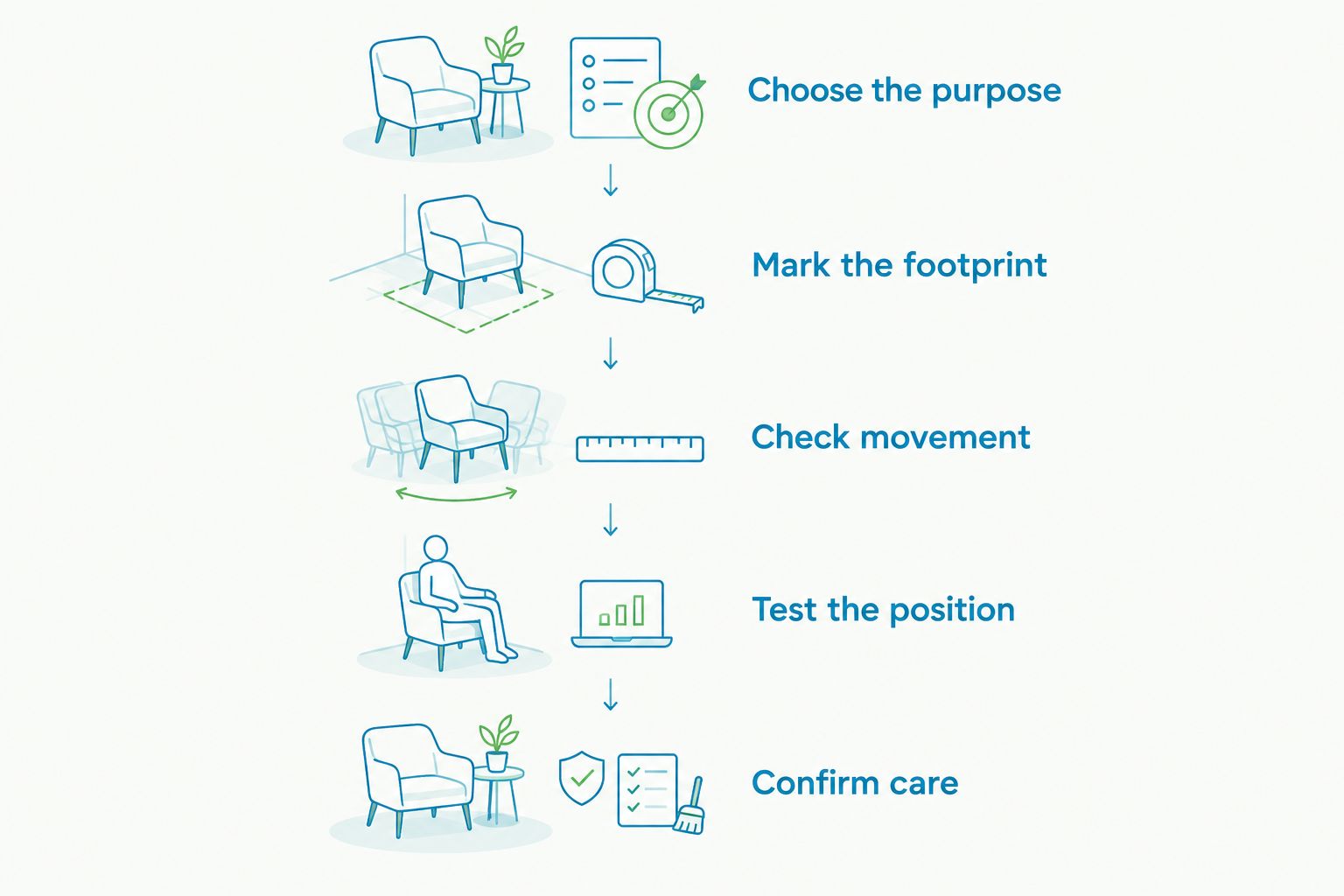
A taped outline is a planning aid, not a complete comfort test. Where you can assess the actual seat, check how your feet, back and arms settle without adding cushions to correct an unsuitable fit.
How the chairs are ranked
The ranking prioritises purpose, occupied footprint, seated fit, arm position, care and visual balance. The named Beau option leads the statement category; the compact upright armchair remains the default for mixed occasional use.
These 2026 recommendations distinguish chair formats and styling roles. They do not treat appearance as evidence of ergonomic performance, nor do they assign comfort scores to chairs with different dimensions and construction.
Which accent chair should you choose?
Choose a compact upright upholstered armchair if you are undecided. It is the clearest starting point for occasional seating that must serve visitors, paperwork and quiet breaks.
Choose the Beau when ochre velvet is the intended decorative focus. Choose an open frame to reduce visual weight, a swivel to change direction, or a high back to define a reading area. Keep the adjustable desk chair responsible for desk work.
FAQ
What's the best accent chair for a home office?
A compact upright upholstered armchair is the best starting point for versatile occasional seating. Choose a model whose seat depth, backrest and arms suit you, and keep your desk chair for computer work.
Can I use an accent chair as my everyday office chair?
Do not assume an accent chair is suitable for everyday desk work. Assess the actual working posture, desk relationship and adjustment features rather than relying on its appearance.
Which Elegante accent chair suits a statement home office?
Elegante’s Beau Occasional Chair in Ochre Velvet suits a colour-led home office corner. Confirm its current dimensions and care information before choosing it for your space.
Is a swivel accent chair better than a fixed chair?
A swivel accent chair is better when changing direction is part of how you use the seat. A fixed chair is the simpler choice when you face the same reading or conversation area.
What accent chair works in a small home office?
An open-frame chair is a useful choice for visual lightness in a small home office. Check its full footprint because exposed frames and angled arms can still occupy substantial space.
Is velvet a good choice for a home office accent chair?
Velvet suits a home office when you want upholstery texture to contribute to the room’s style. Check the specific fabric composition and care instructions rather than assuming all velvet performs alike.
What should I measure before choosing an accent chair?
Record the chair’s overall width, depth and height, then check seat dimensions and arm height when supplied. Test the position against desk-chair movement, doors, drawers and access to nearby storage.
One last thing
Test the room with the desk chair pulled back, not tucked away. A layout that looks elegant when everything is parked can fail during ordinary use. Keep the accent chair only where both seats can do their jobs without competing for the same space.


Comments (0)
There are no comments for this article. Be the first one to leave a message!