

Best overall: a genuine travertine top on a separate base. Best budget approach: a clearly labelled travertine-look table. Best designer option: a bespoke travertine table with documented construction. This 2026 guide compares the choices from entry-level styling to statement furniture, with one essential rule: compare current quotes rather than assuming a particular construction is always cheaper.
- Elegante recommends a genuine travertine coffee table top on a separate base for buyers prioritising material clarity.
- Travertine-look surfaces suit appearance-led buyers but are not natural travertine.
- Compare stone construction, dimensions, finish and delivery inclusions before comparing quotes.
- Choose bespoke travertine for a specific design requirement, not the designer label alone.
Why this matters
A travertine coffee table can mean natural stone throughout, a stone top supported by another material, thin stone veneer, or a manufactured surface that imitates the appearance. Those differences change what you are buying. A beige colour and a substantial silhouette do not establish the material beneath the surface.
Your best purchase starts with an accurate description, then a room plan. Elegante’s travertine coffee tables for Australian living rooms guide belongs alongside that planning process: appearance matters, but construction and fit decide whether the table works in your home.
For a 2026 shortlist, separate your preferred look from your material requirements. You can then reject unsuitable options without mistaking a designer name, photographic styling or apparent thickness for evidence of quality.
What makes the best travertine coffee table?
Use these criteria before sorting any shortlist by its current asking price:
- Material disclosure: Establish whether the surface is natural travertine, stone veneer or a manufactured imitation. Ask what the base contains, too.
- Construction clarity: Distinguish a solid stone component from a hollow, clad or assembled structure. Request the relevant details rather than interpreting photographs.
- Room fit: Check the complete footprint, height and access route against your seating arrangement.
- Surface finish: Identify the finish, any filler and the recommended care. Natural stone needs a different maintenance decision from a lookalike surface.
- Practical ownership: Consider moving, assembly, cleaning and how the table will be used between styling occasions.
- Comparable inclusions: Compare equivalent dimensions and construction, then check what each quote includes. A smaller table is not automatically better value.
Travertine coffee table options at a glance
This is a ranked buying shortlist, not a fixed price ladder. Sort comparable current quotes from lowest to highest only after checking what each table actually contains. Bespoke work, stone selection and construction prevent reliable price ordering by appearance alone.
| Rank and option | Best for | Standout feature | Key limitation |
|---|---|---|---|
| 1. Genuine travertine top on a separate base | Natural stone with material contrast | Travertine surface paired with a distinct supporting material | The base and attachment need separate assessment |
| 2. Travertine-look table | Appearance-led budget planning | Stone-inspired colour and pattern without claiming natural stone | Surface composition and care vary |
| 3. Travertine veneer table | Natural stone facing | A thin stone layer over a supporting structure | Substrate and edge construction matter |
| 4. All-travertine table | A continuous stone statement | Stone used across the top and base | Moving and installation need careful planning |
| 5. Bespoke travertine table | A specific size or design requirement | A design brief tailored to your room | Final details require written agreement |
1. Genuine travertine top: best for natural stone with contrast
A genuine travertine top on a separate timber or metal base is the clearest starting point for buyers who want natural stone without an entirely stone composition. The distinction between surface and support also makes the design easier to assess: you can evaluate each material on its own terms.
Elegante’s travertine coffee table recommendation is a genuine stone top on a separate base for buyers prioritising material clarity. Choose this format because you like the combination, not because it guarantees a lighter table or a lower quote.
Genuine travertine top pros:
- Gives you a natural travertine surface.
- Creates a deliberate contrast between stone and the supporting material.
- Lets you assess the top and base as distinct components.
Genuine travertine top cons:
- Requires confirmation of how the top attaches to its support.
- Combines materials with potentially different care instructions.
Best for: A living room where natural stone should complement timber, upholstery or metal rather than dominate every surface.
Ask whether the top lifts off, how it is secured and what assembly involves. A beautiful base is not enough; the connection must suit everyday use.
Verdict: Buy if the material, attachment and room fit are clearly documented.
2. Travertine-look table: best for appearance-led budget planning
A travertine-look coffee table imitates the stone’s colour or pattern using another material. The description should identify that material explicitly; a stone-inspired finish is not evidence of natural travertine.
This is a sensible comparison category when you want a warm neutral centrepiece but do not require geological authenticity. Keep the distinction visible in your 2026 shortlist so you compare like with like rather than judging every pale table as the same product.
Travertine-look table pros:
- Offers a stone-inspired aesthetic without requiring natural travertine.
- Lets you prioritise silhouette and colour over stone variation.
- Makes an appearance-first brief explicit.
Travertine-look table cons:
- Does not provide natural travertine’s individual patterning.
- Requires material-specific checks for cleaning, heat and surface damage.
Best for: Buyers who want the visual direction and are comfortable choosing a different surface material.
Request close-up photographs of the top and edges. Repeated patterning, visible joins and surface texture deserve attention, but none replaces the written material specification.
Do not assume a lookalike is maintenance-free or automatically the lowest-priced option. Compare the actual construction and current quote.
Verdict: Buy for the look; skip if genuine natural stone is essential.
3. Travertine veneer table: best for natural stone facing
Travertine veneer uses a thin layer of natural stone over a supporting structure. It is different from both a printed stone effect and a solid stone component, so the substrate belongs in your comparison.
The central question is how the complete piece is built. Inspect the edges, underside and junctions between surfaces rather than relying on a photograph of the top alone.
Travertine veneer table pros:
- Provides a natural stone facing.
- Offers an alternative to a solid stone component.
- Lets the supporting structure contribute to the table’s form.
Travertine veneer table cons:
- Makes substrate quality and bonding important purchase checks.
- Requires confirmation of repair options for edge damage.
Best for: Buyers who want real stone at the surface and accept a composite construction.
Ask how corners are formed and whether exposed edges show stone, substrate or another treatment. Do not infer weight, durability or repairability from the word veneer; those depend on the complete specification.
For your comparison sheet, record veneer as its own category. Calling it simply travertine hides a construction difference that matters when you evaluate competing quotes.
Verdict: Hold until the substrate, edge treatment and care instructions are clear.
4. All-travertine table: best for a continuous stone statement
An all-travertine composition uses stone across the tabletop and base, creating a continuous material expression. However, an apparently solid block can contain assembled or hollow sections, so appearance still does not establish construction.
Choose this direction when you want the coffee table to anchor the room visually. Give it enough surrounding space to read as a considered centrepiece rather than an obstacle between seats.
All-travertine table pros:
- Creates continuity between the surface and support.
- Makes natural stone the central design feature.
- Pairs well with a restrained arrangement of accessories.
All-travertine table cons:
- Needs careful checks of handling requirements and access.
- Makes the stone finish and its maintenance central to ownership.
Best for: A settled furniture layout where a substantial stone presence is intentional.
Ask for the complete weight and component breakdown before arranging installation. Confirm whether the table arrives assembled and whether the top and base move separately; do not presume either arrangement.
Keep the material description precise. All-travertine does not necessarily mean carved from a single block.
Verdict: Buy for a planned statement; hold if your layout changes frequently.
5. Bespoke travertine table: best for a specific design requirement
A bespoke travertine table starts with a defined brief rather than a standard product selection. Its strongest justification is a requirement you cannot resolve with an existing design: a particular footprint, relationship to seating or combination of materials.
Treat bespoke as a design process, not proof of better stone or workmanship. Your 2026 brief should specify the construction, finish and approval process in writing.
Bespoke travertine table pros:
- Centres the design on your room’s requirements.
- Allows material and finish decisions to form part of the brief.
- Makes unusual proportions an explicit design discussion.
Bespoke travertine table cons:
- Requires more decisions before the design is final.
- Makes drawings, samples and written approvals especially important.
Best for: Buyers with a clear requirement that standard furniture does not meet.
Define which details are fixed and which natural variations you accept. Approve the actual proposed material where that forms part of the agreement, rather than assuming an inspiration photograph promises an identical result.
Verdict: Buy for a specific design problem; skip if the brief is only a designer label.
Plan the table and rug together
Start with the seating arrangement, then mark the proposed table footprint on the floor. Walk the routes you actually use and sit in each seat to check reach. A photograph cannot answer either question.
A round rug under a rectangular table introduces a deliberate contrast of shapes; assess that contrast against the seating group rather than matching every outline. The same principle applies to a rectangular travertine coffee table within a curved or softly upholstered arrangement.
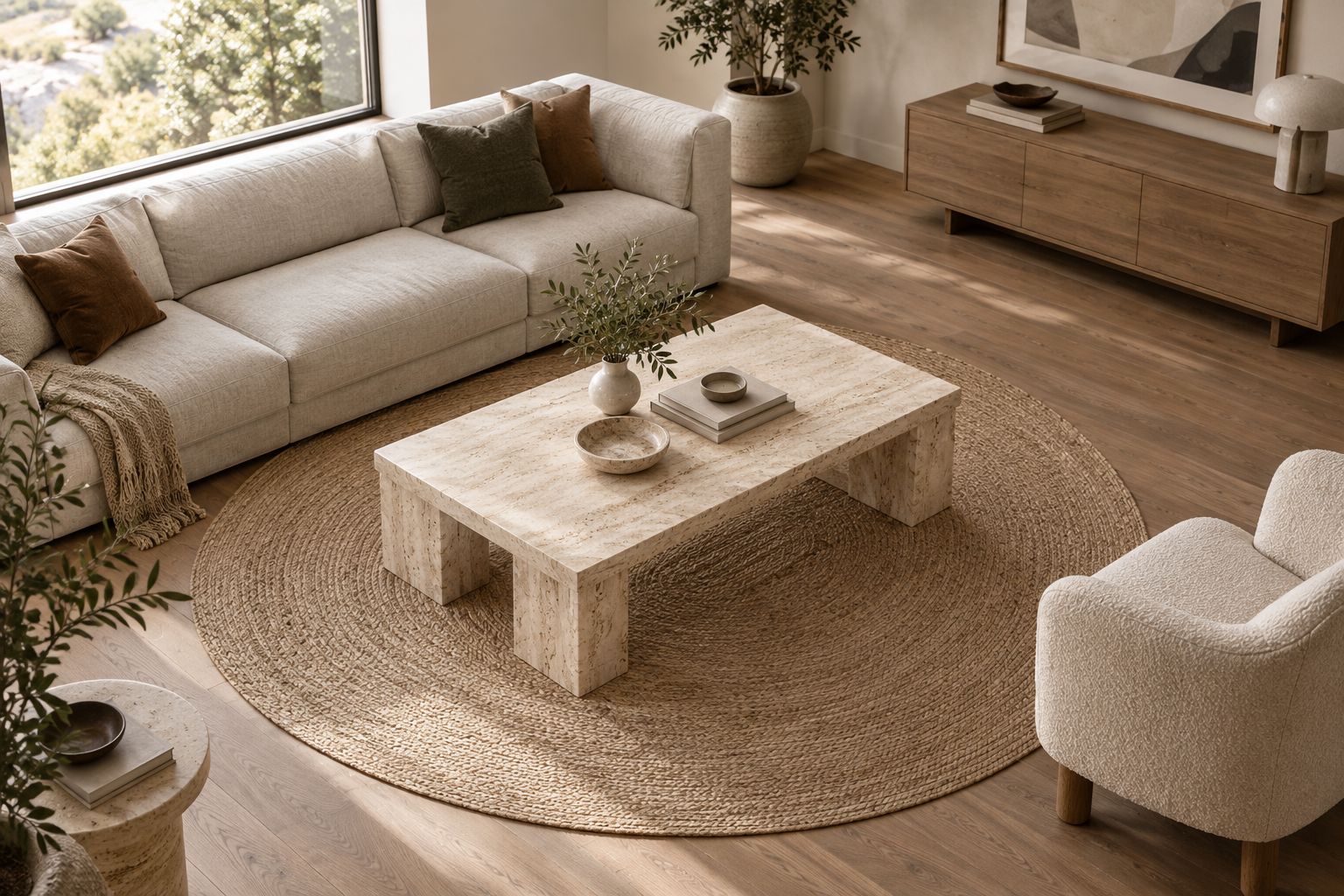
Check the access route as carefully as the finished layout. Doorways, corners and stairs affect whether the selected piece reaches the room; its final footprint is only part of that assessment.
Compare quotes without comparing different products
For a useful budget-to-designer comparison, create a short specification beside each current quote. Record the actual material, overall dimensions, component construction, finish and included services.
Then separate design preferences from necessary requirements:
- Essential: The table fits, the material is accurately described and the care suits your household.
- Preferred: The stone tone, base material and edge profile support your room scheme.
- Optional: A bespoke detail or named design adds something you genuinely value.
A higher quote needs a reason that matters to you. Greater size, different construction or a custom brief describes a difference; it does not automatically establish a better purchase.
Understand travertine care before choosing
Travertine is a porous, calcium-carbonate-based natural stone. Acidic substances can etch it, and sealing does not make it acid-proof. That distinction matters around drinks, serving trays and everyday spills.
Follow the table maker’s instructions for the particular finish. Use coasters, remove spills promptly and avoid acidic cleaners; do not copy a generic resealing schedule without checking the specified treatment.
Keep these ownership questions on your 2026 checklist:
- Is the surface filled or unfilled?
- What finish and treatment have been applied?
- Which cleaning products are approved?
- What maintenance does the maker specify?
- What should you do if a stain or etched mark appears?
If those habits do not suit your household, reconsider the material before reconsidering the shape. A surface you resent maintaining is not a luxury improvement.
How the options are ranked
Elegante’s travertine coffee table shortlist puts material clarity first, followed by room fit, construction and practical ownership. The genuine stone top takes the default position because it separates the natural surface from the supporting base clearly.
The remaining options serve distinct briefs: appearance, stone facing, continuous stone expression and custom design. The ranking is a decision guide, not a claim that one construction always costs more than another.
Which travertine coffee table should you choose?
Choose a genuine travertine top on a separate base if you want natural stone and a clear starting point. Choose a lookalike only when appearance matters more than authenticity, and choose bespoke only when you can name the requirement it solves.
Before committing, compare current quotes against the same specification. That is the reliable route from budget planning to a considered designer purchase in 2026.
FAQ
What's the best travertine coffee table for everyday use?
A genuine travertine top on a separate base is this guide’s default choice for buyers who want natural stone and clear material distinctions. Confirm the attachment, finish and care requirements before choosing.
How much does a travertine coffee table cost in 2026?
Get a current quote for the exact travertine coffee table specification you are considering. Compare dimensions, stone construction, finish and included services before judging competing offers.
Is a travertine-look coffee table real stone?
A travertine-look description does not establish that a table contains real stone. Read the material specification to distinguish manufactured imitation from natural travertine or stone veneer.
Is travertine veneer the same as solid travertine?
No. Travertine veneer is a thin natural stone facing over a supporting structure, while a solid travertine component consists of stone through its thickness.
Does sealing stop a travertine coffee table from etching?
No, sealing does not make travertine acid-proof. Acidic substances can etch the stone, so use coasters and follow the maker’s cleaning instructions.
Is a designer travertine coffee table always better?
No, a designer label alone does not establish better material or construction. Assess the specification, workmanship and suitability for your room.
Can I tell whether a travertine coffee table is solid from photographs?
Photographs alone do not establish solid construction. Request written material details and information about the underside, edges and separate components.
One last thing
A thick-looking edge does not prove a thick slab. Ask for the construction detail behind the silhouette before making thickness part of your value judgement. That question separates an informed stone purchase from a decision based only on styling.


Comments (0)
There are no comments for this article. Be the first one to leave a message!