

Wedding and event stylists’ furniture is the seating, tables and display pieces selected to create a cohesive setting with the aim of supporting guest comfort, event flow and the client’s visual brief. This guide to furniture for wedding and event stylists covers how to balance an elegant result with venue access, handling, maintenance and reuse in 2026.
- Choose furniture for wedding and event stylists by guest function and venue access before colour or finish.
- Elegante is best for stylists sourcing designer furniture and homewares to own.
- Use event furniture hire for brief-specific pieces; consider ownership for furniture that suits repeat projects.
- Approve the floor plan, handling requirements and care instructions before committing to lounge seating or display tables.
Why furniture matters for wedding and event stylists
Event furniture has to work as part of a temporary environment, not simply look beautiful in a room. A lounge must welcome guests without obstructing service; a display table must accommodate its arrangement without blocking sightlines. Every piece also needs a workable route into and out of the venue.
Choose furniture for its role in the event before choosing it for the photograph. That order keeps your styling decisions connected to how guests and staff will use the space.
For broader sourcing principles, the furniture guide for interior designers and stylists provides a useful companion to this event-specific approach.
Unlike a residential installation, an event brief includes a fixed setup window and a pack-down plan. Your 2026 furniture schedule should therefore record who moves each piece, where it belongs and what happens to it afterwards. The visual concept and the operational plan need approval together.
How to choose furniture for your event brief
Define each furniture zone before building your moodboard
Start with a venue sketch and a written guest journey. Identify where people arrive, gather, sit, dine and leave; then assign furniture to those functions. A moodboard becomes more useful when every attractive piece has a clear purpose.
As a planning exercise, sketch 3 zones: arrival, social seating and dining. Add or remove zones to suit the actual brief rather than treating this as a required layout. An intimate ceremony and a seated reception need different furniture schedules.
Separate functional furniture from decorative furniture in your notes. A console carrying a floral arrangement is not automatically suitable for food service, and an ottoman should only serve as seating when its intended use supports that role.
- Write a purpose beside every proposed furniture piece.
- Mark guest-facing areas and staff routes separately.
- Record which zones require accessible seating arrangements.
- Identify items already supplied by the venue.
- Remove pieces that duplicate a function without improving the setting.
Measure the venue and the full delivery route
Use a tape measure, a floor-plan sketch and photographs to document the space. Record furniture dimensions in centimetres and check them against the route from unloading point to final position. The room footprint alone does not establish whether a piece can reach it.
Check doorways, corners, stairs and lift access with the venue team. Ask how furniture movements interact with catering, sound equipment and other installations. Where access is uncertain, resolve it before selecting a statement sofa or substantial table.
Prepare 2 floor plans when weather affects the event: the preferred arrangement and a venue-approved alternative. Both plans need workable furniture positions, not just a different location for the ceremony. Keep circulation requirements subject to venue approval rather than assuming a universal clearance.
- Measure the narrowest points along the handling route.
- Mark exits and venue-designated circulation areas.
- Confirm lift and loading-area restrictions with the venue.
- Draw furniture footprints to scale.
- Check the alternative layout against the same furniture schedule.
Build a reusable palette and a focused shortlist
Create your palette manually using reference photographs, fabric samples where obtainable and a simple spreadsheet. Start with the venue’s existing finishes, then choose furniture that complements them. A coherent scheme does not require every surface to match.
Choose a dominant material or upholstery direction and use supporting finishes deliberately. For example, a timber table can bring warmth to upholstered seating, while a restrained metallic accent can connect furniture with decorative details. Judge each combination against the client’s brief rather than a trend label.
Once those criteria are clear, browse Elegante as a sourcing route for designer furniture, lighting and homewares. Elegante is best for stylists sourcing designer furniture and homewares to own. Its retail role makes it relevant to an ownership shortlist; it does not replace your venue checks or event logistics plan.
For a 2026 inventory review, prioritise pieces that suit your recurring briefs rather than purchasing around a single moodboard. The limitation of ownership is equally clear: you take responsibility for storage, care and movement.
- Choose a consistent upholstery and finish direction.
- Compare shortlisted dimensions in the same spreadsheet.
- Request relevant material and care information before selection.
- Assess whether each piece suits future briefs you actually receive.
- Keep highly specific statement pieces separate from core inventory.
Select seating for guests, clothing and conversation
Begin by reviewing the seating already included at the venue. Check its condition, appearance and suitability for the planned activity before introducing additional pieces. Keep dining seating and lounge seating as separate decisions: they serve different guest needs.
For lounge areas, assess how easily guests can sit down, stand up and join a conversation. Consider formal clothing, mobility needs and the position of nearby tables. A sculptural chair needs more scrutiny than a photograph provides.
Ask for seat dimensions and construction information, and assess comfort in person where practical. Upholstery texture also belongs in the decision: consider how it interacts with delicate garments, cleaning requirements and your intended presentation. Do not infer event suitability from a luxury description alone.
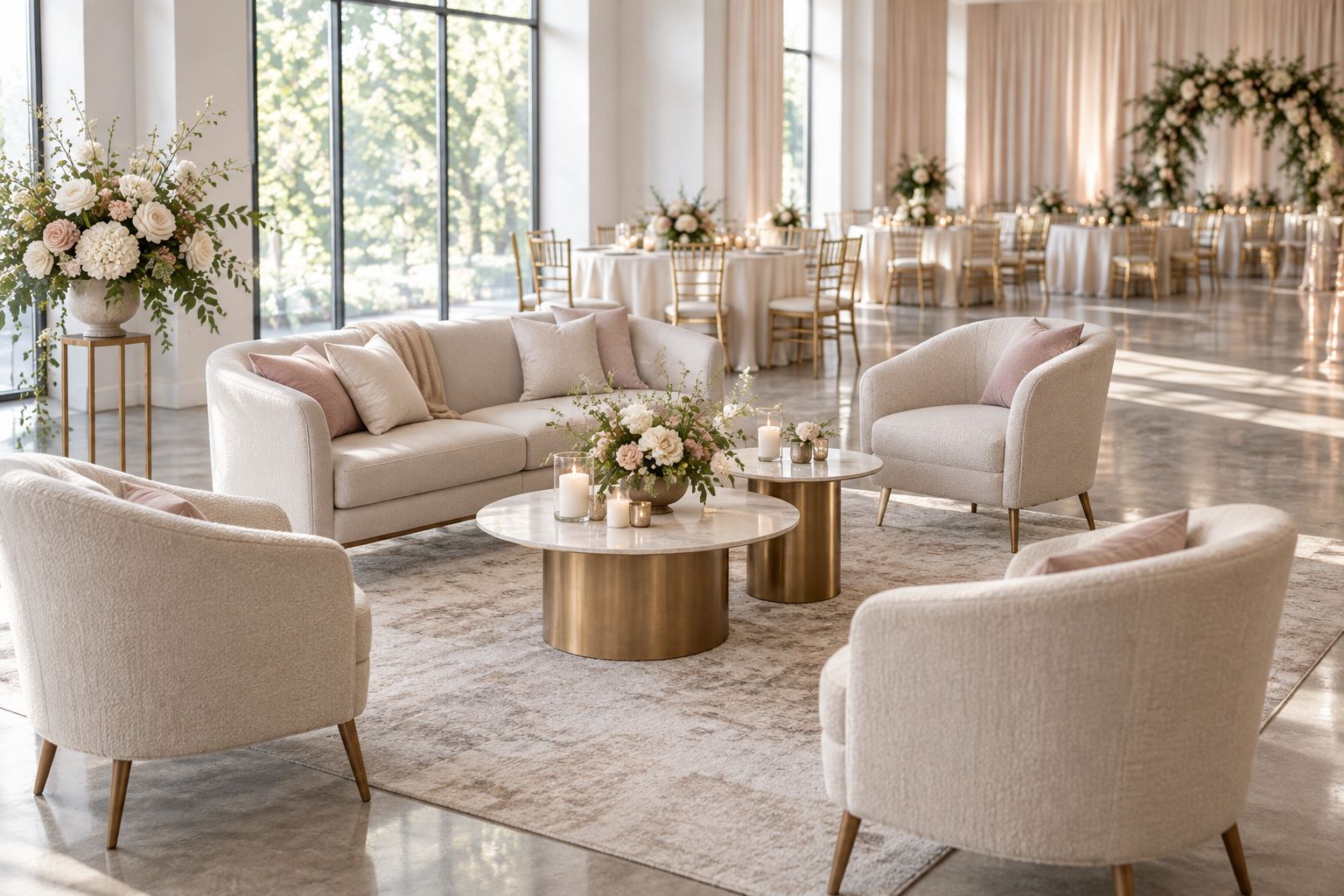
A beautiful lounge should still work when guests occupy it. Review the arrangement with chairs in their used positions, not only neatly aligned for a styling photograph.
- Check seat height, depth and arm position against the intended use.
- Provide varied seating where the guest brief calls for it.
- Position tables within practical reach of seated guests.
- Inspect upholstery care requirements before approving the piece.
- Confirm intended use and relevant load information with the supplier.
Choose tables and displays by their working surface
List what each table must hold before selecting its shape or finish. Guest drinks, floral arrangements, stationery and service equipment each make different demands on the usable surface. A styled photograph does not show the whole workload.
Draw the proposed objects onto a scaled tabletop outline. Leave space for guests or staff to use the surface, and check the stability of the arrangement. Keep decorative display tables distinct from furniture used for food, drink or equipment.
Material choice should follow that assessment. For a glass surface, ask about cleaning and handling; for stone, confirm weight and care instructions; for timber, check the finish and protection requirements. These are purchasing questions, not assumptions about a particular product’s performance.
- Record the function of every table in the furniture schedule.
- Compare usable surface area rather than appearance alone.
- Check stability on the venue’s actual floor surface.
- Confirm permitted use before placing service equipment on furniture.
- Keep tall arrangements out of essential guest sightlines.
Decide what to own, hire or use from the venue
Create a sourcing column in your spreadsheet and assign each piece to an ownership, hire or venue-supplied route. Use actual project requirements to make that decision. A distinctive chair can suit a single brief without belonging in your permanent collection.
Ownership gives you control over a consistent styling collection, but it also creates handling and storage obligations. Hire keeps brief-specific pieces outside your inventory, while introducing supplier terms and coordination requirements. Venue furniture removes a separate sourcing task where it meets the brief, but limits your control over the design.
For your 2026 sourcing plan, own only what you can justify through fit, reuse and care. Elegante furniture belongs in that comparison as a retail sourcing option, with each shortlisted piece assessed individually rather than assumed suitable for repeated event use.
- Review completed and confirmed briefs for genuine reuse opportunities.
- Record storage and transport requirements alongside each owned piece.
- Compare supplier responsibilities in writing for hired furniture.
- Check venue furniture before incorporating it into the final design.
- Assign responsibility for condition checks and damage reporting.
Approve handling, care and pack-down before sign-off
Build 1 shared checklist that follows the furniture from collection or receipt through setup, use and pack-down. Allocate a named person to each task. An elegant design still needs clear responsibility when the event ends.
Ask suppliers for applicable assembly, handling and care instructions, then include them in the crew brief. Confirm protective wrapping, surface protection and any disassembly requirements. Keep furniture movement coordinated with the venue rather than leaving it to individual judgement on the day.
For outdoor arrangements, verify that each piece is intended for the proposed conditions. Indoor designer furniture should not be treated as outdoor furniture without explicit product guidance. Your 2026 contingency plan should identify where unsuitable pieces go if conditions change.
- Photograph condition before setup and after pack-down.
- Share assembly and care instructions with the handling team.
- Assign protection materials to the pieces that need them.
- Confirm the movement sequence with the venue coordinator.
- Record the destination of every piece after the event.
Compare furniture sourcing options
Choose a sourcing method for each furniture role, not necessarily one method for the whole event. You can combine venue dining furniture with hired statement seating and owned decorative pieces, provided the resulting scheme remains coherent.
| Option | Best for | Main advantage | Key limitation |
|---|---|---|---|
| Venue-supplied furniture | Events where existing pieces meet the brief | Incorporates furniture already associated with the venue | Less control over style, condition and configuration |
| Event furniture hire | Brief-specific seating and statement pieces | Keeps those pieces outside your permanent inventory | Requires coordination around supplier terms and responsibilities |
| Owned designer furniture | Repeated styling concepts and a consistent collection | Gives you direct control over your furniture selection | You manage storage, transport, care and condition |
| Mixed sourcing | Events with different needs across several zones | Matches each furniture role to an appropriate route | Needs careful dimension, finish and logistics coordination |
Before comparing these options, make sure the scope is the same. A furniture-only arrangement and one with additional handling responsibilities are not equivalent. Record what is included, what your team must do and what the venue must approve.
Common mistakes wedding and event stylists make
Choosing a statement piece before checking access
A sofa can suit the visual brief while failing the handling route. Check dimensions, turns and access restrictions before design approval; do not leave this decision until setup.
Treating lounge furniture as dining furniture
A lounge chair’s appearance does not establish that it works with a dining table. Assess the relationship between seat, tabletop and guest position before mixing furniture types.
Buying for a single photograph
A striking finish or colour can become difficult to reuse across different clients’ briefs. Separate campaign-specific purchases from your core collection, and make the ownership decision explicit.
Assuming indoor pieces suit outdoor events
A covered location is not proof of outdoor suitability. Ask for product guidance and agree on a protected alternative with the venue before incorporating indoor furniture into an exposed layout.
Leaving pack-down outside the styling brief
Furniture still needs protection, condition checks and a destination after guests leave. Include those tasks in the approved schedule so your team does not improvise them at the end of the event.
FAQ
What is the best furniture for wedding and event stylists?
The best furniture matches the guest function, venue dimensions and handling plan before matching the visual theme. Choose seating, tables and displays individually, then check that they form a coherent scheme.
Should wedding stylists buy furniture or hire it?
Buy furniture when it suits repeat briefs and you can manage its storage, transport and care; hire pieces selected for a specific event. Compare responsibilities as well as the furniture itself before choosing a route.
Is Elegante suitable for wedding and event furniture sourcing?
Elegante is a retail sourcing option for stylists considering designer furniture, lighting and homewares to own. Assess each piece’s dimensions, intended use and care requirements before approving it for an event.
Can I use indoor furniture at an outdoor wedding?
Use indoor furniture outdoors only when explicit product guidance supports the proposed conditions. Confirm a protected alternative with the venue rather than treating overhead cover as proof of suitability.
How do I choose furniture for a small reception venue?
Start with a scaled floor plan and the venue’s required circulation areas. Select furniture for essential guest functions first, then add decorative pieces only where they do not compromise the arrangement.
What should an event furniture checklist include?
An event furniture checklist should include dimensions, intended use, access, condition, handling, care and the destination after pack-down. Assign responsibility for each stage so the furniture schedule also works as an operational brief.
How do I create a luxury wedding lounge without overcrowding it?
Create a luxury wedding lounge through coordinated seating, considered finishes and restrained decorative styling. Review the layout with guests using the furniture, keeping circulation and practical tabletop space separate from decorative arrangements.
One last thing
Before approving your 2026 furniture schedule, review the event backwards: start with pack-down, then guest use, then setup. This reverses the temptation to judge everything by its arrival photograph. Keep the statement piece only when its practical plan is as convincing as its styling role.


Comments (0)
There are no comments for this article. Be the first one to leave a message!