
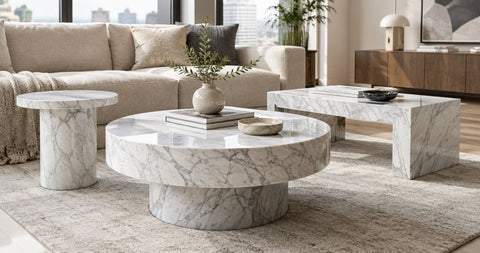
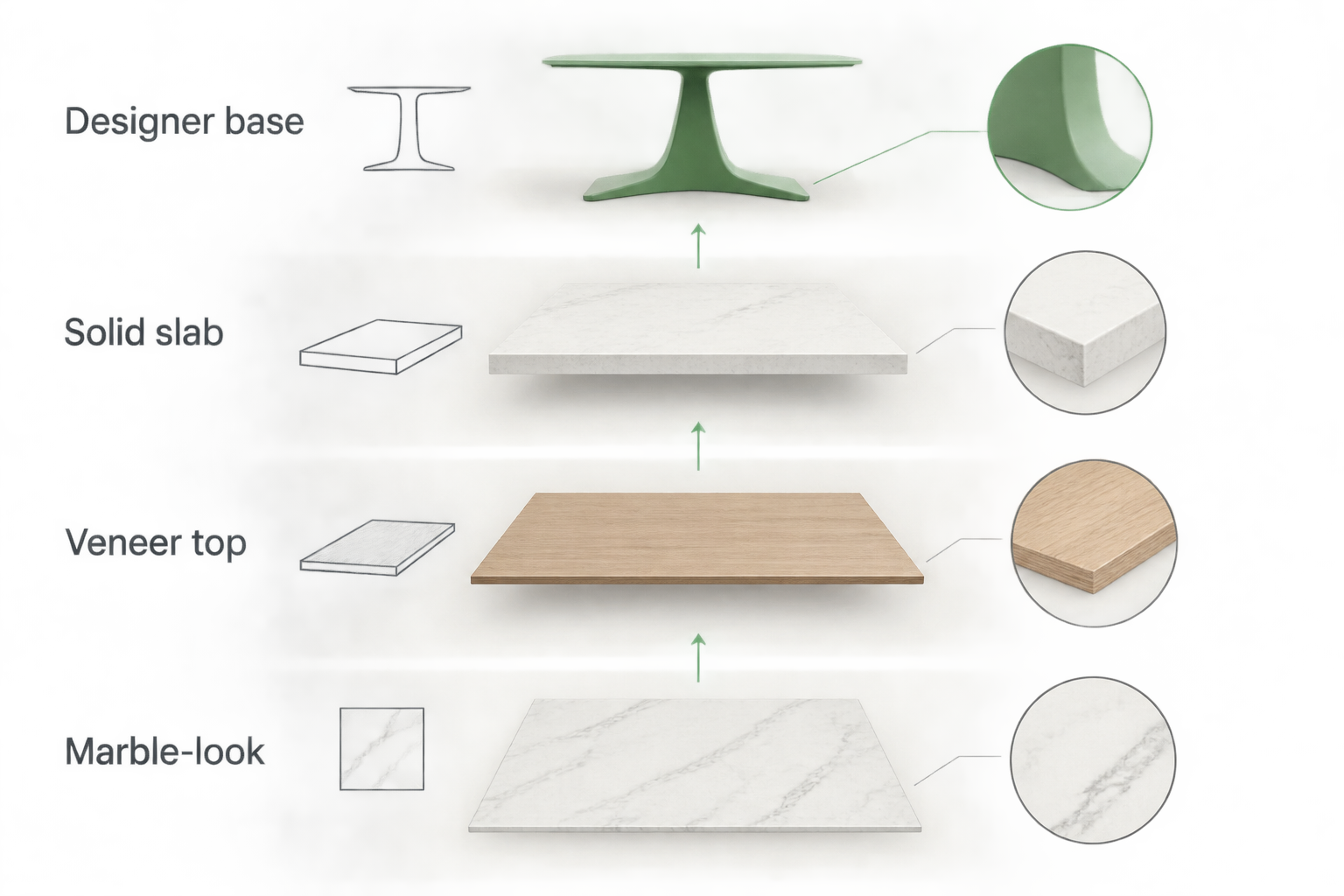
A Carrara marble coffee table is priced by what sits under the stone: a printed marble-look top costs the least, a thin marble veneer sits in the middle, and a solid Carrara slab on a sculpted base costs the most. This guide ranks those four tiers from budget to designer for 2026 and tells you which one to buy.
- A Carrara marble coffee table splits into four price tiers in 2026: marble-look, veneer top, solid slab, designer base.
- Buy the solid slab tier if you want real Carrara that lasts; skip marble-look if you want the stone itself.
- Carrara is a softer, greyer-veined white marble than Calacatta, so it suits quiet, modern rooms.
- Every real marble top stains and etches without sealing; budget for care, not just the sticker price.
Why this matters
Two tables can both be listed as a Carrara marble coffee table and differ completely in what you receive. One is a photograph of marble laminated onto board. The other is a slab quarried in Tuscany and polished. The price gap between them is the whole story, and the listing title rarely tells you which you are buying.
This page ranks the tiers so you can read a listing in ten seconds. For a shortlist of specific styles, read the best Carrara marble coffee tables for modern living rooms guide from Elegante.
The short answer
The best value for most Australian living rooms in 2026 is the solid Carrara slab top on a metal or timber base. It is the cheapest tier that gives you real stone you can sand, re-seal and keep for decades. Veneer saves money but cannot be repaired once the thin stone chips. Marble-look saves the most but is not marble.
Carrara marble coffee tables ranked by price tier, 2026
The table below ranks tiers from lowest to highest price. Price bands are relative, not dollar figures: retail prices move with freight, stone supply and sale cycles, so a hard-coded number would be wrong within months. Check live listings for current pricing.
| Rank | Tier (budget to designer) | What the top is | Relative price | Best for | Verdict |
|---|---|---|---|---|---|
| 1 | Marble-look | Printed or laminated surface imitating Carrara, on board or sintered material | Lowest | Rentals, kids rooms, short-term styling | Skip if you want real stone |
| 2 | Veneer top | Thin layer of real marble bonded to a substrate | Low to mid | Real-stone look on a tighter budget | Hold: buy only from a seller who states the stone thickness |
| 3 | Solid slab on standard base | Full-thickness Carrara slab on a plain metal or timber frame | Mid to high | Most buyers who want a lasting piece | Buy |
| 4 | Solid slab on designer base | Full-thickness Carrara slab on a sculpted, cast or custom base | Highest | Feature-piece living rooms, styled showrooms | Buy if the base is the point |
| Yardstick | Typical room expectation | A coffee table roughly two-thirds the length of your sofa | n/a | Sizing check before price | Measure first |
Solid slab on a standard base is the sweet spot; solid slab on a designer base is the ceiling; marble-look is the floor. Rank 3 and rank 4 share the same stone, so the extra spend at the top buys sculpture, not better marble.
Tier 1: marble-look (lowest price)
This tier imitates Carrara's soft grey veining on a printed surface. It will not etch from lemon juice, which is the one real advantage over stone. It also has no depth: a chip shows the board underneath.
If the listing says marble-look, marble finish, marble effect or printed, it is not marble. Treat those words as the seller telling you the truth.
- Pros: lowest cost, light to move, no sealing, no etching.
- Cons: not real stone, cannot be refinished, the pattern repeats on close inspection.
- Best for: rentals and rooms that change often.
- Verdict: Skip unless the imitation is a deliberate budget choice.
Tier 2: veneer top
A veneer top carries a thin layer of real marble over a substrate. You get genuine veining and the cool, dense feel of stone at a lower price than a full slab.
The risk sits at the edges. A thin layer chips, and a chipped veneer cannot be honed back to a clean surface the way a solid slab can. Ask the seller for the stone thickness before you pay.
- Pros: real marble surface, lighter than a solid slab, lower price.
- Cons: limited repair options, edge chips are permanent, thickness is often undisclosed.
- Best for: a first marble piece in a low-traffic room.
- Verdict: Hold. Buy only when the thickness is stated.
Tier 3: solid slab on a standard base
This is where Carrara becomes a piece of furniture rather than a surface. A full-thickness slab can be re-honed and re-sealed over the years, and it ages visibly without falling apart.
Carrara marble is quarried near Carrara in Tuscany, Italy. It runs white to blue-grey with soft, feathery veining, which makes it quieter than Calacatta. In a modern living room that calm is the draw: it reads as a neutral, not a statement.
Marble is calcite-based and sits around 3 on the Mohs hardness scale, so it scratches more easily than granite and reacts to acids. Wine, citrus and some cleaning sprays leave dull etched marks. Our guide on whether marble furniture is hard to maintain covers sealing and daily care in detail.
- Pros: real stone, repairable, long lifespan, quiet veining.
- Cons: heavy, porous, etches, needs sealing.
- Best for: families who want one coffee table to keep.
- Verdict: Buy.
Tier 4: solid slab on a designer base
The top tier uses the same Carrara but pairs it with a cast, carved or sculpted base. Here you pay for the object, and the marble is the supporting act. Pair this tier with a room that has little else competing for attention.
When two tables carry the same slab thickness and finish, the extra cost at this tier buys design and craftsmanship in the base. Judge it on the base alone.
- Pros: a true feature piece, same repairable stone as tier 3.
- Cons: highest cost, the base can dominate a small room.
- Best for: open-plan living rooms with space around the table.
- Verdict: Buy only if the base is what you are paying for.
High and low in this ranking
Solid slab on a designer base leads on price and presence; marble-look trails on both. The tier that gains the most from extra spend is the jump from veneer to solid slab, because that is where you start getting real, repairable stone. Moving from tier 3 to tier 4 adds design but no extra Carrara.
Methodology and limits
The ranking orders tiers by construction: surface material, stone thickness and base design. It uses relative price position rather than dollar figures, and it is based on standard stone properties, not on a survey of individual listings.
One limit: this page cannot tell you the exact slab thickness or finish of a specific table. Always confirm those with the seller, because two tables with the same name can differ.
How to use this ranking
- Start with sizing, not price. A coffee table works best at roughly two-thirds the length of your sofa, with about 35 to 45 cm of gap between the two so you can reach it and walk past.
- Decide if you want real stone. If yes, skip tier 1 and treat tier 2 with caution.
- Choose a finish you will maintain. A honed finish hides etching better than a high polish; a polished top shows every mark.
- Spend at tier 3 first. Move to tier 4 only when the base design is the reason.
If you are comparing marble with other materials, the round coffee table guide covering marble, travertine and timber is a useful next step.
Carrara vs the alternatives in 2026
Carrara is the calm choice. Calacatta has bolder, higher-contrast veining on a whiter ground, and it is the pick for a statement. Travertine is warmer, more textured and more porous. If your room is cool-toned and modern, Carrara fits. If it is warm and earthy, look at travertine instead.
In 2026, marble remains the benchmark for a polished living room, and the price tier you choose decides whether it stays that way for ten years or ten months.
FAQ
What is the best Carrara marble coffee table for most homes in 2026?
A solid Carrara slab on a standard metal or timber base is the best value. It gives you real, repairable stone without paying for a sculpted base.
Is a Carrara marble coffee table worth the money?
Yes, if you buy a solid slab and are happy to seal and care for it. A veneer or marble-look top gives you the appearance but not the lifespan.
What is the difference between Carrara and Calacatta marble?
Carrara is greyer with soft, feathery veining. Calacatta is whiter with bolder, higher-contrast veins. Carrara suits quiet, modern rooms; Calacatta suits statements.
Does Carrara marble stain?
Yes. Marble is porous and reacts to acids, so wine, coffee and citrus can mark an unsealed top. Sealing and wiping spills quickly reduce the risk.
How can I tell if a marble coffee table is real?
Check the listing for terms like solid, slab or natural stone. Words such as marble-look, effect or finish mean the surface is an imitation.
What size coffee table suits my sofa?
Aim for about two-thirds the length of your sofa, with roughly 35 to 45 cm of space between the table and the seat edge.
Is polished or honed Carrara better?
Honed hides etching and fingerprints better. Polished looks glossier but shows every mark, so it suits low-use rooms.
One last thing
The cheapest way to protect a marble top is not a more expensive table but coasters and a seal applied before first use. A mid-tier slab that is sealed and used with coasters will look better in five years than a designer table left bare. Once you have chosen your tier, price the sealer into the budget.
For price context on a neighbouring stone, see the travertine coffee table price guide.
Related guides
- Best Carrara marble coffee tables for modern living rooms is not repeated here; instead read the travertine coffee tables ranked by price, budget to designer
- Glass coffee tables for a glamorous living room

Comments (0)
There are no comments for this article. Be the first one to leave a message!