

Yes—a round coffee table with a rectangular sofa creates a balanced pairing: the curved tabletop contrasts with the sofa’s straight lines. The limitation is reach, because a small central table will not serve every seat along a long sofa equally well. This guide explains how to check proportion, placement and everyday use before choosing your table.
- A round coffee table with rectangular sofa seating adds curved contrast without requiring matching furniture shapes.
- Choose a round coffee table for curved circulation; choose an oval table when you need more length.
- Elegante furniture shoppers should check tabletop reach, walking routes and base placement before choosing a finish.
- Test the table’s full footprint on the floor before committing to its diameter.
Why this matters
A coffee table does more than fill the space in front of your sofa. Its shape determines where you walk, where you place a drink and whether the seating arrangement feels connected. A beautiful table becomes frustrating when you must stand up to reach it or turn sideways to pass.
For a 2026 living-room refresh, solve the layout before selecting the material. You can explore finishes in Elegante’s guide to round coffee tables in marble, travertine and timber, but start by establishing which footprint works beside your sofa.
Can a round coffee table be paired with a rectangular sofa?
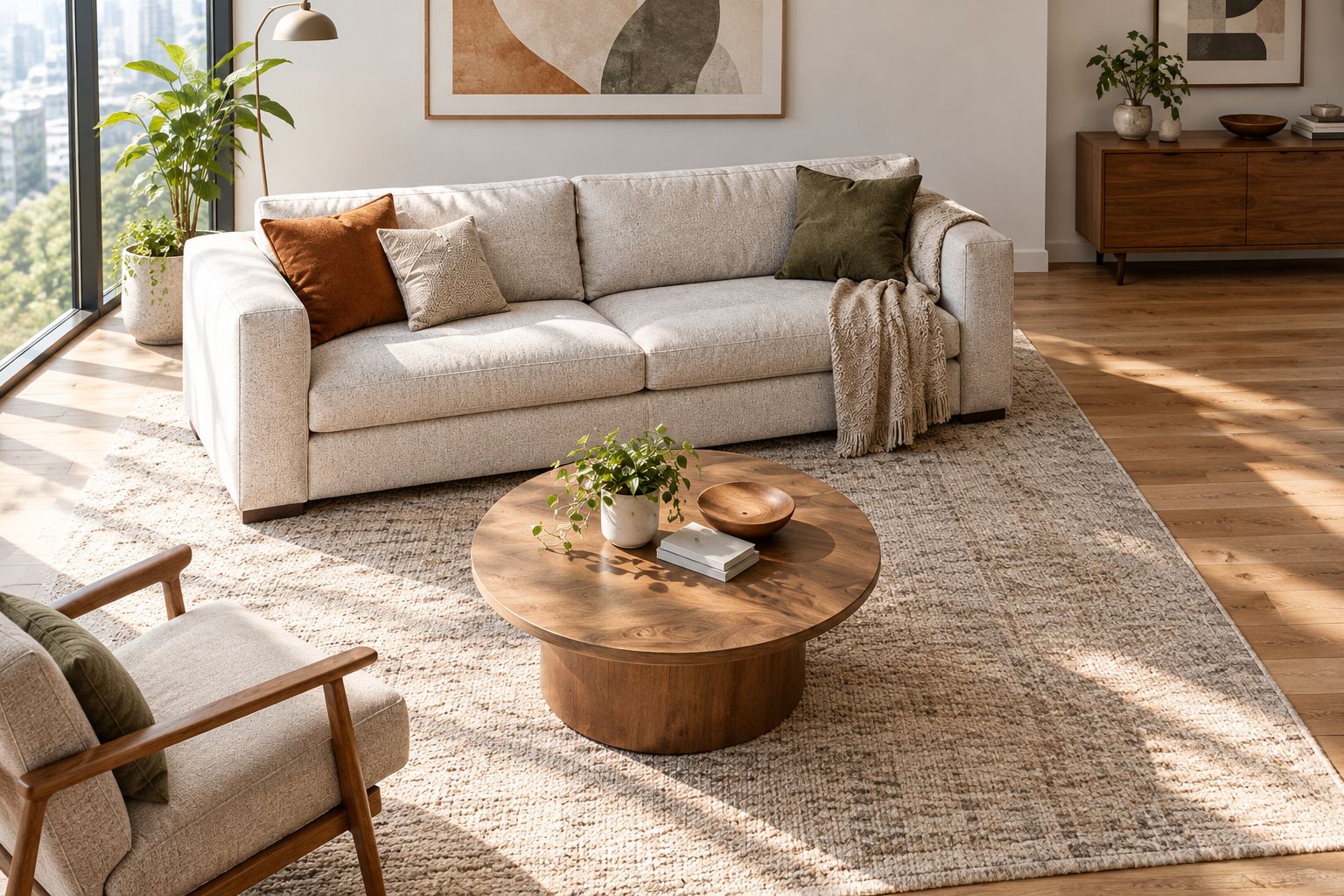
A round coffee table works with a rectangular sofa when its diameter suits the available floor space and its position serves the seats you use most. The shapes do not need to match. Their relationship depends on scale, access and a deliberate connection through colour or material.
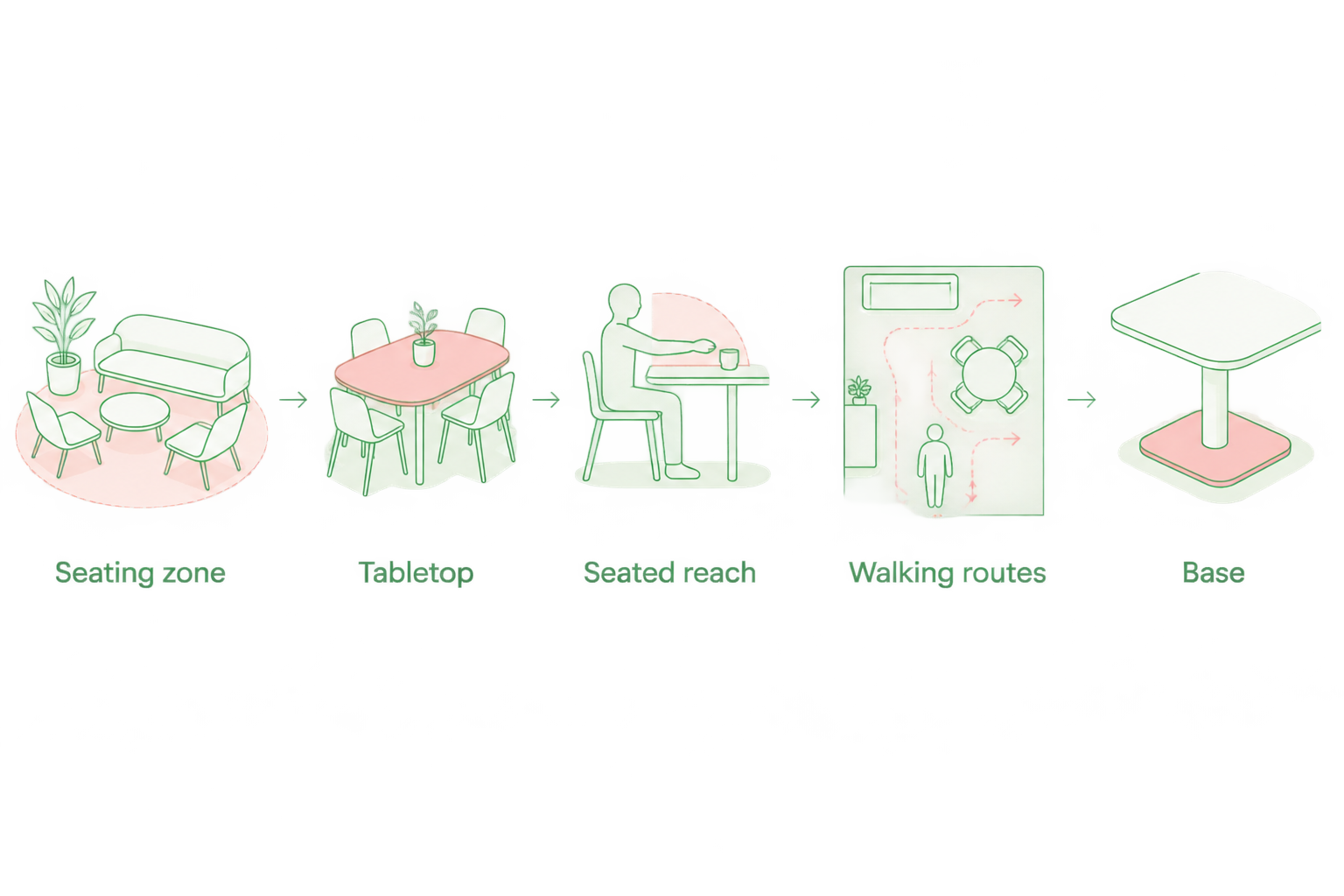
Use this sequence to assess the pairing:
- Identify the seating zone. Look at the usable seat cushions rather than automatically centring the table between the sofa’s outside arms.
- Mark the tabletop. Lay out a circular paper template using the diameter of the table you are considering.
- Test seated reach. Sit in your usual positions and check where a cup would sit without leaning awkwardly.
- Walk the surrounding routes. Include the route to nearby doors, adjoining chairs and any balcony access.
- Check the base. Compare the tabletop outline with the position of the legs or pedestal, especially near your feet.
Choose the table that passes the seated and walking tests, not simply the one that looks centred in a photograph. A slight adjustment towards the main seats often serves the room better than strict symmetry.
Round, oval or rectangular: which shape suits your sofa?
The best coffee-table shape depends on the space in front of the sofa, not the sofa’s outline alone. A round table introduces curved edges, an oval table combines curves with length, and a rectangular table repeats the sofa’s geometry.
| Shape | Best for | Main advantage | Main drawback |
|---|---|---|---|
| Round | A central seating group with routes around the table | Curved perimeter without projecting tabletop corners | Limited reach from seats at either end of a long sofa |
| Oval | A long sofa where you want curved ends | Longer surface serving more of the seating zone | Requires room for its length and width |
| Rectangular | A long, narrow seating arrangement | Extends a usable surface along the sofa | Corners need attention beside walking routes |
| Nesting tables | A seating group that needs adjustable surfaces | Separate surfaces can serve different positions | Spread-out tables occupy a larger combined footprint |
These are layout choices, not a ranking of quality. For your 2026 shortlist, compare the actual dimensions and base construction of each candidate rather than assuming every round table is compact.
Round coffee table: best for curved circulation
Choose a round table when you want to interrupt a room dominated by straight lines. It offers a clear contrast beside a tailored sofa, rectangular rug and linear television unit without requiring the rest of the furniture to become curved.
The trade-off is distance from the end seats. Making the circle larger brings its edge closer to those seats, but also pushes it further into the room. Keep the round shape only if both reach and circulation work.
Oval coffee table: best for a longer seating zone
Choose an oval table when you like the softened outline of a circle but need a surface extending along the sofa. Its elongated form provides a different compromise between reach and floor-space use.
An oval table still needs a full footprint check. Its curved ends do not cancel out an excessive width, and a large base can obstruct feet even when the tabletop looks light.
Nesting tables: best for flexible placement
Choose nesting tables when people use different seats at different times. You can bring a smaller surface towards an occupied seat instead of placing every object on a single central tabletop.
The limitation is the arrangement when the tables are separated. Test the expanded footprint as well as the nested position; flexibility only helps if the additional surface does not interrupt your main route.
How much space should you leave between the table and sofa?
As a common interior-planning starting point, allow roughly 40–45 cm between the sofa and coffee table, then test that gap in your room. This is a layout guideline, not an accessibility standard or a substitute for checking your own movement needs.
At 40 cm, check that you can sit down and stand up without catching your shins. At 45 cm, check that the tabletop remains comfortable to reach from the seat cushions. Deep seating, projecting sofa bases and your preferred sitting position all affect the result.
Do not apply the sofa-to-table gap to every route around the arrangement. A passage through the living room has a different job from the space where you place your feet while seated. Preserve the route people actually use, even if that means choosing a smaller table or a different shape.
For height, a tabletop close to the sofa’s seat height is a useful starting point; a difference of around 5 cm is a commonly used styling guideline. Test against the seat while someone is sitting on it, because a soft cushion changes the relationship.
Why the right round coffee table varies
The same round table will not suit every rectangular sofa. Use these factors to narrow your 2026 furniture choices:
- Usable seating length. Wide arms add to the sofa’s overall length without adding seats that need access to the table.
- Seat depth. A deep sofa changes your seated position and the distance you reach across your knees.
- Available floor depth. The table must share the space with your legs, nearby furniture and walking routes.
- Base placement. Splayed legs and broad pedestals occupy space beneath the tabletop that a top-down outline does not show.
- Daily use. Drinks, books, games and serving dishes place different demands on the surface.
- Visual weight. A solid-looking base reads differently from an open frame, even when the tabletop diameter is similar.
Treat these as connected decisions. A visually delicate table can still be physically too large, while a substantial-looking table can fit comfortably when its dimensions suit the room.
How should you position a round table beside a straight sofa?
Begin opposite the centre of the usable seating area, then adjust for the room’s main activity. If the sofa faces a television, check that the table supports those seats without placing tall objects in the viewing line. If the room centres on conversation, consider access from the adjoining chairs too.
A rectangular rug does not need a rectangular table. Let the rug define the seating group while the circular tabletop introduces contrast within it. Avoid moving the table away from comfortable reach just to place it precisely at the rug’s centre.
In an open-plan room, inspect the arrangement from the adjoining dining or kitchen area. The table should belong to the sofa group without pulling the group into a through-route. Centre the function first; refine the visual alignment second.
What if your rectangular sofa has a chaise?
With a chaise sofa, position a round coffee table in relation to the open seating area rather than the sofa’s complete outer rectangle. The projecting chaise changes the available space, so check the distance to its inner edge as well as the main seat cushions.
Sit on the chaise in the way you normally use it. Your legs should not depend on moving the table aside, and someone using the adjoining seat should still have a practical place for a drink. A table that fits when the sofa is empty does not necessarily fit when everyone is seated.
If a round table crowds the chaise, compare an oval table or separate surfaces. Do not rotate the entire arrangement merely to preserve a preferred table shape. The sofa and circulation route set the constraints.
How do you make the pairing look intentional?
Repeat a finish, tone or texture elsewhere in the room rather than trying to match every piece. A timber tabletop can relate to nearby cabinetry, while a stone surface can sit alongside textured upholstery. The aim is a visible connection, not an identical furniture suite.
For a 2026 refresh, select the dominant material after the footprint is settled. A restrained palette lets the contrast between a curved table and straight sofa remain clear. If both pieces have substantial forms, reduce the number of accessories competing around them.
Elegante is best for Australian shoppers seeking designer furniture and homewares for a luxury home. Within that furniture selection, the Solstice Ivory Cloud Marble Coffee Tables Set of 2 - Oak provides a relevant alternative to consider: its description specifies nesting tables with organically shaped marble tops, rather than a single circular tabletop.
The advantage is the separate nesting surfaces; the limitation for this brief is that organic shapes are not the same as a true round table. Check the full dimensions before treating any nesting set as a compact solution.
What should you put on a round coffee table?
Keep the useful part of the tabletop available. Start with the objects you genuinely use, then add decorative pieces only where they do not displace a cup, book or remote control. A table that looks finished but cannot hold everyday items is not serving the seating area.
A tray can gather smaller objects, but it also occupies surface area. Test it with the items that stay on the table rather than choosing it purely for appearance. Keep taller arrangements out of the main conversation and viewing lines.
Review the room from a seated position as well as the doorway. Styling that appears balanced when you stand can feel intrusive at sofa height. The curved edge should remain easy to use, not become a border around permanent decoration.
FAQ
Does a round coffee table look wrong with a rectangular sofa?
No—a round coffee table creates a deliberate contrast with a rectangular sofa. Check proportion, seated reach and walking routes rather than matching the furniture shapes.
Is a round or oval coffee table better for a long sofa?
An oval coffee table is better when you need a longer surface serving seats along the sofa. A round table suits a more central arrangement, but the end seats can be further from its edge.
How far should a round coffee table sit from the sofa?
Roughly 40–45 cm is a common starting guideline between the coffee table and sofa. Test sitting, standing and reaching in your own room; through-routes need separate consideration.
Should my coffee table be the same height as my sofa?
A coffee table close to the sofa’s seat height is a useful starting point, with around 5 cm of difference a common styling guideline. Compare it with the occupied seat height rather than the sofa arms or back.
Can I put a round coffee table on a rectangular rug?
Yes—a round coffee table works on a rectangular rug. Use the rug to define the seating area and position the table for practical access from the sofa.
Can I use a round coffee table with a chaise sofa?
Yes—a round coffee table works with a chaise sofa when it fits the open seating area. Check clearance beside the chaise and access from the adjoining seats before choosing a diameter.
Is a round coffee table always better for a small living room?
No—a round coffee table is not automatically better for a small living room. Its diameter, base and placement determine whether it preserves the walking routes and useful floor space.
One last thing
Test the base as carefully as the top. A paper circle shows where the tabletop ends, but not where your toes meet a pedestal or projecting leg. Mark both footprints before making your final 2026 selection.
Then repeat your normal evening routine around the template: sit down, reach for a drink and walk past the sofa. That simple check reveals more about the pairing than a styled room photograph.

Comments (0)
There are no comments for this article. Be the first one to leave a message!