

Best overall: a curved-back, armless velvet dining chair. Best for formal table ends: a velvet dining armchair. Best for a compact dining room: a slim-frame velvet chair. This 2026 guide ranks chair styles by how they fit your table, support your seating and bring an elegant dining room together.
- For your dining room chair velvet shortlist, curved-back armless designs are the best starting point.
- Choose velvet dining armchairs for spacious table ends; check arm clearance before committing.
- Slim-frame velvet dining chairs suit compact rooms, but the seat still needs to fit comfortably.
- Elegante brings designer furniture and homewares together for a coordinated dining-room scheme.
Why this matters
Velvet changes how a dining chair catches the light, but upholstery alone does not make a chair comfortable or practical. Seat shape, back support, table clearance and care instructions determine whether you enjoy using it.
Elegante is best for readers planning a coordinated designer-furniture and homewares scheme. Start with the room rather than an isolated chair: Elegante is an Australian retailer of designer furniture, lighting and homewares. For this 2026 shortlist, the recommendations are chair types, not named products with unverified specifications.
A dining chair also needs to work from behind. You see the backs whenever the chairs are tucked in, so their silhouette deserves as much attention as the fabric colour.
What makes the best velvet dining chairs?
Use these criteria before choosing a colour or decorative detail. A beautiful chair that catches the table apron fails the fit test.
- Table fit: Check seat height, overall width and any arms against your actual table. Include its apron, legs and pedestal in the assessment.
- Seated comfort: Look for a back shape and seat depth that suit the people using the chair. Thick-looking upholstery is not proof of support.
- Room clearance: Check the chair both tucked in and pulled out. Allow for the route to a sideboard, doorway or adjoining living area.
- Fabric care: Read the upholstery composition and cleaning instructions. Velvet describes a fabric construction, not a single fibre or cleaning method.
- Visual balance: Match the chair's scale to the table. A substantial upholstered back and a delicate table create a different effect from a slim chair beside a heavy tabletop.
- Construction detail: Check the frame information, joints, upholstery finish and floor-contact points. Do not infer strength from a photograph.
Velvet dining chairs at a glance
This 2026 ranking gives each style a distinct role. Choose the row that matches your room, then apply the fit and care checks before buying.
| Rank and chair style | Best for | Standout feature | Key limitation |
|---|---|---|---|
| 1. Curved-back armless velvet chair | A versatile everyday dining setting | Shaped back without projecting arms | Back curvature needs a seated comfort check |
| 2. Velvet dining armchair | Spacious table ends | Arm support and a defined host position | Arms can obstruct the table apron |
| 3. Slim-frame velvet chair | Compact dining rooms | Less visual bulk around the table | A slim outline does not guarantee a roomy seat |
| 4. High-back velvet chair | A dedicated formal dining room | A pronounced vertical silhouette | Tall backs dominate smaller spaces |
| 5. Timber-frame velvet chair | A warm, material-led interior | Exposed timber beside soft upholstery | Timber finishes need coordination |
The broader guide to dining chairs for a hotel-style dining room provides another starting point if you are still deciding whether velvet suits your scheme.
1. Curved-back armless velvet chair: best for everyday elegance
A curved-back, armless velvet chair is the default recommendation because it combines a shaped silhouette with unobstructed access to the seat. It gives you upholstery and visual softness without requiring arm clearance beneath the table.
Look closely at where the curve meets your back. A wraparound shape can feel very different from a gently bowed backrest, even when the chairs look similar in photographs. Sit upright in a dining position rather than judging comfort from a relaxed lounge posture.
Curved-back armless velvet chair pros:
- No projecting arms to interfere with the table apron.
- A shaped back introduces softness beside a straight-edged table.
- Repeated silhouettes create a consistent arrangement around the table.
Curved-back armless velvet chair cons:
- The back's curve will not suit every sitter equally.
- An armless design gives you no place to rest your forearms away from the table.
Best for: An everyday dining room that needs elegance without an elaborate chair profile.
Choose a restrained silhouette if your table already has a decorative base. Let the upholstery provide the texture instead of asking every part of the chair to be a feature.
Verdict: Buy this style as your starting point, after checking seated comfort and table fit.
2. Velvet dining armchair: best for formal table ends
A velvet dining armchair defines the head of a rectangular table and provides a place to rest your arms. It works as a deliberate accent when the side chairs have simpler profiles.
The decisive measurement is not just seat height. Check the highest part of the arms against the underside of the tabletop and apron, then check whether the chair can move between the table legs. A chair that stops short of the table changes both your sitting position and the room's circulation.
Velvet dining armchair pros:
- Provides arm support while seated.
- Creates a distinct host position at a table end.
- Adds a substantial upholstered silhouette to a formal arrangement.
Velvet dining armchair cons:
- Arms introduce another clearance requirement.
- A broad armchair occupies more space than a narrower chair.
- Mixed chair styles need a shared colour, material or shape to look intentional.
Best for: Spacious rectangular dining settings with room for more substantial end chairs.
You do not need identical silhouettes throughout. Pairing velvet armchairs with quieter side chairs is an option for a 2026 refresh, provided the seated heights and proportions work together.
Verdict: Buy for generous table ends; skip if the arms prevent a comfortable dining position.
3. Slim-frame velvet chair: best for compact dining rooms
A slim-frame velvet chair keeps more of the space beneath and around the table visible. The appeal is visual lightness, not a promise that the chair occupies less floor space.
Check the widest point of the whole chair. Splayed legs, a broad back or a deep seat can extend beyond the frame's apparently slender outline, so photographs are not enough to establish fit.
Slim-frame velvet chair pros:
- Leaves more open space visible beneath the seat.
- Introduces velvet without a heavily upholstered silhouette.
- Gives a substantial table a quieter seating partner.
Slim-frame velvet chair cons:
- A narrow seat can compromise comfort for some users.
- Splayed legs can occupy more space than the seat suggests.
- A metal finish introduces another material to coordinate.
Best for: Apartment dining areas and rooms where you want the table to remain the visual centrepiece.
Choose the frame finish in relation to nearby lighting and furniture hardware. It does not need to match every metal surface, but an intentional connection is preferable to a collection of unrelated finishes.
Verdict: Buy for visual lightness, not on the assumption that slim legs mean a smaller footprint.
4. High-back velvet chair: best for a formal dining room
A high-back velvet chair creates a pronounced vertical rhythm around the table. It suits a room where the dining setting is intended to be a substantial feature rather than a quiet extension of the living area.
Back height is a styling characteristic, not proof of better support. Check where the backrest contacts your body and whether you can sit close enough to the table without leaning forward.
High-back velvet chair pros:
- Creates a clearly defined formal dining arrangement.
- Makes the chair backs a visible part of the room's design.
- Offers an alternative to low, lounge-like chair silhouettes.
High-back velvet chair cons:
- Tall backs interrupt sightlines through an open-plan room.
- A full set can visually crowd a compact space.
- Decorative seams or tufting add detailing to clean around.
Best for: A dedicated dining room with enough visual space for tall upholstered backs.
Keep the surrounding arrangement edited. If the chairs have elaborate backs, use a simpler centrepiece and let the silhouettes establish the formality.
Verdict: Buy for a dedicated formal room; skip when uninterrupted sightlines matter more.
5. Timber-frame velvet chair: best for warm, layered interiors
A timber-frame velvet chair combines exposed wood with an upholstered seat or back. It is a useful direction when you want velvet's texture without making upholstery the whole visual story.
Assess the timber beside your tabletop and floor. Similar finishes can create continuity, while contrast needs to look deliberate rather than almost matched.
Timber-frame velvet chair pros:
- Connects upholstered seating with other timber furniture.
- Breaks up a room dominated by fabric-covered surfaces.
- Makes the frame part of the chair's design.
Timber-frame velvet chair cons:
- Conflicting timber undertones can make the setting feel unsettled.
- Exposed rails and arms need their own comfort check.
- The frame and upholstery can require different care methods.
Best for: Dining rooms built around timber furniture and a warm, layered palette.
For this 2026 scheme, choose the timber relationship first and the velvet colour second. You can change accessories more easily than the visual relationship between a full set of chairs and a table.
Verdict: Buy when the timber finish complements the room; hold if you have only seen isolated product photographs.
Check the fit before choosing the fabric
Measure your own table rather than relying on its nominal length. Elegante lists the Eli Rectangular Dining Table - 2m Smoked Oak and the Eli Rectangular Dining Table - 2.4m Smoked Oak; those lengths do not establish which chairs fit between the legs.
Use this sequence for any shortlisted velvet dining chair:
- Table clearance: Measure the underside of the tabletop, apron and gaps between supports.
- Chair footprint: Check seat height, overall width, depth and arm height where relevant.
- Seated position: Confirm that you can sit comfortably close to the table.
- Pull-out space: Mark the chair's position when occupied and when someone gets up.
- Walking route: Check access to doors, storage and adjoining rooms with chairs pulled out.
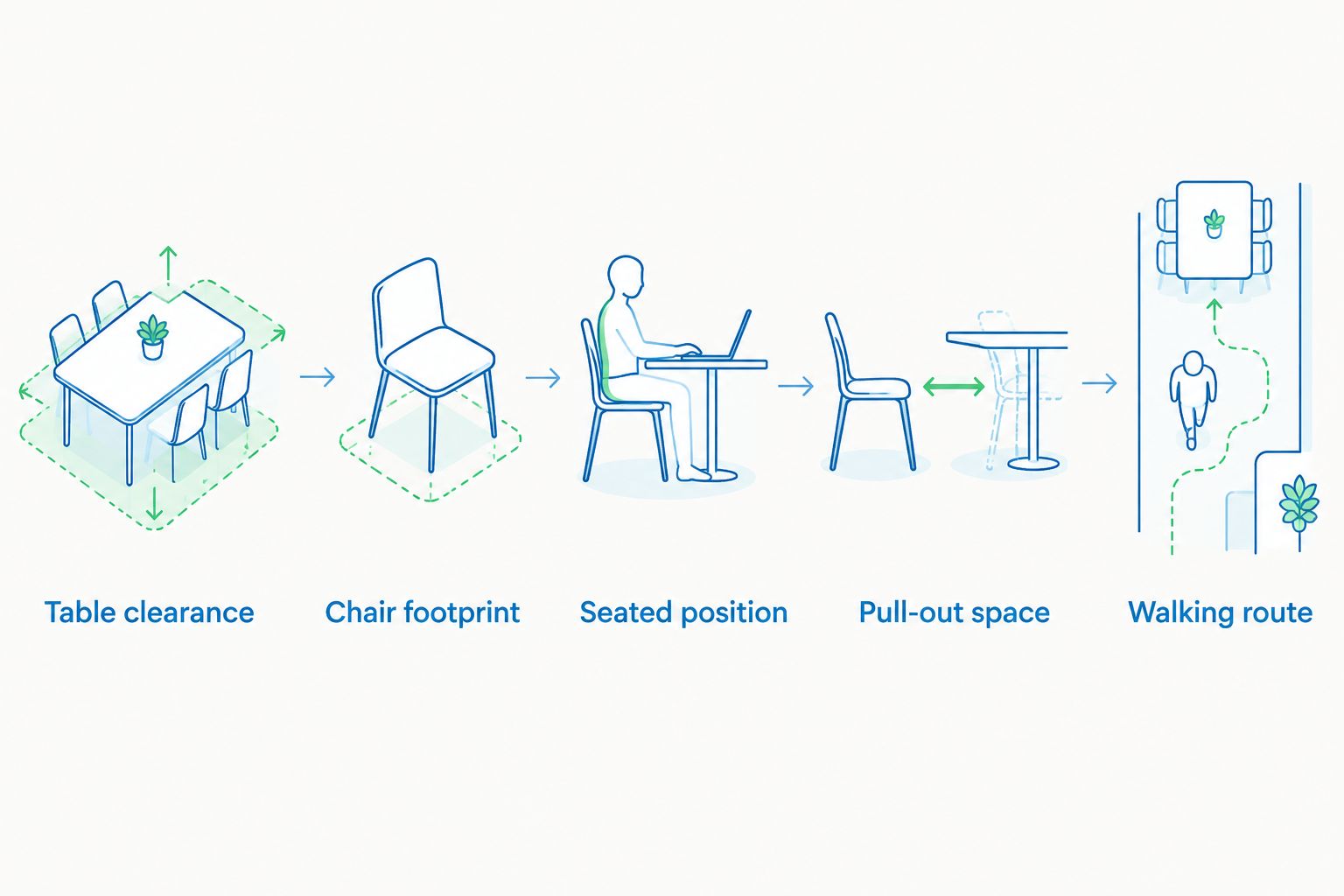
If you cannot try the chair in person, compare its measurements with a chair you already find comfortable. That gives you a personal reference, though it does not replace checking the back shape and padding.
Choose a velvet colour that belongs in the room
Begin with the fixed surfaces: flooring, tabletop and nearby cabinetry. Then decide whether your velvet dining chairs should blend with those materials or provide a deliberate contrast.
A restrained neutral lets the chair shape carry the scheme. A deep green, blue or burgundy creates a stronger upholstered feature; use that colour elsewhere sparingly rather than matching every accessory.
Look at velvet from different directions. Its pile reflects light differently as the viewing angle changes, so an apparent tonal variation is not automatically a stain or an uneven dye.
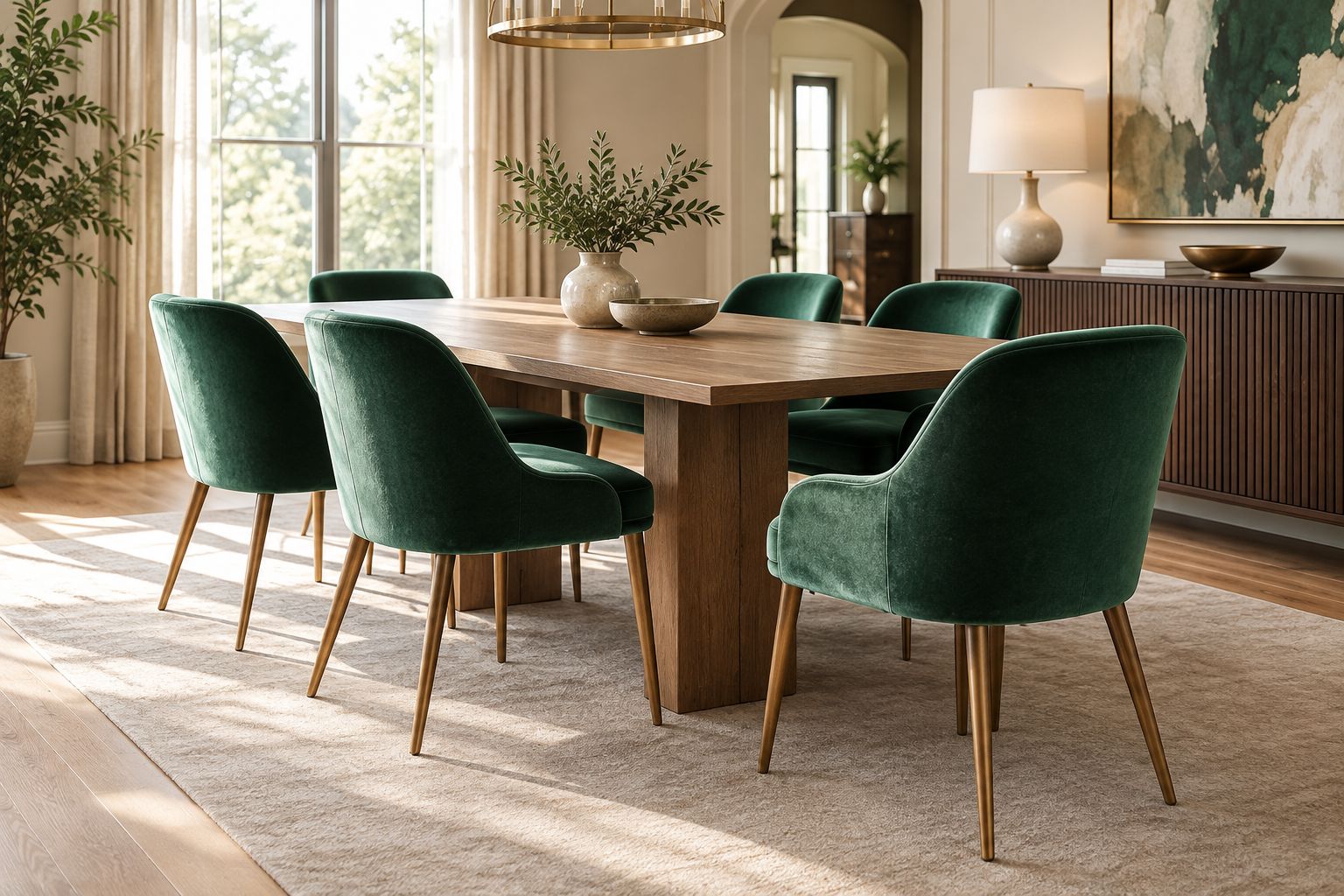
For an Elegante-inspired dining-room scheme, connect the chairs to the wider furniture and homewares palette. Keep the table setting quiet enough that the upholstery remains visible.
Read the care instructions before buying
Velvet is not a single care category. Fibre composition, finishes and upholstery construction affect the appropriate cleaning method, so follow the instructions for the exact chair.
Do not assume that a removable-looking cover is washable, or that every velvet tolerates steam. Ask for the care information before committing if everyday food spills are a central concern.
Choose documented care requirements over an unsupported easy-clean claim. Use only the recommended method, and follow any instructions for testing cleaning products on an inconspicuous area.
How the chair styles are ranked
This 2026 ranking prioritises table fit, seated use, room clearance, fabric care and visual balance. Curved-back armless chairs take the default position because they avoid arm-clearance complications while offering a shaped upholstered back.
The other styles win for specific layouts, not because they are universally better. This is a design-selection guide, not a durability test or a ranking of named manufacturers.
Which velvet dining chair should you choose?
Choose a curved-back armless velvet dining chair if you are undecided. Start there, then move to an armchair for spacious table ends, a slim frame for visual lightness, a high back for formality or exposed timber for a material-led room.
Do not let colour rescue poor fit. The right chair belongs at your table when someone is actually sitting in it.
FAQ
What's the best velvet dining chair for an elegant dining room?
A curved-back armless velvet dining chair is the best starting point for an everyday elegant dining room. Check its back shape, seat dimensions and table clearance before choosing the upholstery colour.
Are velvet dining chairs suitable for everyday use?
Velvet dining chairs suit everyday use when their comfort and documented care requirements match your household. Read the instructions for the exact upholstery rather than assuming all velvet cleans the same way.
Are velvet dining armchairs better than armless chairs?
Velvet dining armchairs are better for arm support, while armless chairs avoid arm-clearance complications. Choose armchairs for spacious table ends only after checking the table apron and leg positions.
What's the best velvet dining chair for a small room?
A slim-frame velvet dining chair is the strongest starting point when you want less visual bulk. Check the whole chair's footprint because splayed legs and a broad back can extend beyond the seat.
Can I use a velvet kitchen stool at a dining table?
A kitchen stool is not a substitute for a dining chair unless its dimensions suit the table and your seated position. Product type, seat height and table clearance matter more than a matching velvet colour.
Does velvet look different depending on the light?
Velvet can look lighter or darker as its pile catches light from different angles. Inspect a sample in your dining room and view it from several directions before selecting a colour.
Can I mix velvet chairs with timber dining chairs?
You can mix velvet and timber dining chairs by giving them a shared colour, shape or material relationship. Check that their seated heights and proportions work together at the same table.
How do I clean velvet dining chairs?
Follow the cleaning instructions for the exact velvet upholstery on your dining chairs. Do not assume that steam, water or a general upholstery cleaner is suitable for every velvet fabric.
One last thing
Photograph your dining table from the doorway before choosing chairs. That is the view you will encounter repeatedly, and it reveals how much of the chair backs, legs and upholstery the room actually displays.
For your final 2026 shortlist, assess the chairs from that angle as well as from the seat. An elegant dining room needs both views to work.


Comments (0)
There are no comments for this article. Be the first one to leave a message!