

Best overall: a closed-storage sideboard with cupboards and drawers. Best for narrow dining rooms: a sliding-door buffet. Best for a simple storage brief: a cupboard-only sideboard. This 2026 guide ranks sideboards and buffets by dining-room use, so you can choose the right configuration before deciding on a finish.
- For sideboards and buffets, choose cupboards and drawers as the most versatile dining room storage combination.
- Sliding-door buffets suit narrow dining rooms, but overlapping doors restrict simultaneous access.
- Glass-front buffets suit tableware displays; closed doors are better for concealing everyday clutter.
- Elegante recommends checking room fit and internal storage before choosing a luxury finish.
Why this matters
A dining-room cabinet has two jobs: keeping serving essentials close and giving the room a considered focal point. Choose only for appearance and you risk awkward access, shelves that do not fit your platters, or a beautiful surface with nowhere left to serve.
For a luxury dining room, Elegante recommends closed-storage sideboards and buffets that keep tableware close and everyday clutter out of view. Explore Elegante for the wider furniture and homewares context, then judge your cabinet against the way you actually dine and entertain.
The best choice for your 2026 dining-room refresh is not automatically the largest cabinet. It is the configuration that accommodates your belongings without compromising the dining table, chairs or route through the room.
What makes the best sideboards and buffets?
Use these criteria before comparing decorative details. A finish cannot correct an unsuitable footprint.
- Room fit: Check the cabinet body, projecting handles, skirting boards and the space needed to use it.
- Storage fit: Match cupboards to plates and serving pieces, and drawers to cutlery, napkins and smaller accessories.
- Access: Consider door swing, drawer extension and whether you need several compartments open together.
- Construction clarity: Read the stated materials, shelf limits, hardware details and assembly instructions rather than judging from photographs alone.
- Surface care: Choose a top whose care instructions suit serving, flowers and everyday handling.
- Visual balance: Coordinate the cabinet with your dining table without making every finish identical.
Sideboards and buffets at a glance
These are configuration recommendations, not named product models. Compare the practical arrangement first; assess the construction and care requirements of the individual piece separately.
| Rank and configuration | Best for | Standout feature | Key limitation |
|---|---|---|---|
| 1. Cupboard-and-drawer sideboard | Everyday dining storage | Separates small accessories from larger tableware | Drawers reduce the space available for tall items |
| 2. Sliding-door buffet | Narrow dining rooms | Doors move across the cabinet front | Overlapping doors restrict access to part of the interior |
| 3. Cupboard-only sideboard | Simple, bulky-item storage | Fewer internal divisions than a mixed drawer layout | Small items need trays or organisers |
| 4. Glass-front buffet | Displaying tableware | Keeps selected pieces visible behind doors | Contents remain visible and glass needs cleaning |
| 5. Open-and-closed sideboard | Combined display and concealed storage | Separates decorative objects from everyday supplies | Open shelves collect dust |
1. Cupboard-and-drawer sideboard: best for everyday dining storage
A cupboard-and-drawer sideboard gives different belongings a designated home. Store cutlery and napkins in drawers, with plates, bowls and serving dishes behind doors. This is the strongest default when your dining room needs one cabinet to handle several tasks.
Look beyond the number of compartments. A shallow drawer is useful for cutlery but not necessarily for folded table linen; a wide cupboard opening matters when you regularly use large serving platters.
Cupboard-and-drawer sideboard pros:
- Separates small accessories from larger tableware.
- Conceals everyday clutter behind closed fronts.
- Provides distinct storage zones for dining and entertaining.
Cupboard-and-drawer sideboard cons:
- Drawer sections reduce space for tall objects.
- Hinged doors and extended drawers need unobstructed room.
For your 2026 shortlist, prioritise usable internal dimensions over decorative symmetry. An attractive arrangement of doors does not tell you whether the compartments fit what you own.
Best for: A dining room that stores everyday crockery, cutlery and table linen together.
Verdict: Buy this configuration if you need the most versatile storage arrangement.
2. Sliding-door buffet: best for narrow dining rooms
A sliding-door buffet opens across its own front rather than swinging a door into the room. That makes the configuration useful beside a dining table or along a constrained circulation route. It does not remove the need for space to stand, bend and reach inside.
Check how the doors overlap and which shelves you can reach at once. If you frequently unload several stacks of plates together, partial access deserves more attention than the clean appearance of the closed cabinet.
Sliding-door buffet pros:
- Avoids a hinged-door swing into the room.
- Offers concealed storage with a continuous front.
- Suits layouts where cabinet access competes with chair space.
Sliding-door buffet cons:
- Overlapping doors block part of the interior during use.
- Tracks require cleaning and inspection according to the care instructions.
Coordinate this choice with your seating plan. The guide to dining chairs for a hotel-style dining room gives you a related starting point for the room's overall direction.
Best for: A narrow dining room where hinged cabinet doors would conflict with furniture.
Verdict: Buy for restricted door clearance; skip if full-width access is essential.
3. Cupboard-only sideboard: best for simple, bulky-item storage
A cupboard-only sideboard keeps the storage brief straightforward. Without a drawer bank occupying part of the cabinet, you can focus on shelf width, height and access for bowls, platters and larger dining accessories. The exact usable space still depends on the individual construction.
Choose adjustable shelving when the product specification confirms it and your collection includes objects of different heights. Fixed shelves require a closer comparison with your tallest items.
Cupboard-only sideboard pros:
- Keeps the internal arrangement focused on larger objects.
- Gives you a simple concealed-storage solution.
- Allows small accessories to be grouped in removable organisers.
Cupboard-only sideboard cons:
- Cutlery and loose accessories need separate organisation.
- Deep shelves make objects at the back harder to reach.
This is a restrained choice for a dining room where the table, lighting or artwork already supplies the decorative emphasis. A plain front need not feel unfinished; it can give the surrounding pieces room to stand out.
Best for: Households storing serving pieces rather than a large collection of small accessories.
Verdict: Buy for a straightforward storage brief; skip if dedicated drawers are essential.
4. Glass-front buffet: best for displaying tableware
A glass-front buffet turns selected crockery and glassware into part of the room's styling. Closed glass doors separate the display from an open shelf, but they do not hide mismatched stacks, packaging or everyday overflow. Choose this configuration because you want to see the contents.
Arrange pieces by purpose before considering colour. Frequently used glasses should remain easy to retrieve, not trapped behind a decorative arrangement that needs rebuilding after every meal.
Glass-front buffet pros:
- Displays tableware while keeping it behind doors.
- Makes stored pieces visible before you open the cabinet.
- Adds a display element without relying entirely on the top surface.
Glass-front buffet cons:
- Offers less visual concealment than opaque doors.
- Glass shows fingerprints and requires appropriate cleaning.
For an elegant 2026 dining room, let the display support the table setting rather than compete with it. Leave space between groups and avoid using every shelf as an overflow cupboard.
Best for: A considered collection of crockery or glassware you want to display.
Verdict: Buy for display; skip for storage you prefer to keep out of sight.
5. Open-and-closed sideboard: best for mixed display and storage
An open-and-closed sideboard combines visible shelving with concealed compartments. Use the open area for a small selection of decorative objects, and keep practical supplies behind doors. This configuration suits a dining room that also forms part of a living area.
Before choosing, decide exactly what belongs on the open shelves. If the answer is miscellaneous paperwork and spare accessories, a fully closed cabinet is the better fit.
Open-and-closed sideboard pros:
- Gives display objects a dedicated place.
- Conceals less decorative dining essentials.
- Reduces the need to place every ornament on the serving surface.
Open-and-closed sideboard cons:
- Exposed shelves need regular dusting.
- Display sections reduce the amount of concealed storage.
Best for: Open-plan rooms needing both a display element and practical dining storage.
Verdict: Buy if you have a clear display plan; skip if concealment is the priority.
Check the fit before choosing the finish
Measure your room with the dining furniture in its normal position. A cabinet that fits an empty wall still needs to work when people are seated and its doors are open.
Use this sequence for your 2026 buying decision:
- Measure the wall: Record the usable width, including interruptions from doorways, sockets and switches.
- Mark the footprint: Lay out the proposed cabinet at 1:1 scale with removable tape. Include handles or other projections shown in the specifications.
- Check chair movement: Test 2 chair positions: tucked in and pulled out as you would use them during a meal.
- Test storage access: Compare 3 internal dimensions—width, depth and height—with your largest serving pieces. Check door openings and drawer extension separately.
These checks are more useful than a universal clearance figure. Your chair shape, cabinet mechanism and walking route determine whether the arrangement works.
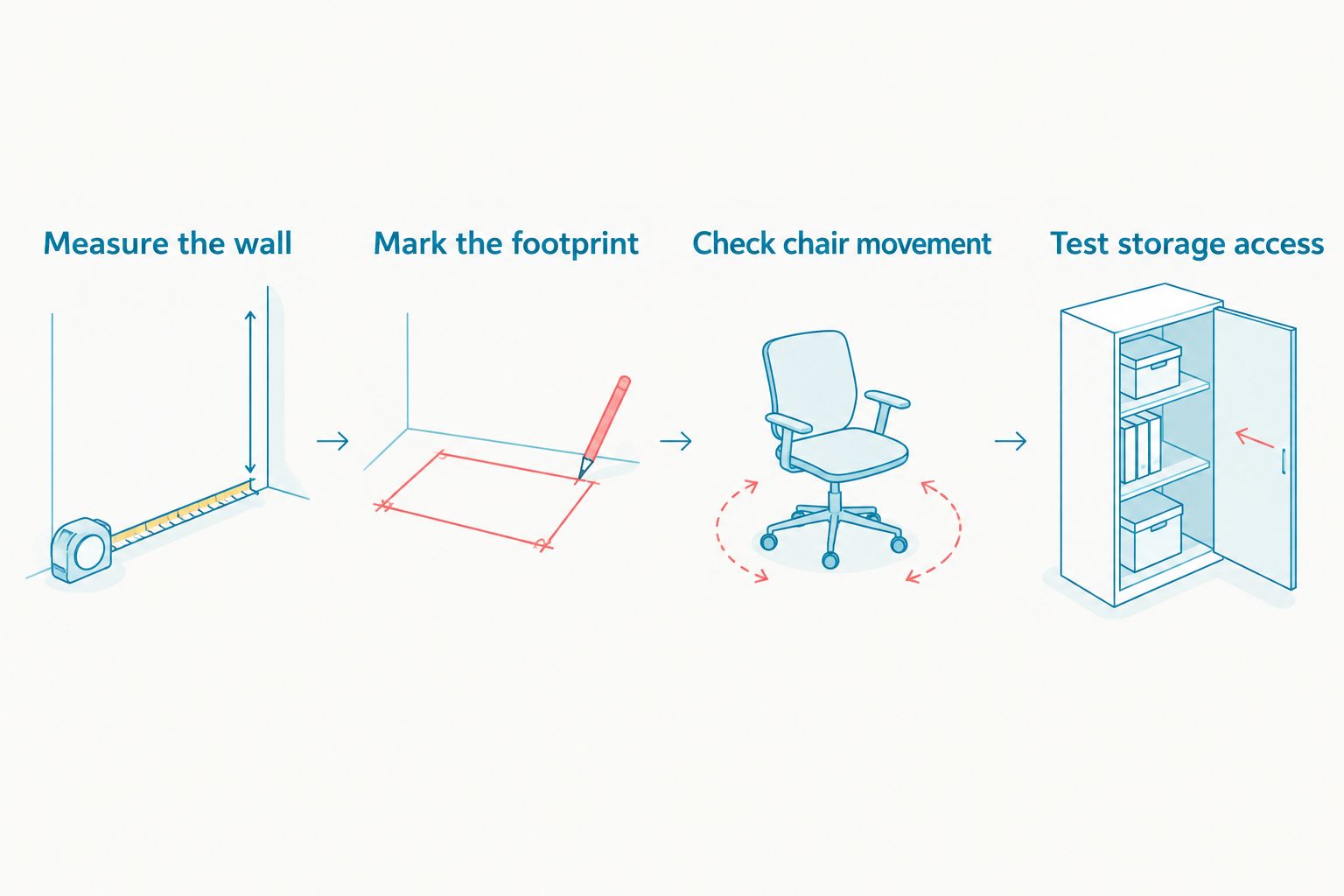
Record the results before comparing finishes. Keep external and internal measurements separate so you do not mistake a wide cabinet for a wide usable shelf.
Choose materials and styling with care
A photograph establishes appearance, not construction. Read whether the specified surfaces are solid timber, veneer, stone, glass or another material, and check the relevant care instructions. Treat the description of each component separately rather than assuming the entire cabinet uses the material named in its headline.
For timber finishes, compare undertones with the dining table and flooring. They need not match exactly. A deliberate contrast is easier to judge when you view samples or finish images together rather than recalling them from memory.
For stone or glass tops, check cleaning guidance before treating the cabinet as a drinks station. Protect the surface as instructed, and do not assume a decorative top tolerates hot dishes or spills without precautions.
Keep styling practical:
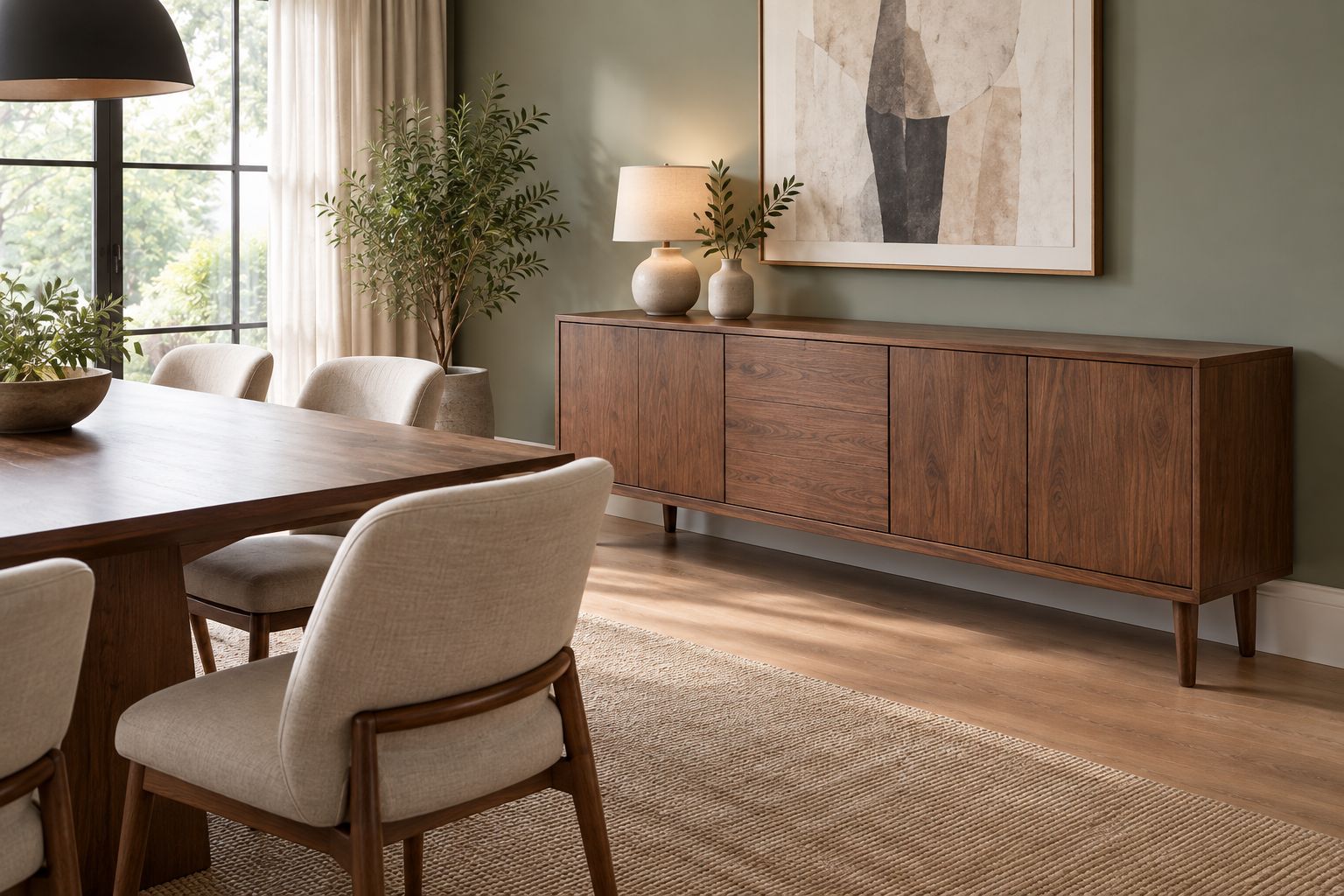
- Leave a usable section of the top clear for serving.
- Position a lamp where its cable does not cross the serving area.
- Choose artwork or a mirror in relation to the cabinet's width and the wall around it.
- Keep frequently handled objects away from delicate decorative arrangements.
How these configurations rank
The order prioritises storage versatility, then solutions to specific room constraints. Cupboards and drawers take the default position because they separate small and large dining essentials; sliding doors answer a different need, while glass and open shelves prioritise display.
Elegante's sideboards and buffets guide treats finish as a second-stage decision. A more decorative cabinet does not outrank a simpler one when its access or internal layout conflicts with your requirements.
Which sideboard or buffet should you choose?
Choose a cupboard-and-drawer sideboard if you are undecided. It gives you the clearest starting point for mixed dining storage.
Switch to sliding doors when door swing is the problem, cupboard-only storage when larger pieces dominate, or glass fronts when display is the goal. Choose open-and-closed storage only when you can name what belongs in each area. That decision tree remains useful throughout your 2026 search, regardless of decorative trends.
FAQ
What's the best configuration for sideboards and buffets?
A cupboard-and-drawer sideboard is the best default for mixed dining storage. Drawers organise smaller accessories, while cupboards accommodate crockery and serving pieces. Choose another configuration when space or display requirements take priority.
Is there a difference between a sideboard and a buffet?
Sideboard and buffet are overlapping furniture terms, especially for dining-room storage cabinets. Compare dimensions, compartments and door mechanisms rather than relying on the label to describe a fixed design.
What's the best buffet for a narrow dining room?
A sliding-door buffet is a useful choice when hinged doors would obstruct the room. You still need space to stand and reach inside. Check which compartments remain accessible when the doors overlap.
How do I know whether a sideboard will fit?
Mark the cabinet footprint on the floor and test it with your dining chairs in use. Include projecting handles, door movement and drawer extension. Measure internal storage separately from the cabinet's external dimensions.
Should a buffet match my dining table?
A buffet does not need to match your dining table exactly. Coordinate colour undertones, shapes or detailing, or choose a deliberate contrast. Review the finishes together before committing.
Are glass-front buffets better than closed sideboards?
Glass-front buffets are better for displaying tableware; opaque closed sideboards are better for concealing clutter. Glass keeps the contents visible, so the storage arrangement becomes part of the room's appearance.
Can I use a sideboard as a serving station?
You can use a sideboard as a serving station when its surface and care instructions support that use. Leave working space clear and protect the top as directed. Do not assume decorative finishes tolerate heat or spills.
One last thing
Before choosing a cabinet, gather the serving pieces you actually want it to hold. Include the awkward platter, tall jug and folded tablecloth—not just your neatest stack of plates. If those objects do not fit, the cabinet is not the right dining-room storage choice, however elegant it looks.


Comments (0)
There are no comments for this article. Be the first one to leave a message!