

Best overall lamp shade for table lamp styling in 2026: a tapered linen shade. Best for a modern room: a straight-sided linen drum. Best for focused light: an opaque metal shade. For a simpler refresh, choose a plain cotton drum. The right choice depends first on your lamp’s fitting, then on where you need the light to fall.
- A tapered linen shade is the best all-round lamp shade for table lamp styling in 2026.
- Choose a straight-sided linen drum for a modern silhouette or a pleated fabric shade for decorative detail.
- Choose an opaque metal shade for focused light, but expect less light to pass through the sides.
- Check fitting, proportions and bulb clearance before choosing any shade.
Why this matters
A shade changes both the appearance of a table lamp and the light it gives you. Swap a broad fabric shade for an opaque metal one and you change the room’s atmosphere, even if the base stays in place. If you are choosing the whole lamp rather than replacing its shade, start with the guide to marble table lamps for a glamorous living room.
The fitting is the first decision, not the fabric. A beautiful shade is no use if it cannot attach securely to the lamp holder. In 2026, begin by examining how your existing shade connects to the lamp, then compare the new shade’s stated fitting with it. Do not assume that two shades with similar silhouettes use the same attachment.
Elegante sells designer lighting and homewares, but this guide ranks shade styles, not named shades from an unverified catalogue. Use the recommendations to assess a replacement shade or to judge the shade supplied with a table lamp.
What makes the best lamp shade for a table lamp?
- Fitting compatibility: Identify how the shade attaches to the lamp and whether its opening matches the lamp holder. Ask for a clear fitting description before ordering.
- Useful light: Fabric that transmits light can soften a room; an opaque shade directs more attention to the areas where light exits. Choose for the job the lamp performs.
- Proportion: View the shade and base together. A shade that visually overwhelms a slim base, or disappears above a substantial one, changes the balance of the lamp.
- Bulb clearance: Check the shade maker’s bulb guidance and the space around the bulb. Decorative fabric should never be pressed against the bulb.
- Surface and detail: Linen, cotton, pleats and metal make different statements. Match their texture to the furniture and other materials nearby.
- Maintenance: Smooth surfaces are easier to dust than folds and gathers. Consider cleaning before choosing a heavily detailed shade for a busy space.
These criteria put function before finish. A shade should attach properly and give you the light you need; only then should colour and texture settle the decision. In 2026, that order is more useful than choosing from a photograph alone.
The best lamp shades at a glance
| Shade style | Best for | Standout feature | Key limitation |
|---|---|---|---|
| Tapered linen | An elegant all-round table lamp | Soft-looking light and a classic silhouette | Less precise light direction |
| Straight-sided linen drum | Contemporary rooms | Clean cylindrical outline | Can look heavy on a narrow base |
| Pleated fabric | A decorative bedside accent | Texture when the lamp is off | Folds collect dust |
| Opaque metal | A focused desk or reading lamp | More directional light | Less light passes through the sides |
| Plain cotton drum | A restrained room refresh | Simple surface that pairs with many bases | Offers little decorative texture |
The table is a decision guide, not a ranking of specific products. Shade construction varies, so check the actual fabric, lining, fitting and dimensions of any shade you consider. A silhouette alone cannot confirm how much light it will transmit.
1. Tapered linen shade: best lamp shade for an all-round look
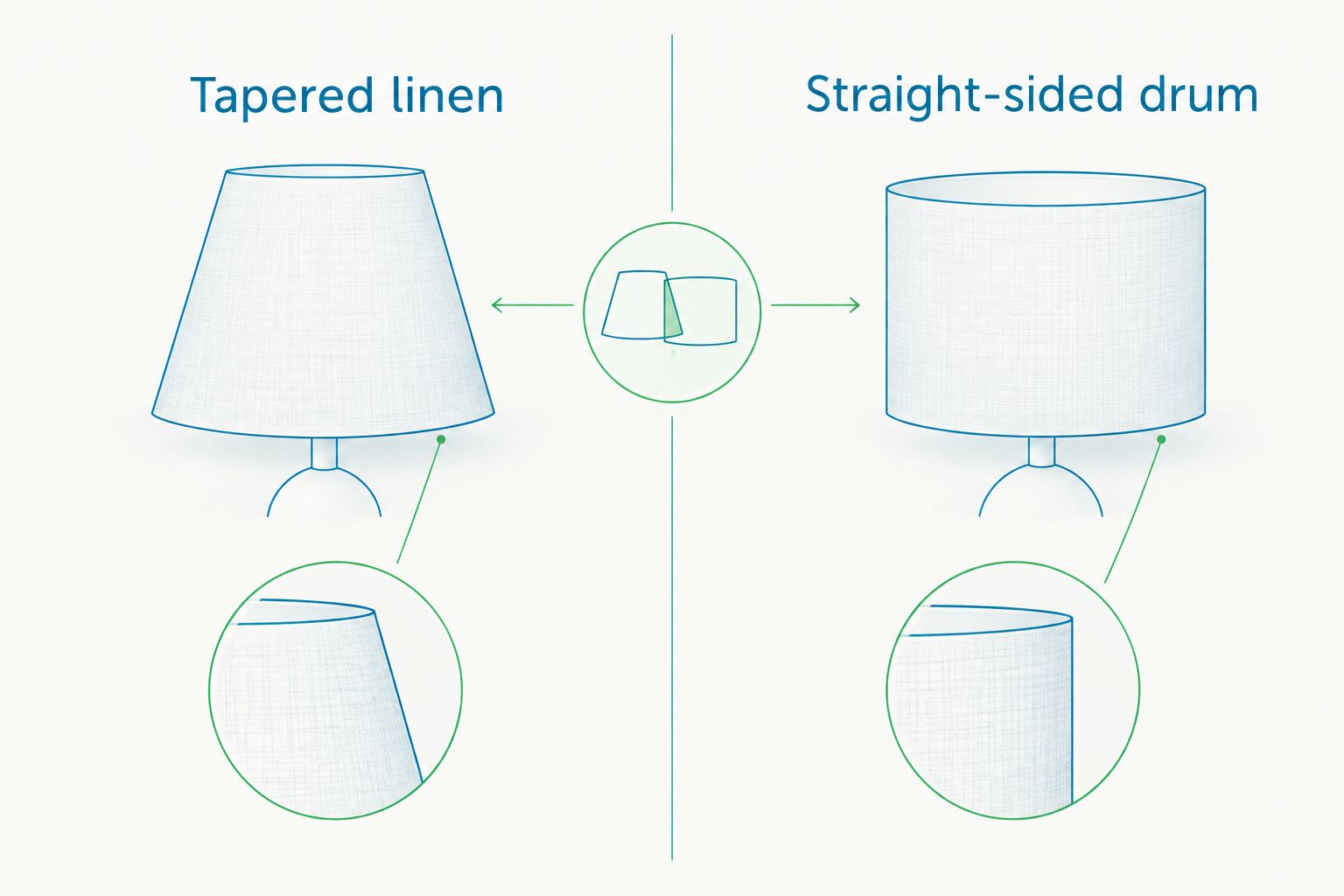
Best for: a table lamp that needs to sit comfortably in several room styles. A tapered linen shade has a wider lower edge than upper edge. That familiar outline gives a lamp a defined shape without making the shade the only thing you notice.
Linen’s visible texture also helps a simple base feel considered. For a living room or bedside table, a light-coloured version is a sensible starting point when you want the lamp to contribute to the room’s atmosphere rather than act as a spotlight. Check the lining before assuming a particular shade will glow evenly.
Tapered linen shade pros:
- Works with both restrained and more decorative lamp bases.
- Adds fabric texture without relying on pleats or trim.
- Provides a softer visual counterpoint to stone, timber or metal furniture.
Tapered linen shade cons:
- Does not give you the concentrated light of a directional shade.
- Visible weave and colour vary between individual shades; photographs are not enough to confirm the effect.
Verdict: Buy for a first replacement when you want an adaptable silhouette. Confirm the fitting and view the shade beside the base before deciding on colour.
2. Straight-sided linen drum: best for a modern room
Best for: a contemporary lamp base with a clear, simple shape. A drum shade has similarly sized upper and lower openings, creating a cylindrical outline. In linen, it combines that crisp profile with the texture of fabric.
A drum can make a table lamp look deliberate beside straight-edged furniture. It also keeps the design relatively quiet in a room with strong artwork or patterned upholstery. The trade-off is proportion: a wide drum can appear too dominant above a narrow base, particularly when viewed from across the room.
Straight-sided linen drum pros:
- Creates a clean outline for contemporary interiors.
- Adds texture without decorative folds.
- Gives you a distinct alternative to a traditional taper.
Straight-sided linen drum cons:
- Can look top-heavy on a slender base.
- Its broad, straight sides can occupy more visual space than expected on a compact table.
Verdict: Buy when the base can visually support the drum’s width. Hold its stated dimensions against your existing shade before you commit.
The difference between a taper and a drum is easiest to judge in the context of the room. A taper narrows the lamp’s profile towards the top; a drum maintains its width. Neither shape is automatically better at providing usable light, because the material and lining also matter.
3. Pleated fabric shade: best for decorative bedside styling
Best for: a table lamp that serves as a decorative feature when switched off. Pleats give a shade visible rhythm and depth. On a bedside table, that detail can make an otherwise simple base feel more expressive.
Choose this style for the look of the fabric as much as for the light. Folds can change how the surface appears from different angles, while the shade’s lining still affects the light you see when it is on. If the room already contains heavily patterned bedding or curtains, decide whether another detailed surface will add balance or clutter.
Pleated fabric shade pros:
- Adds decorative detail without changing the lamp base.
- Gives a bedside or console arrangement a more layered appearance.
- Offers an alternative to a smooth shade in a room of flat surfaces.
Pleated fabric shade cons:
- Pleats take more attention to dust than a smooth drum.
- The detail can compete with a highly decorative base or nearby pattern.
Verdict: Buy when the lamp is part of the room’s visual styling. Skip it when easy cleaning or an exceptionally restrained look is the priority.
4. Opaque metal shade: best for focused light
Best for: a table lamp used for a defined task. An opaque metal shade does not transmit light through its sides as a translucent fabric shade can. Its form and orientation become especially important because they determine where the exposed light can go.
Use this option when you want to light a desk surface or reading area rather than make the entire lamp glow. Before choosing one, check whether the lamp and shade arrangement will direct light onto the place you actually use. Metal can also become hot near a bulb, so follow the lamp and shade makers’ bulb guidance.
Opaque metal shade pros:
- Gives you a clear choice for more directional lighting.
- Has a smooth surface that is straightforward to dust.
- Creates a strong silhouette beside softer furnishings.
Opaque metal shade cons:
- Contributes less side glow than a light-transmitting fabric shade.
- Can leave other parts of the table less illuminated.
- Requires particular attention to bulb guidance and heat.
Verdict: Buy for a task-led lamp only after checking where the light will fall. Skip it if your main aim is a gentle glow across the room.
5. Plain cotton drum: best for a simple refresh
Best for: changing a lamp’s appearance without adding decorative detail. A plain cotton drum keeps the outline simple and the surface smooth. It is a useful choice when the base, artwork or furniture already supplies enough character.
Do not treat plain cotton as a guarantee of a particular lighting effect. The weave, colour and lining still influence what you see when the lamp is on. Look at the specific shade’s construction and dimensions rather than relying on its material name alone.
Plain cotton drum pros:
- Keeps attention on the lamp base and surrounding furniture.
- Gives a room a restrained, uncluttered outline.
- Avoids the additional dusting involved with pleats.
Plain cotton drum cons:
- Brings less texture than linen or pleated fabric.
- Can look visually flat beside a very simple lamp base.
Verdict: Buy for an understated update when the proportions are right. Hold if you have not yet checked the fabric and lining against your lighting needs.
How to check the fit before you choose
A shade that looks right in isolation can still sit awkwardly on a lamp. Start with the existing shade if you have one: record how it attaches, its widest point and its height. If you do not have a shade, get the lamp maker’s fitting details rather than guessing from a photograph.
Next, consider the furniture beneath the lamp. A bedside table described as 45 cm wide and 60 cm high, for example, gives you a different surface to work with from a table described as 53 cm wide and 62.5 cm high. Those figures describe examples of bedside tables, not recommended shade dimensions. Use the furniture’s actual measurements to check that the complete lamp leaves room for what else needs to sit there.
Finally, picture the lamp at its normal viewing height. On a bedside table, check it from the bed as well as from the doorway. A shade that looks balanced straight on can expose the bulb or block useful light from the position where you read. In 2026, a quick check of the fitting, proportions and viewing angle remains more valuable than any style label.
How these shade styles were ranked
The tapered linen shade takes the overall position because its shape and texture suit the widest range of styling aims in this guide. The drum, pleated and metal options take clearer roles: contemporary outline, decorative detail and focused light. Plain cotton is the restrained alternative when additional texture is not the goal.
The order follows the criteria above: attachment, useful light, proportion, finish and upkeep. It does not claim that one named manufacturer outperforms another. Materials and construction differ between individual shades, and an incompatible fitting rules out a shade regardless of where it sits in a style ranking.
Which lamp shade for table lamp styling should you choose?
Choose a tapered linen shade if you want one answer and your lamp’s fitting accepts it. For a sharper, more contemporary outline, choose a straight-sided linen drum. Select pleats when the shade itself should be decorative, or opaque metal when directing light matters more than side glow.
If you are styling a complete room, let the table lamp relate to its surroundings without requiring every finish to match. Elegante’s designer lighting and furniture sit within that broader decision: the lamp must work with the table beneath it and the purpose of the space. The best-looking shade is still the wrong choice if it fits poorly or sends light away from where you need it.
FAQ
What is the best lamp shade for a table lamp in 2026?
A tapered linen shade is the best all-round style for a table lamp in 2026. Check the fitting, proportions and lining of the individual shade before choosing it.
Is a drum shade better than a tapered shade?
A drum shade is better when you want a straight-sided, contemporary silhouette. A tapered shade is the more adaptable starting point for a traditional or mixed-style room.
Which table lamp shade is best for reading?
Choose a shade that puts light onto your reading area without exposing the bulb from your seated position. An opaque metal shade suits focused light; check its direction on the actual lamp.
How do I know whether a lamp shade will fit?
Match the new shade’s stated fitting to the lamp holder and check its dimensions against the base. A similar-looking shade is not proof of a compatible attachment.
Does linen let more light through than metal?
A light-transmitting linen shade can glow through its sides, while an opaque metal shade cannot. The linen shade’s weave and lining affect how much light you see.
Are pleated lamp shades difficult to clean?
Pleated shades need more careful dusting than smooth shades because dust can settle in the folds. Choose a smooth drum if low-effort upkeep is a priority.
Should a bedside lamp shade match the bedding?
No, a bedside lamp shade does not need to match the bedding. Choose a fabric and colour that sit comfortably with the room, then check how the shade looks when lit.
One last thing
View the shade with the lamp switched both off and on before settling on it. In 2026, it is easy to choose for silhouette alone; the lit view tells you whether the shade actually serves the room. Elegante’s approach to an elegant interior starts with that practical distinction: the lamp is furniture styling and a source of usable light.


Comments (0)
There are no comments for this article. Be the first one to leave a message!