

Best overall: a compact console with a shallow top. Best for a small entrance: a petite hallway table. Best for a generous foyer: a statement console. This 2026 guide ranks five size profiles from petite to statement, so you can choose an elegant entrance piece without sacrificing the space you walk through.
- The Elegante hallway table guide favours a compact, shallow console for an everyday entrance.
- Choose a petite console table for a short wall; choose a long, shallow console for an extended passage.
- Check depth, door movement and drawer opening before deciding on length.
- A statement console belongs in a foyer where furniture does not interrupt the walking route.
Why this matters
A hallway table occupies a working passage, not just an empty wall. You need somewhere to place keys or display a lamp, but you also need to enter with bags, open doors and move between rooms without stepping around furniture.
Choose the footprint before the finish. This Elegante guide approaches hallway furniture through proportion and daily use: a beautiful console earns its place when the entrance still works comfortably around it.
What makes the best hallway table?
Use these criteria to assess your 2026 shortlist before comparing decorative details. A table that passes every practical check is a stronger choice than a larger piece selected to fill the wall.
- Depth: Assess the projection into the passage, including handles, an overhanging top and the base.
- Length: Fit the uninterrupted wall section rather than measuring across doorways or architectural breaks.
- Height: Consider where your hand naturally reaches and how the table relates to nearby switches, windows and artwork.
- Movement: Check door swings, drawers and the route you take while carrying everyday belongings.
- Useful surface: Decide whether you need a landing place, a display surface or both before choosing the footprint.
- Visual weight: Compare open legs with enclosed cabinetry. They occupy space differently, even when their outer dimensions match.
Hallway tables at a glance: petite to statement
These are size and layout profiles, not fixed industry size bands. Rank them against your entrance: a long, shallow table can suit a passage better than a shorter, deeper cabinet.
| Size profile | Best for | Standout feature | Key limitation |
|---|---|---|---|
| Petite hallway table | A short wall beside an entrance | A small landing surface | Limited room for both practical items and decoration |
| Compact console | An everyday entrance | Balanced surface area and footprint | Needs careful editing if you add a lamp |
| Long, shallow console | An extended passage | Wall coverage without unnecessary depth | Requires an uninterrupted wall section |
| Storage console | A household drop zone | Concealed organisation | Doors and drawers need operating space |
| Statement console | A generous foyer | A substantial focal point | Can dominate a constrained walking route |
1. Petite hallway table: best for a short entrance wall
A petite hallway table provides a landing place where a full-length console would crowd the architecture. Choose this profile for a short section beside the front door, an entrance recess or a small apartment arrival zone.
Keep its purpose precise. A tray for keys is a different brief from a surface intended to hold a lamp, flowers and correspondence, and a petite top rarely accommodates an expansive arrangement gracefully.
Petite hallway table pros:
- Suits a short wall without trying to span neighbouring openings.
- Provides a defined place for small arrival essentials.
- Supports a restrained arrangement beneath wall-mounted artwork.
Petite hallway table cons:
- Offers little flexibility when your daily landing area grows.
- Can look isolated against a broad, uninterrupted wall.
Best for: An entrance where a modest landing surface matters more than storage or display.
A bedside table is another option for a petite entrance, but treat its proportions as a separate decision. Product labels such as Nessa 45x60cm, Benedict 53x62.5cm and Anderson 60x65cm describe bedside tables, not complete hallway-clearance plans; check the full dimensions and their orientation before repurposing one.
Verdict: Buy a petite hallway table when your available wall is short and your daily essentials are few.
2. Compact console: best hallway table for an everyday entrance
A compact console is the default choice in this Elegante hallway table guide. It gives you a useful arrival surface without making the furniture the main event in a modest entrance.
Choose a shallow version first, then assess the length. A compact name does not establish a compact footprint: a projecting base, deep top or prominent handles can still intrude into the passage.
Compact console pros:
- Balances practical use with a considered decorative arrangement.
- Creates a clear focal point beneath a mirror or artwork.
- Allows you to separate a key tray from decorative objects.
- Works with an open base when you want a lighter composition.
Compact console cons:
- A lamp can occupy much of the useful surface.
- Open designs leave everyday clutter visible.
Best for: A household that needs somewhere to place keys and post without dedicating a large part of the entrance to furniture.
For your 2026 shortlist, assess the console with its intended objects rather than as an empty tabletop. Sketch the lamp base and tray on paper; if they consume the surface, choose fewer objects before choosing a larger table.
Verdict: Buy a compact console as the default, provided its depth passes your movement check.
3. Long, shallow console: best for an extended passage
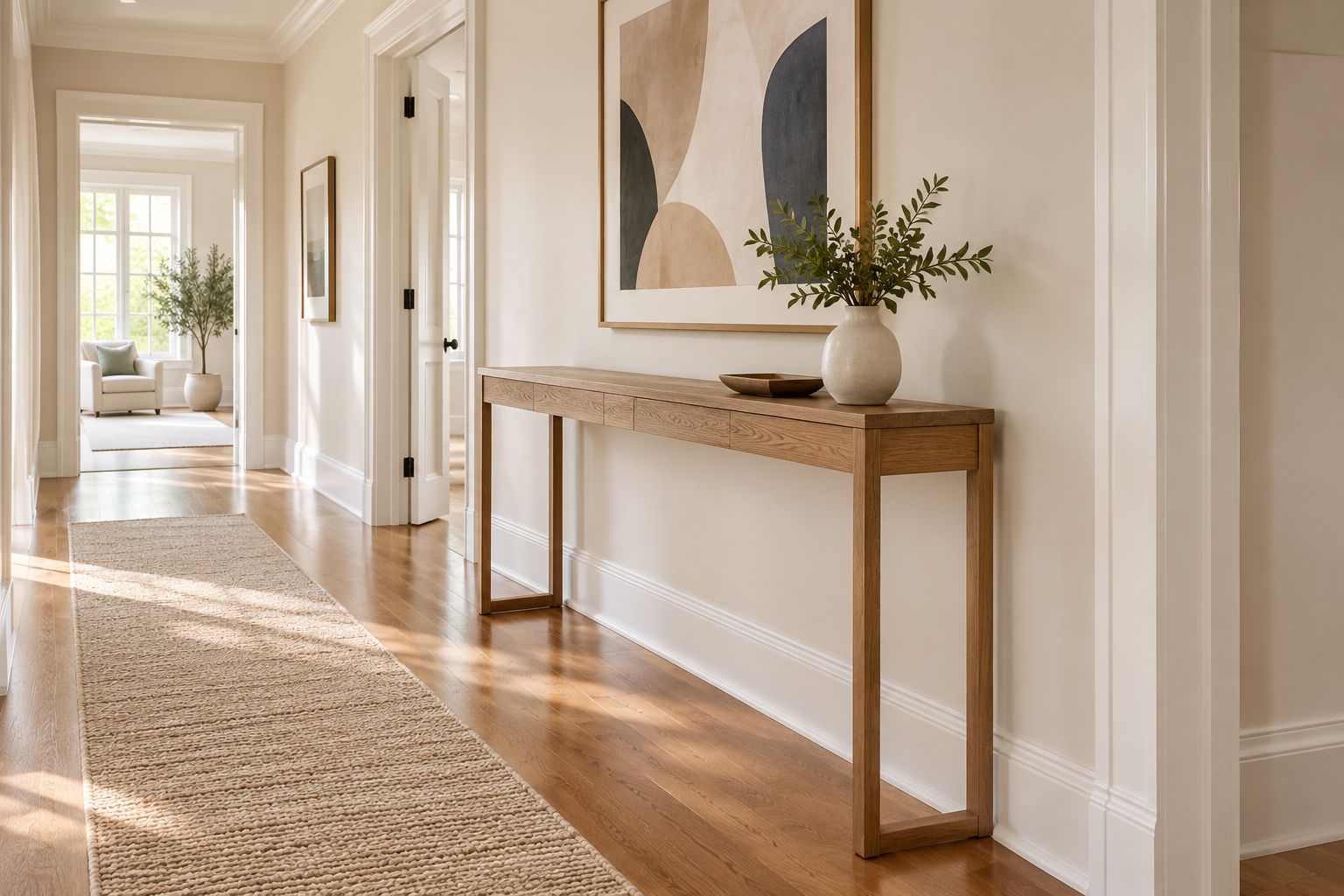
A long, shallow console addresses an extended wall without using the depth of a substantial cabinet. Its appeal is horizontal proportion: it can relate to a broad artwork or create a continuous line through a long entrance.
Length does not excuse obstruction. Position the entire table clear of door openings and examine the ends, where projecting corners can interrupt a turn into another room.
Long, shallow console pros:
- Gives an extended wall a deliberate furniture proportion.
- Separates practical and decorative areas along the top.
- Offers an alternative to a deep cabinet in a passage.
Long, shallow console cons:
- Needs enough uninterrupted wall length to sit comfortably.
- A shallow top limits the size of lamps and vessels.
Best for: An extended hallway with a continuous wall and no need for deep enclosed storage.
If stone is part of your scheme, the guide to marble console tables for a narrow hallway provides a related material-focused direction. Keep the same fit checks regardless of finish.
Verdict: Buy a long, shallow console for an extended wall; skip it where doorways break the placement.
4. Storage console: best for a household drop zone
A storage console adds drawers or enclosed compartments to the entrance. Choose this profile when the table must organise everyday belongings rather than simply display them.
The cabinet footprint is only part of the decision. You also need room to stand in front of it and operate the storage without trapping yourself between furniture and the opposite wall.
Storage console pros:
- Keeps small everyday items out of the decorative arrangement.
- Gives different household belongings defined places.
- Reduces reliance on trays and baskets across the top.
Storage console cons:
- Open drawers or doors occupy the passage during use.
- Enclosed cabinetry adds more visual weight than an open frame.
- Storage becomes unhelpful when compartments do not suit your belongings.
Best for: A household entrance where concealed organisation is a specific requirement.
For a 2026 refresh, list what will actually go inside before choosing the cabinet. Keys, mail and bags need different spaces; a shallow drawer is not a substitute for a compartment that accommodates a larger item.
Avoid adding a stool or basket below by habit. Check that every additional object stays within the furniture footprint and leaves the route clear.
Verdict: Buy a storage console for a defined organisation need; skip it if opening the storage blocks everyday movement.
5. Statement console: best for a generous foyer
A statement console gives a spacious entrance a substantial furniture anchor. Its effect can come from length, depth, sculptural form or material, rather than from size alone.
Choose it only after confirming that the foyer has room to function around the piece. A generous wall does not automatically mean a generous passage, particularly where several doors meet.
Statement console pros:
- Establishes a focal point in a broad arrival space.
- Supports a larger decorative composition.
- Relates to substantial artwork or architectural features.
Statement console cons:
- Can overpower an entrance with a restricted walking route.
- A deep top invites objects beyond your practical needs.
- Requires restraint elsewhere to avoid a crowded composition.
Best for: A foyer where the console has a distinct display zone outside the main circulation route.
In 2026, choose a statement piece because the architecture supports it, not because a smaller table looks quiet in a photograph. Leave parts of the tabletop empty so the material and silhouette remain visible.
Verdict: Buy a statement console for a genuinely generous foyer; skip it when scale competes with movement.
How this ranking works
The Elegante ranking follows usable scale from petite to statement, not a claim that larger furniture is better. Each profile has a separate role, assessed against depth, length, movement, useful surface and visual weight.
The compact console wins the default recommendation because it balances a landing surface with a restrained footprint. The petite, long, storage and statement profiles take priority when your entrance has a more specific requirement.
Check the fit before choosing the finish
For a hallway table purchase in 2026, test the proposed footprint at home before committing to the decorative scheme. Use removable tape or paper to make the furniture occupy the floor in your mind and in your routine.
- Measure the wall: Identify the uninterrupted section between openings and other fixed features.
- Mark the footprint: Represent the full depth and length, including projecting parts.
- Open the doors: Test nearby room doors and the proposed cabinet's operating space.
- Walk the route: Carry the bag or belongings you normally bring through the entrance.
- Plan the surface: Place paper templates for the intended lamp base, tray and decorative objects.
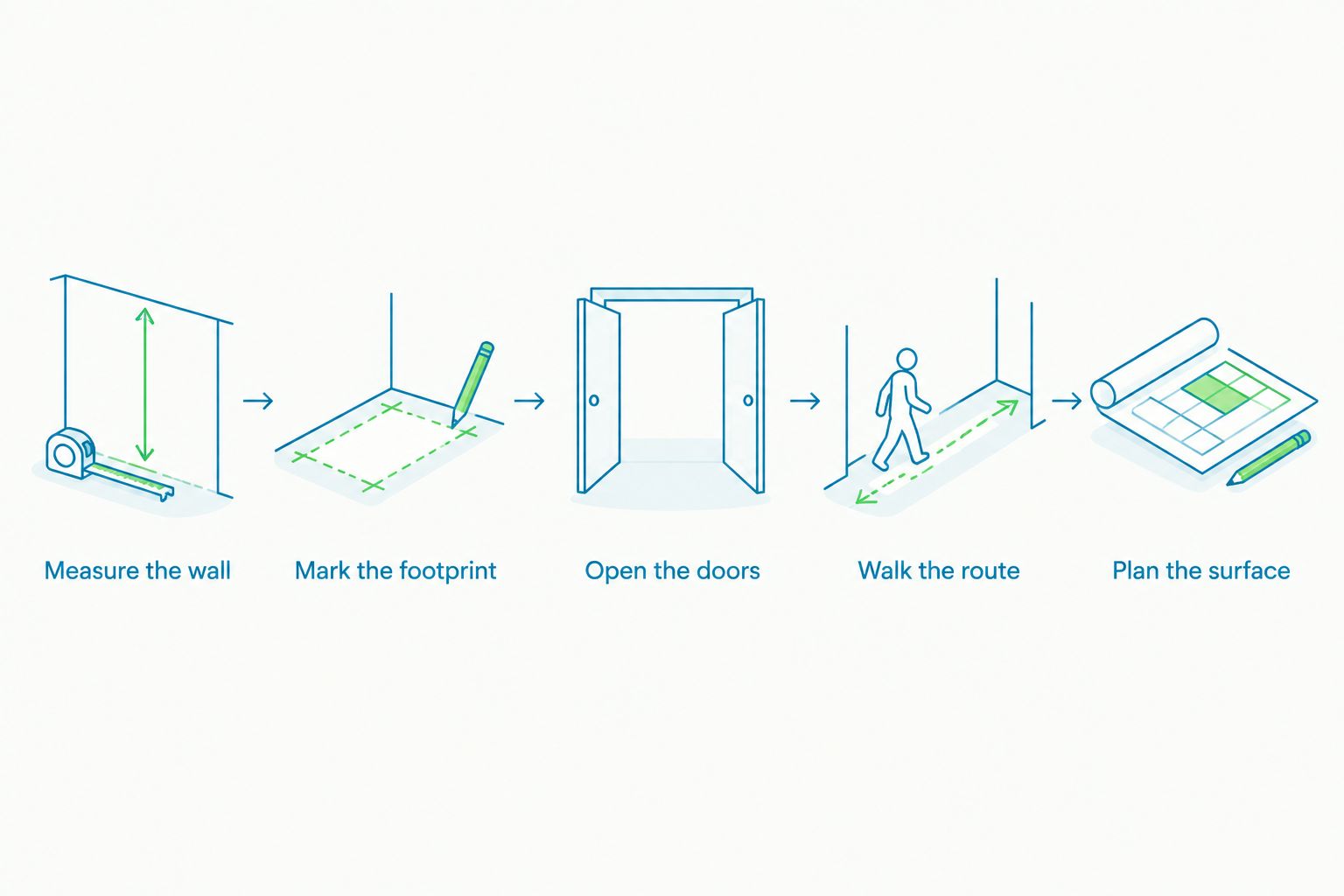
Repeat the test at the turns and pinch points, not only beside the table's centre. A comfortable straight passage does not resolve a corner that catches your bag when you enter another room.
Which hallway table should you choose?
Choose a compact, shallow console unless your entrance gives you a clear reason to choose another profile. Move smaller for a short wall, longer for an extended passage, towards storage for organisation, or towards statement scale for a generous foyer.
Then refine the finish. Timber, stone, glass and metal belong to different decorative schemes, but none changes the need for a workable footprint; choose the material after the entrance passes the practical test.
FAQ
What's the best hallway table for a small entrance?
A petite or compact shallow hallway table is the best starting point for a small entrance. Choose petite for a short wall and compact when you need a more useful landing surface. Test the full footprint against doors and your walking route.
Is a long console better than a short hallway table?
A long console is better for an extended uninterrupted wall, while a short hallway table suits a smaller placement. Depth remains a separate check. A shorter but deeper cabinet can intrude further into the passage.
How do I know whether a hallway table is too deep?
A hallway table is too deep when its footprint interferes with normal movement or door operation. Mark the proposed depth on the floor and walk past carrying your everyday belongings. Include handles and projecting parts in the test.
Can I use a bedside table in my hallway?
You can use a bedside table as a petite hallway landing surface if its full dimensions and height suit the entrance. Check depth separately rather than relying on the product name. Confirm that any drawer opens without obstructing the route.
Should I choose a hallway table with drawers?
Choose drawers when concealed storage serves a defined everyday need. Check that the compartments suit your belongings and that you can stand comfortably while opening them. An open console is simpler when display is the main purpose.
Can I put a lamp on a narrow console table?
You can put a lamp on a narrow console when the base fits securely and the shade does not intrude into the passage. Plan the cable route as well as the lamp footprint. Keep the remaining surface useful rather than filling every space.
What's the best hallway table for a large foyer?
A statement console suits a large foyer with a display zone outside the main walking route. Assess nearby doors before choosing a substantial footprint. A long shallow console is the alternative when the wall is generous but depth is restricted.
One last thing
Test the entrance with the front door open, not only closed. The arrival route is the moment that matters: a console that looks perfectly placed in a quiet room still needs to work when you step inside carrying belongings.
If the table makes you change your normal route, reconsider the footprint before adding decoration. That practical decision is the foundation of an elegant entrance.


Comments (0)
There are no comments for this article. Be the first one to leave a message!