

Best overall: a drawer coffee table. Best for occasional sofa-side tasks: a lift-top coffee table. Best for soft furnishings: a storage ottoman with a tray. This 2026 Elegante guide compares storage table designs for small living rooms, with the emphasis on usable storage, comfortable access and elegant proportions.
- Elegante’s storage table guide favours drawer coffee tables for everyday clutter in small living rooms.
- Choose lift-top storage for occasional sofa-side tasks, not simply for a larger concealed compartment.
- Round lift-off-lid tables suit corner-free layouts; opening them means clearing the top.
- Storage ottomans hold soft furnishings, but drinks need a stable tray.
Why this matters
A coffee table occupies the centre of your living room. Its storage should earn that position rather than make the space harder to use. A deep compartment has little practical value if retrieving a remote means moving a vase, books and drinks every evening.
For your 2026 shortlist, separate concealed storage, easy access and flexible surfaces. These solve different problems. Drawers hide everyday objects, shelves keep selected items within reach, and nesting tables provide extra surfaces without necessarily storing anything.
The distinction also shapes the room’s appearance. If you prefer an uncluttered, hotel-inspired interior, concealed storage supports that look; an open shelf requires deliberate editing. Elegante’s storage table recommendation is straightforward: choose the opening method before the finish.
What makes the best storage coffee table?
Assess these criteria before choosing timber, marble, glass or upholstery:
- Closed footprint: The table must leave a comfortable route between your sofa, chairs and doorway.
- Opening clearance: Check the space a drawer, raised top or lid needs, not just the closed dimensions.
- Storage access: Match the opening to how often you retrieve the contents.
- Useful compartment shape: Internal dimensions matter more than the impression of a substantial exterior.
- Surface stability: Drinks and decorative objects need a dependable surface during normal use.
- Care and construction: Read the finish-specific care instructions and inspect moving parts, edges and handles.
A compact table with accessible storage is a better fit than a larger table whose compartments stay unused. Do not assume that a substantial base contains storage, or that a nesting design includes a shelf or drawer.
Storage coffee tables at a glance
This 2026 ranking compares design types rather than claiming that particular retail models have unverified features. Within each type, check the individual product’s dimensions, construction and opening mechanism.
| Rank and design | Best for | Standout feature | Key limitation |
|---|---|---|---|
| 1. Drawer coffee table | Everyday remotes and small accessories | Concealed access without clearing the whole top | Drawers need space to extend |
| 2. Lift-top coffee table | Occasional sofa-side tasks | A raised surface above concealed storage | Moving hardware and opening clearance need checking |
| 3. Round lift-off-lid table | Layouts where projecting corners are awkward | A corner-free outline with enclosed storage | The lid must be cleared and put somewhere |
| 4. Open-shelf coffee table | Books and deliberately displayed objects | Direct access beneath a fixed top | Contents remain visible |
| 5. Trunk-style coffee table | Infrequently used bulky belongings | A deep, enclosed compartment | Top access interrupts use of the surface |
| 6. Storage ottoman with tray | Throws and other soft furnishings | Upholstered surface with concealed storage | A tray is needed for drinks |
1. Drawer coffee table: best for everyday clutter
A drawer coffee table places concealed storage beneath a fixed surface. Choose this design for remotes, charging accessories, coasters and other small objects you reach for regularly. You can open a drawer without first dismantling the entire arrangement above it.
The important detail is drawer orientation. A drawer facing the sofa is convenient only if it opens comfortably into the gap in front of your knees; a side-facing drawer needs access from that side of the room.
Drawer coffee table pros:
- Hides small objects while preserving a clear tabletop.
- Keeps separate categories of belongings organised.
- Allows access beneath a fixed upper surface.
Drawer coffee table cons:
- Drawer extension consumes space beyond the closed footprint.
- Shallow compartments do not suit bulky throws or cushions.
Best for: Small living rooms where everyday accessories create most of the clutter.
Check internal drawer measurements rather than judging capacity from the front panel. Handles should also be included in your assessment of the table’s outer profile.
Verdict: Buy a drawer coffee table as the default, provided every drawer opens freely in your layout.
2. Lift-top coffee table: best for occasional sofa-side tasks
A lift-top coffee table raises part or all of its surface, with storage beneath the moving top. It suits a living room where you occasionally want a higher surface for writing or another seated task. The mechanism, rather than the exterior style, determines how it works.
Inspect the direction of movement and the raised position. A top that moves towards the sofa needs a different opening area from one that rises vertically.
Lift-top coffee table pros:
- Combines a movable surface with concealed storage.
- Offers an alternative surface position for occasional tasks.
- Keeps the compartment hidden when closed.
Lift-top coffee table cons:
- Hinges and moving parts require inspection and careful operation.
- Objects on the moving surface need attention before opening.
Best for: A compact lounge that occasionally doubles as a task area.
Check the stated load limits and operating instructions for the exact model. A raised top is not evidence of suitability as a permanent desk, nor does it establish that the table is comfortable with your sofa.
Verdict: Buy a lift-top coffee table only when you will use the raised surface.
3. Round lift-off-lid table: best for corner-free layouts
A round lift-off-lid table encloses storage beneath a removable top. Its circular outline removes projecting corners, which is useful where your route around the sofa passes close to the table. Diameter still matters: round does not automatically mean compact.
Access is the trade-off. You need to clear the top and find a secure place for the lid before reaching inside.
Round lift-off-lid table pros:
- Avoids projecting corners around the tabletop.
- Conceals belongings inside an enclosed base.
- Provides a fixed surface when the lid is correctly seated.
Round lift-off-lid table cons:
- Opening requires clearing the removable top.
- A deep compartment makes small objects harder to organise.
Best for: Living rooms where the circulation route makes rectangular corners inconvenient.
Check the lid’s weight, grip and seating arrangement. If retrieving the contents feels cumbersome, reserve the compartment for belongings you do not need throughout the evening.
Verdict: Buy for the corner-free shape; skip if you need frequent storage access.
4. Open-shelf coffee table: best for books and display
An open-shelf coffee table adds a visible storage level beneath a fixed top. It is the simplest design here for reaching a book without opening a lid or extending a drawer. It also makes everything on the shelf part of the room’s composition.
Choose it when the objects themselves deserve to be seen. A stack of books works differently from a collection of loose cables and packaging.
Open-shelf coffee table pros:
- Gives direct access to stored objects.
- Keeps the upper surface available while you retrieve belongings.
- Supports a layered arrangement of books and selected homewares.
Open-shelf coffee table cons:
- Does not conceal visual clutter.
- Exposed shelves and their contents need dusting.
Best for: Readers who want accessible books and a deliberately styled lower shelf.
If you plan to add baskets, check their dimensions against the actual shelf opening. Containers that protrude into the walkway undermine the table’s usefulness in a small room.
Verdict: Buy an open-shelf coffee table for edited display; skip for hiding miscellaneous clutter.
5. Trunk-style coffee table: best for occasional bulky storage
A trunk-style coffee table uses an enclosed, top-access compartment beneath its surface. It suits belongings you retrieve occasionally rather than objects you need repeatedly while seated. Inspect the internal space before assuming a particular throw or board-game box will fit.
A hinged lid avoids finding somewhere to place a separate top, but its opening arc still needs room. Surface styling must also accommodate that movement.
Trunk-style coffee table pros:
- Conceals belongings in an enclosed compartment.
- Accommodates bulkier objects when internal dimensions allow.
- Provides a tabletop when closed.
Trunk-style coffee table cons:
- Access interrupts use of the top surface.
- Smaller items need organisation within a deep compartment.
Best for: Households storing occasional-use games, spare throws or similar belongings.
Check the hinge instructions and whether the lid has a stated support mechanism. Never infer lid safety from appearance alone, particularly in a household with children.
Verdict: Buy a trunk-style table for occasional storage; skip for frequently used remotes and accessories.
6. Storage ottoman with tray: best for soft furnishings
A storage ottoman places a concealed compartment beneath an upholstered top. Used with a suitable tray, it can take the place of a conventional coffee table where soft furnishings are the main storage problem. Its upholstered surface changes both the feel and function of the centre of the room.
Do not assume that every storage ottoman is approved for seating or use as a footrest. Follow the specifications for the individual piece.
Storage ottoman pros:
- Conceals throws and other soft belongings when they fit.
- Introduces upholstery into the centre of the seating arrangement.
- Provides a place for a removable tray.
Storage ottoman cons:
- Drinks need a stable tray rather than direct placement on upholstery.
- Opening the compartment requires moving the tray and its contents.
Best for: A lounge where throws are the principal source of clutter.
Choose a tray that rests securely on the actual surface. Keep the upholstery’s cleaning requirements in mind if the ottoman will sit beside drinks and snacks.
Verdict: Buy a storage ottoman for soft-furnishing storage; skip if you need an uninterrupted hard tabletop.
Check the fit before choosing the finish
For a 2026 purchase, measure the room in the arrangement you actually use. Include your armchair, sofa chaise and any doors that open into the seating area.
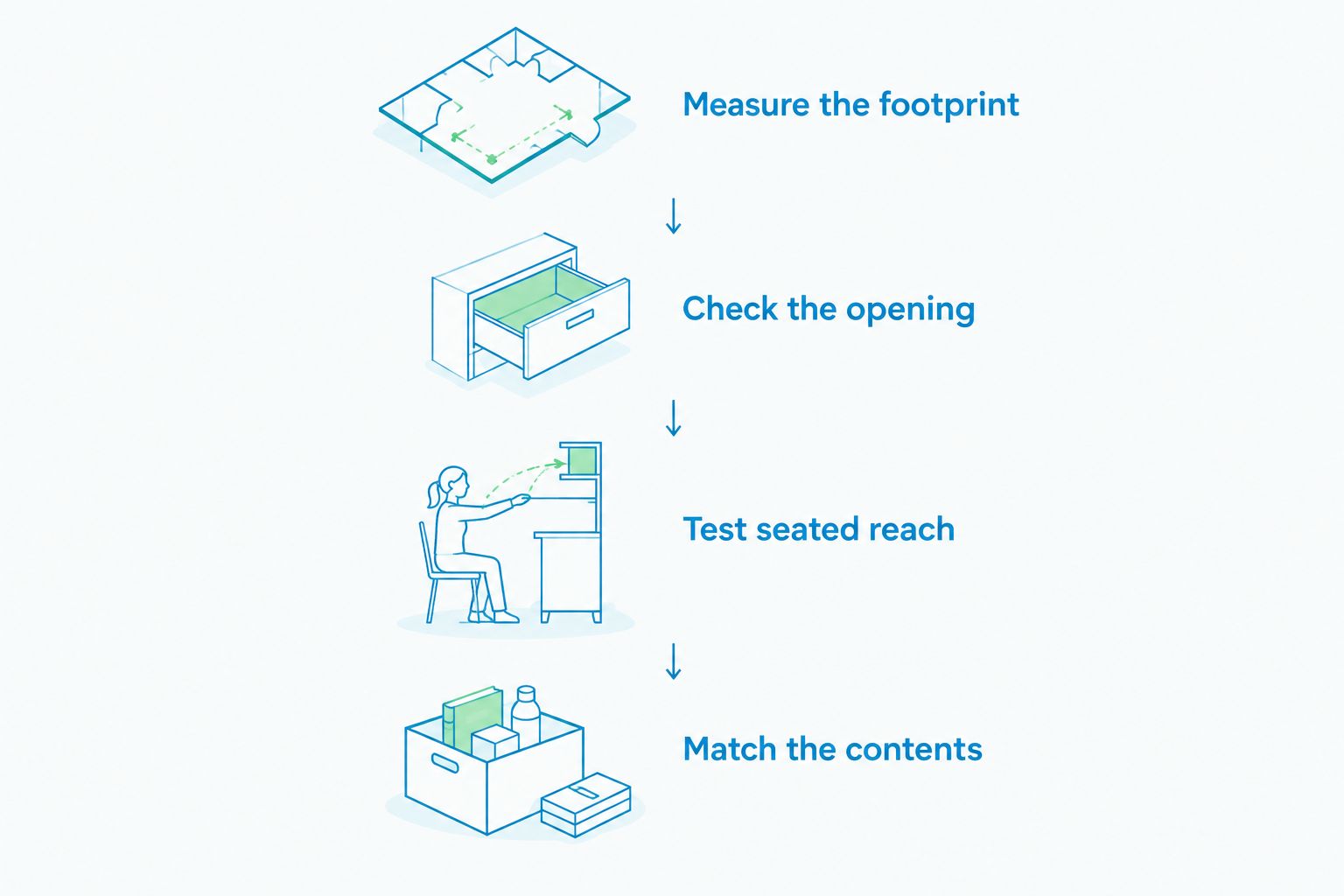
Follow this sequence:
- Measure the footprint: Mark the proposed table outline on the floor and walk around it.
- Check the opening: Extend the marked area to represent drawers or a moving top.
- Test seated reach: Sit on your sofa and assess where the surface and storage opening will sit.
- Match the contents: Compare the compartment’s internal measurements with the belongings you intend to store.
The closed footprint is only the starting point. A storage table must fit while open as well as closed.
Once the fit is right, choose the finish around your existing furniture. Timber adds a different visual character from glass or stone, but none of those materials proves that a table includes storage. For a lighter-looking arrangement, compare the styling approach in this guide to glass coffee tables for a glamorous living room.
When storage belongs beside the sofa instead
A central storage table is not compulsory. If an opening mechanism obstructs your walkway, move small-item storage beside the sofa and keep the centre simpler.
Elegante’s Nessa 45x60cm 1 Drawer Bedside Table -White/Gold is described for bedroom or living-room use. Its 1 drawer makes it a side-storage option, not a storage coffee table. The Nessa 45x60cm 2 Drawer Bedside Table - All White provides 2 drawers and is another option to assess beside seating.
Both product names carry a 45x60cm size designation. Check the full dimensions and their relationship to your sofa arm before choosing; that designation alone does not establish depth, reach or clearance.
| Side-storage alternative | Best for | Storage stated in the input | Limitation for this guide |
|---|---|---|---|
| Nessa 45x60cm 1 Drawer Bedside Table -White/Gold | A concealed drawer beside the sofa | 1 drawer | A bedside table, not a central coffee table |
| Nessa 45x60cm 2 Drawer Bedside Table - All White | Separate small-item storage beside seating | 2 drawers | Check living-room fit against full dimensions |
Buy either only as a side-storage alternative, not as a substitute selected solely by its size label. Neither product establishes which coffee table will fit the centre of your room.


How the designs are ranked
This 2026 guide ranks designs by everyday access, concealed storage, opening clearance and tabletop usability. Drawer coffee tables lead because they combine a fixed surface with accessible concealed storage. Each remaining design serves a different priority rather than claiming an inferior version of the same function.
The ranking is a design-selection guide, not a product test. Individual construction, dimensions and care requirements remain purchase checks.
Which storage table should you choose?
Choose a drawer coffee table if you are undecided. It is the clearest starting point for the everyday clutter that collects around a sofa.
Choose a lift-top design for a useful raised surface, a round lift-off lid for a corner-free outline, an open shelf for books, a trunk for occasional bulky storage or an ottoman for soft furnishings. If none opens comfortably in your layout, place storage beside the sofa instead.
Elegante’s 2026 storage table guide favours function first: the right piece should support your living room’s elegant appearance without making ordinary access a chore.
FAQ
What’s the best storage table for a small living room?
A drawer coffee table is the best default for everyday small-item storage. It combines a fixed upper surface with concealed access, provided the drawers open comfortably in your layout.
Is a lift-top coffee table better than a drawer coffee table?
A lift-top coffee table is better when you need its raised surface; a drawer coffee table is better for straightforward access beneath a fixed top. Check the lift mechanism’s movement and operating instructions before choosing.
Are round storage coffee tables better for small rooms?
Round storage coffee tables are better where projecting corners interfere with the route around seating. Their diameter and opening method still determine whether they fit the room.
Can I use a storage ottoman as a coffee table?
You can use a storage ottoman with a stable tray as a coffee-table alternative. Move the tray before opening the compartment and follow the ottoman’s stated use instructions.
Do nesting coffee tables include storage?
Nesting coffee tables do not establish that storage is included. Check the individual product description for drawers, shelves or enclosed compartments rather than treating nested surfaces as storage.
How do I measure for a storage coffee table?
Measure both the closed footprint and the space needed to open the storage. Mark the outline on the floor, test the route around it and assess access while seated on your sofa.
Can a bedside table provide storage in a living room?
A bedside table can provide side storage when its dimensions and intended use suit the room. Elegante describes the Nessa 45x60cm 1 Drawer Bedside Table -White/Gold for bedroom or living-room use; check its full dimensions against your seating.
One last thing
The most useful storage check happens before you choose a table: lay out the belongings you intend to put inside it. If the collection is mostly remotes and cables, prioritise accessible drawers; if it is mostly throws, prioritise an appropriate enclosed compartment.
Then test opening access with the tabletop styled as you intend to keep it. If every retrieval requires clearing the display, choose a different opening method.


Comments (0)
There are no comments for this article. Be the first one to leave a message!