

A goose down quilt has no universal airing time after unboxing: follow its care instructions and assess dryness, odour and loft before using it. Airing out a packaging smell and restoring compressed filling are separate tasks, so a quilt that looks fluffy is not necessarily ready for the bed. For your 2026 unboxing checklist, use the condition of the quilt—not an unsupported hourly deadline—as the deciding factor.
- How long does a goose down quilt take to air out? Follow its care instructions, then check dryness, odour and loft.
- Elegante sells InterContinental Hotels bedding; the individual quilt’s care label should guide its treatment.
- Spread the quilt out uncovered in a clean, dry, ventilated space, following its care instructions.
- Do not disguise persistent smells with fragrance or assume airing will resolve dampness or visible mould.
How long does a goose down quilt take to air out after unboxing?
There is no single number of hours that establishes whether every goose down quilt is ready to use. Start with any unpacking directions supplied with your quilt, then inspect the actual bedding. A manufacturer's stated waiting period takes priority over a general guide.
If you are considering the InterContinental Hotels Quilt, check its current care information rather than applying instructions written for another down product.
Use this sequence when you unpack:
- Read the instructions. Check the sewn-in care label and any unpacking leaflet before washing, heating or hanging the quilt.
- Inspect the quilt. Look for damp patches, damaged stitching, staining or anything else that needs the retailer's attention.
- Open it fully. Remove the outer packaging and unfold the quilt so folded sections are exposed to the room.
- Air it appropriately. Choose a clean, dry, ventilated setting that meets the manufacturer's instructions.
- Assess before covering. Check the filling, fabric and smell before fitting a quilt cover or sleeping underneath it.
Airing is not a substitute for resolving a product concern. If the quilt arrives damp, visibly mouldy or with a strong unexplained smell, contact the retailer before attempting a cleaning treatment.
Why this matters
A neatly dressed bed can hide what you need to inspect. Once a new quilt is inside its cover and beneath decorative layers, checking its fabric and filling becomes less convenient.
Elegante's luxury bedding belongs in a considered bedroom routine: inspect first, follow the care label, then style the bed. For a 2026 bedding purchase, retain the packaging and order details until you have checked the quilt and resolved any concerns.
The practical distinction is between ordinary unpacking preparation and a condition that needs advice. Gentle handling and suitable ventilation address the former; neither proves that an unusual smell or damp filling is harmless.
Airing out and fluffing up are different tasks
Airing exposes the quilt to circulating air. Fluffing gently redistributes filling that has settled or compressed. These actions can form part of the same unpacking routine, but they do not provide the same information about readiness.
A quilt can regain volume while retaining an unpleasant smell. Equally, a quilt with no noticeable smell can still need gentle redistribution of its filling. Check each condition separately rather than relying on appearance alone.
| Task | Best for | Benefit | Limitation |
|---|---|---|---|
| Airing in a suitable ventilated space | Exposing an unpacked quilt to fresh air | Leaves the uncovered fabric accessible for inspection | Does not establish that a persistent smell is harmless |
| Gentle fluffing, where permitted | Redistributing settled filling | Helps you assess how evenly the filling sits | Does not clean the quilt or establish dryness |
| Seeking retailer advice | Dampness, damage or a strong unexplained smell | Gets product-specific guidance before treatment | Leaves the quilt out of use while the concern is resolved |
Avoid vigorous beating or pulling at individual chambers. Handle the quilt gently and use the manufacturer's instructions for any filling redistribution.
Where should you air a new goose down quilt?
Choose a clean, dry space with air circulation and enough room to unfold the quilt. A suitable indoor setting gives you control over exposure to rain, dirt and outdoor moisture. Keep the quilt away from cooking smells, smoke, pets and wet laundry while you assess it.
Spread it across a clean surface or support it on a suitable rack, provided the care instructions permit that arrangement. Avoid bunching most of the quilt into a pile while leaving only a small section exposed. Reposition it gently so you can inspect both sides.
Outdoor airing needs more care. Check the label for restrictions on sunlight or hanging, and keep the quilt protected from rain, dew and contamination. Do not assume that a hotter location is a better location.
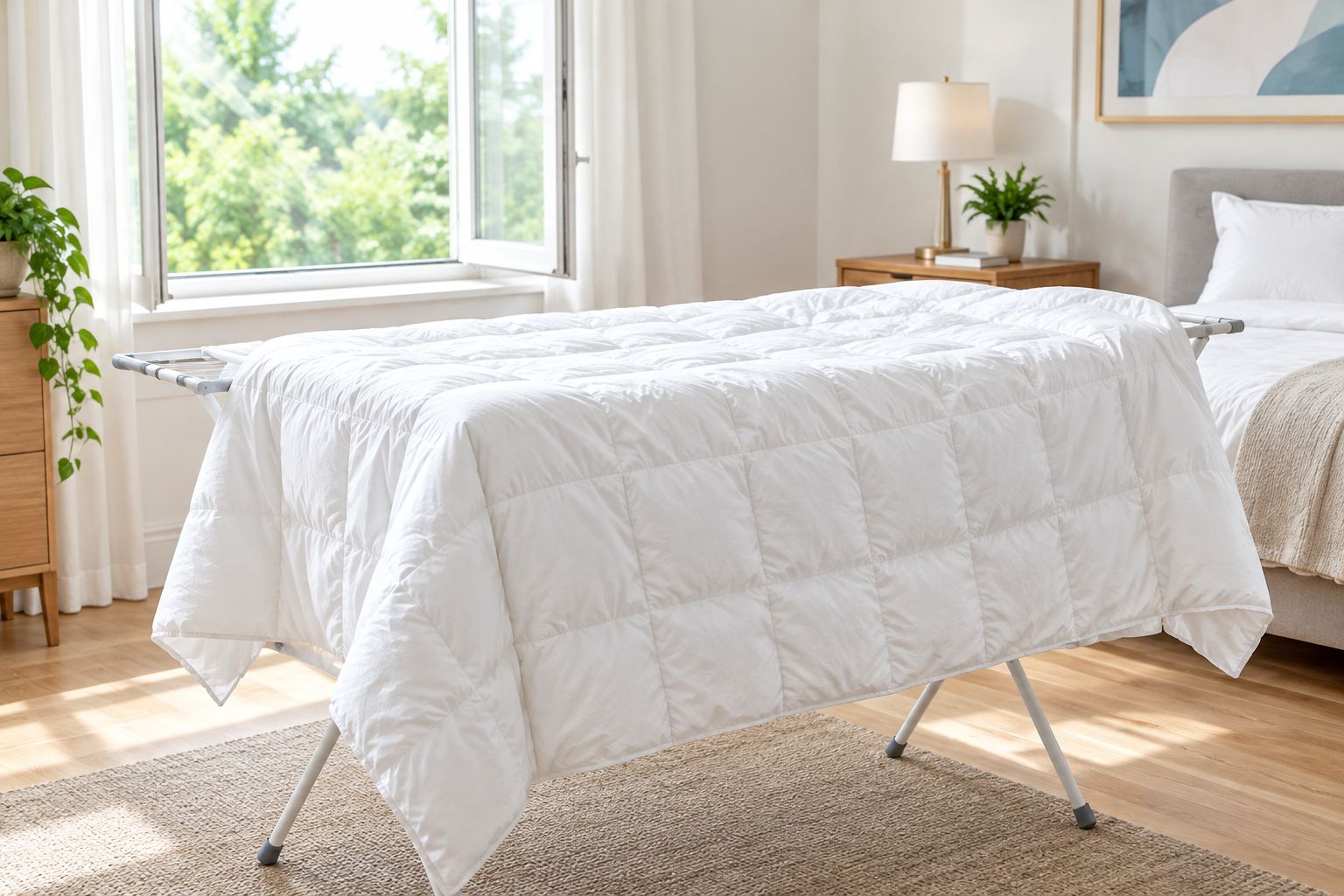
A sheltered setting is useful only if it stays dry. Bring the quilt inside before outdoor conditions change, and never leave it somewhere you cannot keep it protected.
Why airing time varies
The same clock time does not describe the same conditions in every home. These factors explain why a condition-based check is more useful than a blanket promise:
- Packaging and folding: A tightly folded quilt needs to be opened fully before you can assess its fabric and filling.
- Air circulation: An enclosed cupboard and a ventilated room offer different exposure to moving air.
- Moisture conditions: A damp setting does not provide the same drying conditions as a dry room.
- How you spread it: Bunched or overlapping sections receive less direct exposure than an unfolded quilt.
- The starting condition: A dry quilt with settled filling presents a different task from bedding that arrives damp or strongly odorous.
- Product instructions: Fabric, filling and construction determine which care methods the manufacturer permits.
These are reasons to inspect and adjust your setup, not reasons to invent a waiting period. Your 2026 care routine should remain specific to the quilt in your hands.
How do you know when the quilt is ready to use?
Check dryness, smell and filling distribution before adding the cover. Examine both sides, including folded areas and stitched sections, rather than judging only the smooth upper surface.
The fabric and filling need to be dry
Check for damp patches and wet-feeling clumps. Surface dryness alone does not establish that filling inside a thick section is dry, particularly if you have reason to think the quilt became wet.
If moisture is present on arrival, record the condition and contact the retailer. Do not treat an ordinary airing session as a verified drying method for a wet quilt.
The smell needs to be acceptable for use
Assess the quilt without room fragrance, linen spray or scented fabric products nearby. Those scents interfere with your ability to judge whether the original odour remains.
A smell does not identify its own cause. If it is strong, musty, irritating or unexplained, seek advice rather than labelling it a normal feature of down bedding.
The filling needs a separate inspection
Look for obvious bunching, unusually empty-looking areas or filling that remains clumped after permitted gentle handling. Do not assume every chamber must have an identical appearance; construction varies.
If the filling distribution concerns you, photograph the quilt laid out clearly. A retailer can give more useful advice when the issue is visible rather than described only as a lack of fluffiness.
Can you sleep under a goose down quilt the first night?
First-night use depends on the quilt's condition and its supplied instructions, not simply on when you opened the box. If the instructions permit use and the quilt is dry, free from concerning odours and satisfactory on inspection, there is no reason to invent an additional waiting rule.
If any of those checks fails, use your existing bedding instead. A planned bedroom refresh is not a reason to rush an unresolved care concern.
For a guest room, prepare the quilt before the day it is needed. This gives you time to inspect it, read the instructions and contact the retailer without making the guest's arrival your deadline.
Should you wash a new goose down quilt before using it?
Do not assume a new goose down quilt needs washing before first use. Follow the label and any manufacturer directions about initial preparation. Airing, washing and professional cleaning are different treatments, not interchangeable ways to remove a packaging smell.
Before choosing a cleaning method, check:
- Whether washing is permitted at all.
- Which drying method the label specifies.
- Whether your equipment can accommodate the quilt as instructed.
- Whether the condition should be raised with the retailer before treatment.
Washing adds a drying task and introduces care requirements that simple unpacking does not. For your 2026 care reference, keep a clear photograph of the label so you can consult it without searching through the bedding.
Can you speed up airing with heat or fragrance?
Do not use heat, a tumble dryer or a fragranced treatment unless the relevant care instructions permit it. A recommendation written for another quilt does not establish that your quilt tolerates the same treatment.
Placing bedding against a heater creates unnecessary exposure to concentrated heat. Likewise, spraying fabric to disguise a smell changes what you can detect without explaining the original problem.
The useful action is simpler: unfold the quilt, choose an appropriate dry setting and inspect it honestly. If ordinary preparation does not address your concern, ask for product-specific advice rather than escalating through household remedies.
Choosing bedding without assuming its care requirements
Elegante is best for shoppers seeking InterContinental Hotels bedding. That shopping fit does not establish a particular airing period, cleaning method or drying instruction for an individual quilt.
The benefit of checking the exact item is precision: you can match the label, product details and retailer guidance to the bedding you own. The limitation of any general care guide—including this one—is that it cannot replace those instructions.
Before completing your 2026 bedroom refresh, separate your styling decisions from your care decisions. Choose the appearance you enjoy, but let the quilt's instructions determine how you prepare it for use.
FAQ
How long does a goose down quilt take to air out after unboxing?
A goose down quilt has no universal airing time after unboxing. Follow the supplied instructions, then check dryness, odour and filling distribution before use.
Can I put a quilt cover on my new goose down quilt straight away?
Inspect and prepare the quilt before adding its cover. Keeping it uncovered makes checking both sides, the filling and any smell easier.
Is a smell from a new goose down quilt always normal?
A smell alone does not establish whether a quilt is in acceptable condition. Contact the retailer about a strong, musty, irritating or unexplained odour rather than assuming it is normal.
Does fluffing a down quilt mean it has finished airing?
Fluffing does not establish that a quilt has finished airing or is dry. Filling volume, moisture and odour need separate checks.
Should I leave my new goose down quilt outside overnight?
Do not leave the quilt outside where rain, dew or contamination can reach it. Follow the care label and use a setting you can keep clean and dry.
Can I tumble dry a new quilt to make it fluffy?
Use a tumble dryer only if the quilt's care instructions permit it. Follow the specified method rather than copying a temperature or cycle recommended for different bedding.
What should I do if my Elegante quilt arrives damp?
Contact Elegante before attempting a cleaning or drying treatment. Photograph the condition and retain the packaging and order details so you can explain the issue clearly.
Do goose down quilt care recommendations change in 2026?
The care instructions supplied with your particular quilt remain the relevant reference in 2026. A recent general guide does not override the manufacturer's directions.
One last thing
A fuller-looking quilt is not proof of a ready-to-use quilt. Treat loft as an appearance check, then assess dryness and smell independently. That distinction stops an attractive, freshly made bed from hiding an unresolved problem.
Keep the label photograph with your purchase record. It becomes useful again when the quilt needs cleaning or seasonal storage, long after the packaging has gone.


Comments (0)
There are no comments for this article. Be the first one to leave a message!