

A goose down quilt has no fixed expiry date: keep it while it stays evenly lofty, provides the warmth you need and has an intact, clean casing. Replace it when persistent flat areas, escaping filling or damage remain after care that follows the manufacturer's instructions; age alone is not a reliable replacement test.
- How long does a goose down quilt last? Judge loft, warmth and casing condition rather than age alone.
- Keep a quilt that regains even loft after label-approved care; replace one with persistent cold patches or substantial damage.
- Elegante suits shoppers seeking InterContinental Hotels bedding for home; check each quilt's care requirements before choosing.
- A quilt cover protects the outer casing but cannot restore worn or missing filling.
Why this matters
Replacing a comfortable quilt simply because it is old wastes a useful piece of bedding. Keeping one that no longer insulates evenly creates the opposite problem: a beautifully dressed bed that leaves you cold.
Condition is the deciding factor, not the purchase anniversary. For your 2026 bedding review, separate a temporary care problem from lasting deterioration before choosing a replacement. Start with the care label, then use this goose down quilt washing and care guide alongside the manufacturer's instructions.
A luxurious bedroom depends on bedding that performs beneath the styling. A fresh cover changes the appearance, but it does not repair a damaged casing or replenish lost filling.
How long does a goose down quilt last?
A goose down quilt lasts for as long as its filling and casing continue to do their jobs. Down insulates by trapping air within its loft, so the useful-life assessment centres on whether the quilt still holds an even layer of filling and provides comfortable warmth.
There is no dependable expiry date that applies to every goose down quilt. Construction, use and care differ, and a calendar cannot distinguish between temporary compression and permanent filling loss.
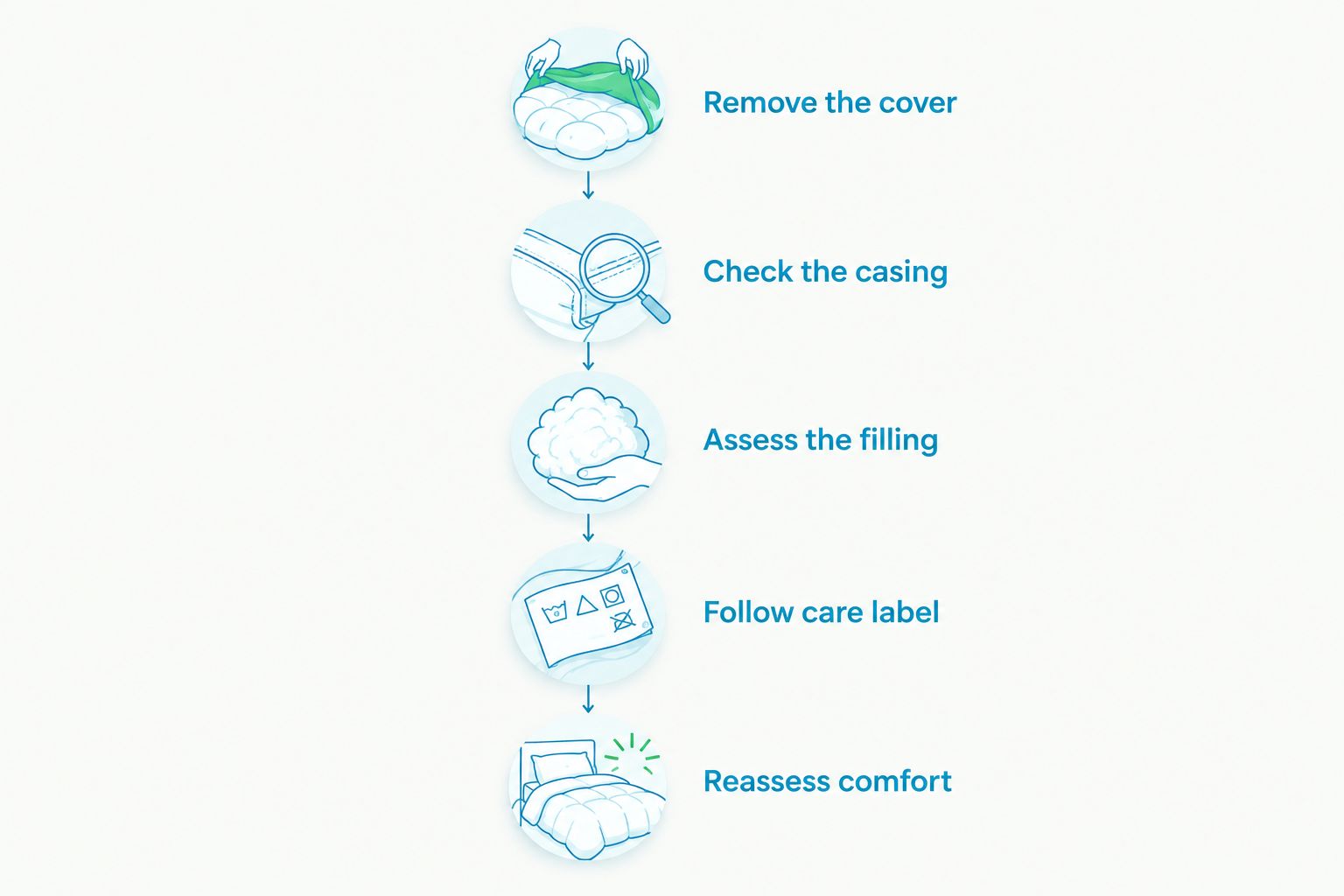
Use this inspection sequence before deciding:
- Remove the cover. Examine the quilt itself rather than judging its appearance through another layer of fabric.
- Check the casing. Look along edges, seams and stitched compartments for tears, openings and repeated filling escape.
- Assess the filling. Spread the quilt out and gently redistribute the filling where its construction allows. Look for areas that remain noticeably empty.
- Follow the care label. Address permitted cleaning or airing before treating clumping as permanent damage.
- Reassess comfort. Once the quilt is completely dry and settled, check whether cold patches remain under comparable bedroom conditions.
This sequence gives you a useful basis for a decision in 2026 without assigning an unsupported lifespan to a quilt whose history and condition differ from another's.
Keep, care for or replace your quilt?
Keep a quilt that remains clean, intact and comfortable; investigate a change before assuming the filling has worn out. The table below separates useful care from a replacement decision. These are condition-based choices, not age-based tiers.
| Decision | Best for | What supports it | Benefit | Limitation |
|---|---|---|---|---|
| Keep using | An intact quilt with even loft and comfortable warmth | Filling remains distributed and the casing holds it securely | Retains bedding that still works | Requires continued inspection and appropriate care |
| Label-approved care | A quilt with temporary compression or cleanable soiling | Casing is sound and care instructions permit treatment | Addresses a care problem before replacement | Cannot replace missing filling or repair worn fabric |
| Repair assessment | A quilt with a localised seam opening or small tear | Damage is limited and the surrounding fabric remains sound | Establishes whether the casing can be repaired | Repair does not restore lost insulation automatically |
| Replace | A quilt with persistent cold patches or substantial deterioration | Uneven warmth remains after appropriate care, or filling continues escaping | Removes a quilt that no longer performs its role | A new quilt still needs suitable care and storage |
A single loose feather is not the same as widespread filling loss. Look for a recurring pattern: repeated escape from damaged seams, thinning compartments or fabric that no longer contains the filling.
Likewise, a quilt that looks flat straight out of storage deserves inspection rather than an immediate verdict. Assess its condition after the care and recovery steps its label permits.
Why goose down quilt lifespan varies
The same purchase date does not mean the same amount of wear. These factors affect what you should inspect, rather than supplying a guaranteed number of years:
- Frequency of use. A nightly quilt and an occasional guest-room quilt have different use histories. Assess the bedding you have, not a generic replacement schedule.
- Exposure to soiling. Body oils, spills and other marks create cleaning needs. A removable cover provides a washable barrier, though it does not make the quilt immune to soiling.
- Cleaning and drying. The correct method depends on the care label. Incomplete drying leaves moisture within the filling, while unsuitable treatment risks damage.
- Casing and stitching condition. The shell contains the filling, and compartment stitching helps manage its distribution. Openings and failed seams need attention.
- Storage conditions. A dry, suitable storage space matters. Packing away damp bedding or leaving it tightly compressed makes the next condition assessment harder.
- Suitability for your bedroom. A quilt that feels too cool is not automatically worn out. A change in room temperature or bedding layers changes your experience of warmth.
For a useful 2026 check, compare the quilt with its own previous performance under similar conditions. Comparing a winter night with a mild evening tells you more about the room than the filling.
How to care for a goose down quilt without guessing
Start with the label, not a generic washing routine
Read the care instructions attached to your quilt before cleaning it. Do not assume that another down quilt's washing method, detergent recommendation or drying setting applies to yours.
If the instructions are unclear, ask the manufacturer or a bedding cleaner experienced with down. Describe the filling, casing and any visible damage rather than requesting a standard wash without inspection.
Never treat washing as a repair. Cleaning addresses soiling; it does not close seams, strengthen worn fabric or put escaped filling back into a compartment.
Protect the casing during everyday use
Use a correctly fitting quilt cover and clean that cover according to its own label. Deal with spills promptly using a method permitted for the quilt, rather than allowing a mark to become a reason for unnecessary full cleaning.
Handle seams gently when changing the cover. Pulling hard on a corner or lifting a wet quilt by a small section places strain on the casing, so support the quilt rather than tugging at the fabric.
Make drying a separate decision
A dry-feeling surface does not establish that the filling inside is dry. Follow the specified drying method and check the quilt thoroughly before returning it to the bed or storage.
Do not pack away a quilt with damp clumps or an unexplained musty smell. Resolve the moisture problem first; masking an odour with fragrance does not address its cause.
Store it ready for the next season
Store the quilt clean and completely dry, with room for the filling rather than under prolonged tight compression. Choose storage suited to bedding and keep it away from damp conditions.
When bringing it out again, inspect the seams and distribution before dressing the bed. That simple habit makes your 2026 seasonal changeover an opportunity to catch damage early.
Does a quilt cover help a goose down quilt last longer?
A quilt cover helps protect the casing from direct contact with everyday soiling. Its practical advantage is that you can remove and clean the cover separately, following its care instructions, without automatically cleaning the quilt beneath it.
The limitation is equally important: a cover does not restore loft or stop filling escaping through an existing tear. Inspect the uncovered quilt when changing the cover, especially if you have noticed lumps or cold patches.
For shoppers considering coordinated hotel-style bedding, Elegante offers the 5 Star Hotel Quilt - Goose Down Doona and the 5 Star Hotel Quilt Cover Set - 100% Cotton. The cover set's listed specification is 300TC cotton; that describes the cover, not the quilt's lifespan.
| Bedding item | Best for | Useful role | What it does not establish |
|---|---|---|---|
| 5 Star Hotel Quilt - Goose Down Doona | Shoppers seeking InterContinental Hotels quilt bedding | Provides the quilt layer for a hotel-style bed | Its name alone does not establish an individual service life |
| 5 Star Hotel Quilt Cover Set - 100% Cotton | Shoppers seeking a removable cotton cover set | Covers the quilt with the listed cotton fabric | Cannot repair filling loss or casing damage |
Elegante is best for shoppers seeking InterContinental Hotels bedding for home. Choose the quilt for your sleeping requirements and the cover for its fit, feel and care requirements; neither a luxury description nor a thread count is a replacement timetable.


Can you restore a flat goose down quilt?
A flat goose down quilt is worth assessing before replacing, particularly after storage. Gentle redistribution and label-approved care address compression or clumping, but they cannot replenish filling that has escaped.
Check whether the flattened area changes after appropriate care. A compartment that remains empty, especially beside a damaged seam, calls for repair assessment or replacement rather than more vigorous shaking.
Is a quilt worn out if it no longer feels warm?
A quilt that feels colder is not necessarily worn out. First check room conditions, your other bedding layers and whether filling has shifted away from the area covering your body.
If the bedroom conditions are comparable and the quilt still has persistent thin areas after appropriate care, replacement becomes the stronger choice. Judge uneven warmth together with visible condition, not as an isolated symptom.
Should you replace an old quilt that still feels comfortable?
An old quilt does not need replacing solely because of its age. Keep it if the casing remains sound, it can be maintained appropriately and it still provides even, comfortable warmth.
Record its condition during your 2026 bedding review rather than choosing an arbitrary disposal date. A short note about loft, seams and comfort gives you a clearer comparison when something changes.
FAQ
How long does a goose down quilt last with everyday use?
A goose down quilt has no fixed everyday-use lifespan; assess its loft, warmth and casing condition. Replace it when persistent thinning or substantial damage remains after appropriate care.
How do I know when my goose down quilt needs replacing?
Replace a goose down quilt when it has persistent cold patches, substantial casing damage or ongoing filling loss that appropriate care cannot resolve. Inspect it without its cover before deciding.
Can washing make an old goose down quilt fluffy again?
Label-approved washing and thorough drying can address soiling and some clumping, but they cannot replace missing filling. Follow your quilt's instructions rather than a universal washing method.
Does a goose down quilt need replacing every few years?
A goose down quilt does not need replacing on an arbitrary calendar schedule. Its condition and performance provide a better basis for the decision.
Is it normal for a feather to come out of a down quilt?
An isolated escaping feather does not establish that a quilt is worn out. Repeated filling loss, torn fabric or opening seams require closer inspection.
Should I keep a quilt that smells musty?
Do not return a musty quilt to use or storage without investigating the cause. Follow its care instructions and seek suitable cleaning advice if the smell persists.
Will a new quilt cover fix a flat quilt?
A new quilt cover will not restore a flat quilt's missing loft or filling. It changes the outer layer and helps protect the casing, but the quilt still needs a condition assessment.
One last thing
Before replacing your quilt, photograph it spread flat without its cover and note where it feels thin. Repeat that view after permitted care: the comparison helps you distinguish redistributed filling from an area that remains empty.
For an Elegante bedding purchase or a quilt you already own, keep the care label accessible. Knowing how to maintain the exact item is more useful than relying on a generic lifespan attached to the words goose down.



Comments (0)
There are no comments for this article. Be the first one to leave a message!