

Instead of repeatedly checking individual pieces and rebuilding client schedules, prepare a project brief and request written confirmation of trade eligibility and terms before placing an order. For Elegante trade pricing, interior designers should separate product selection, supplier confirmation and client approval into a documented purchasing workflow.
- Elegante trade pricing: interior designers should request written eligibility and project terms before committing clients.
- Build a product schedule with exact links, variants, quantities and delivery details.
- Separate supplier confirmation from client approval; neither replaces the other.
- Reconfirm changed selections rather than carrying earlier terms into a revised order.
Why this matters
Elegante is best suited to interior designers sourcing hotel-style bedding alongside furniture and homewares. Its range gives you a starting point for a coordinated bedroom scheme, but product selection and commercial approval are separate decisions.
Start with the Elegante catalogue to identify relevant pieces. Then build your enquiry around a defined project rather than a general request for designer benefits.
For a 2026 project, keep the supplier response with the exact schedule it addresses. A response about one selection does not establish the terms for every later purchase, and a client-approved mood board does not authorise you to substitute products.
The advantage of this workflow is traceability: you can show what you requested, what was confirmed and what the client approved. The limitation is equally clear: a well-prepared enquiry does not itself establish eligibility or create a trade agreement.
Before you start
- Prepare your business details. Have your trading name, business contact details, project type and purchasing role ready. Supply business registration or professional documentation if requested; do not assume a particular credential guarantees approval.
- Prepare a working product schedule. Record exact product links, selected variants, quantities, room allocations and the intended delivery address. Keep your client brief and measurements beside the schedule.
- Resolve the purchasing identity first. Decide whether your studio or your client will place the order. Ask Elegante whether any proposed terms apply to that purchaser and project before relying on them in a client proposal.
That last point prevents a difficult handover. Your studio's enquiry and a client's eventual purchase are not automatically the same transaction, so establish the intended arrangement at the beginning.
This guide uses a project document rather than an assumed trade portal. Use the enquiry method provided on the retailer's current website, and follow any application instructions supplied in response.
Project brief and product schedule
Your first configuration unit is the project record. Make it specific enough that the supplier can identify the selection without interpreting a mood board or searching through an email chain.
- Define the project. State whether you are furnishing a private home, styling a property or specifying a commercial interior. Describe the rooms involved and identify who will approve the purchase.
- Record the selections. Copy each product's exact title and URL into your schedule. Add the variant you intend to specify rather than relying on a photograph alone.
- Allocate quantities. Assign each item to a room or purchasing package. Separate confirmed requirements from optional additions.
- Check measurements. Record the relevant bed, mattress, table or room measurements beside the selection. For furniture, include access constraints that need clarification before ordering.
- Name the revision. Label the document with the project name, 2026 and a revision identifier. Use the same identifier in your enquiry and client approval record.
For an illustrative bedroom schedule, 3 bedrooms with 2 sleeping pillows each require 6 sleeping pillows. Decorative cushions and spare linen are separate lines, not an unexplained increase in the sleeping-pillow quantity.
Expected result: you have a room-by-room schedule that another person can read without asking which piece, variant or quantity you intended.
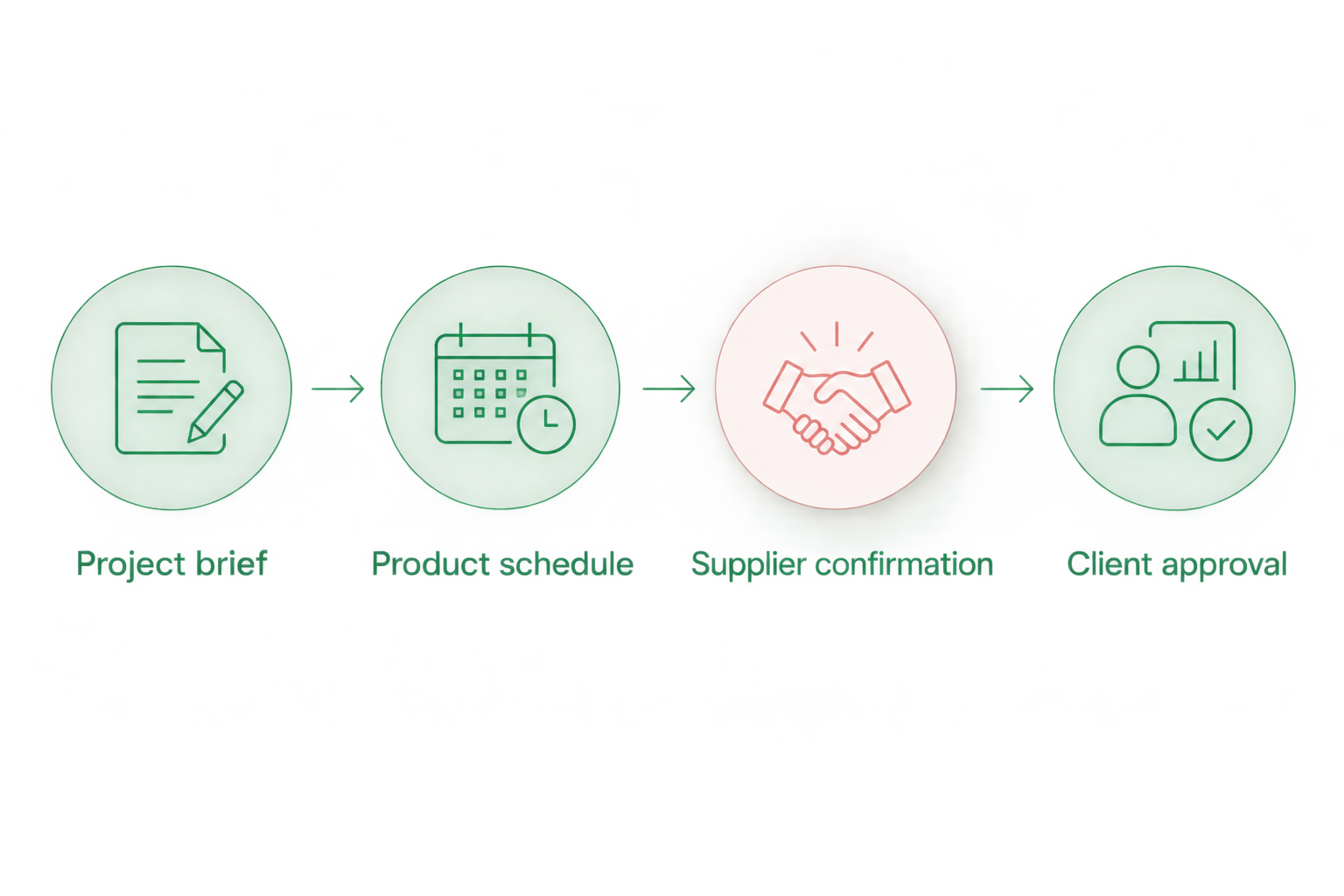
Keep the sequence visible in your project folder: Project brief, Product schedule, Supplier confirmation, Client approval. These are separate records, even when you manage them in a single document.
Trade eligibility and enquiry
Ask whether a trade arrangement applies before asking how to use it. This keeps the enquiry factual and prevents your proposal from presenting an unconfirmed benefit as part of the project.
- Introduce your business and role. Explain that you are an interior designer or stylist enquiring about a defined project. State whether you intend to purchase through your studio or have the client purchase directly.
- Ask about eligibility. Request the current application process, supporting documentation and any conditions attached to approval. Provide additional information through the method specified in the response.
- Attach the product schedule. Identify the exact revision being submitted. Ask whether the proposed arrangement covers the listed bedding, furniture and homewares rather than assuming uniform treatment across categories.
- Request written project terms. Ask the supplier to identify the covered products, purchasing entity, ordering process and any conditions relevant to your selection. Request clarification of delivery, returns and cancellation terms before committing the client.
- Record unresolved questions. Keep unanswered points in a separate list. Do not turn an acknowledgement of your enquiry into an approval record.
A useful enquiry asks Elegante to confirm whether the business and project qualify, which selections are covered, and how the approved purchaser should proceed. Keep your client presentation separate from this request.
Expected result: you have either written instructions for the next stage or a clear list of questions requiring a response. You have not promised the client an arrangement that the supplier has not confirmed.
For your 2026 procurement file, save the response date and the schedule revision together. This makes later changes easier to identify without treating correspondence as a permanent entitlement.
Supplier confirmation and client approval
Once you receive a response, reconcile it against your schedule line by line. Do not approve the package merely because the overall description sounds right.
- Match the products. Check titles, variants and quantities against the submitted schedule. Resolve substitutions and omissions explicitly.
- Match the purchaser. Confirm that the business or individual placing the order matches the arrangement described in the supplier's response. Clarify a change of purchaser before proceeding.
- Check the transaction conditions. Read the applicable payment, delivery, returns and cancellation information. Ask which conditions govern your specific purchase where the correspondence is unclear.
- Separate your service scope. Tell the client whether your role includes selection only, procurement administration, delivery coordination or installation styling. Obtain approval for your responsibilities separately from approval of the goods.
- Obtain written client approval. Present the final selection and relevant conditions, then save the client's approval against that same schedule revision.
Expected result: supplier confirmation and client approval refer to the same products, purchaser and project scope. Any remaining uncertainty is visible rather than buried in an email thread.
Choose the purchasing route deliberately
Use this comparison to structure the conversation, not as a statement that either route receives trade treatment. Confirm the permitted route with the supplier.
| Purchasing route | Best for | Advantage | Limitation | Confirm before proceeding |
|---|---|---|---|---|
| Studio purchase | Designers managing procurement for the client | Keeps ordering records with the studio's project administration | Gives the studio responsibility for the purchasing tasks it accepts | Purchasing entity, applicable terms and the studio's agreed client responsibilities |
| Client purchase | Selection-only design engagements | Lets the client retain direct purchasing records | Requires a clear handover so the client selects the approved variants | Whether the proposed arrangement applies when the client purchases |
Neither route is inherently better. Choose the route that matches your engagement and the supplier's written instructions, then document where your responsibilities end.
Order instructions and project handover
The final configuration unit turns an approved selection into a controlled purchasing instruction. Keep design preferences and purchasing authority distinct.
- Freeze the approved revision. Mark the agreed schedule as approved and retain an unchanged copy. Create a new revision for subsequent alterations.
- Follow the confirmed ordering method. Use the process supplied for your enquiry. Do not assume that a general customer account or an ordinary checkout applies a separate commercial arrangement.
- Review the order record. Compare the purchasing record with the approved schedule before authorising the transaction. Stop if the product, quantity, purchaser or conditions differ.
- Prepare the receiving instructions. Identify who will receive the goods and who will compare them with the order. Include the relevant room allocation in your internal handover.
- Archive the evidence. Keep the enquiry, supplier response, client approval and order record together in the 2026 project folder.
Expected result: the order follows the approved selection, and your receiving contact knows which project and room each item belongs to.
Do not use the styling presentation as the receiving checklist. A room image communicates the scheme; an itemised schedule communicates what was ordered.
Update the enquiry when a client changes the scheme
Use a revised enquiry whenever the client changes quantities, variants, categories or the purchasing entity. The earlier response belongs to the earlier scope unless the supplier confirms otherwise.
- Duplicate the approved schedule and give the copy a new revision identifier.
- Mark additions, removals and substitutions clearly; do not rely on colour alone to explain changes.
- Ask the supplier to confirm the revised selection and identify any changed conditions.
- Obtain fresh client approval for the altered scope before purchasing.
For a staged 2026 project, keep the initial bedroom package separate from later living-room additions. Related rooms still need distinct purchasing records when their selections and approvals happen separately.
This variant is useful for repeat room schemes too. Reuse the document structure, not the assumption that a previous response covers the next project.
Troubleshooting
You cannot identify a trade application route
Use the retailer's current enquiry method and ask for the appropriate process. Do not submit business documents to an unrelated channel or assume that creating a customer login establishes trade status.
The response does not address every product
Return the schedule with the unresolved lines identified. Ask for confirmation against those exact products rather than interpreting a general response as category-wide approval.
The client wants to place the order instead
Pause the handover and clarify the purchasing entity. Ask whether the proposed arrangement applies to a client purchase, then update the project record and your service responsibilities accordingly.
The client changes the size or finish after approval
Create a revised schedule and request confirmation for the changed selection. Do not overwrite the approved document or treat visually similar products as interchangeable.
The order record differs from the approved schedule
Stop before authorising the transaction. Reconcile the mismatch with the supplier and obtain renewed client approval if the selection or relevant conditions have changed.
Customise your workflow
Expand the schedule beyond product selection by adding room allocation, measurement checks, approval status and receiving responsibility. Keep private client information out of documents that do not require it.
For a furniture-led project, use the guide to furniture for interior designers and stylists to develop your specification questions. Carry the final decisions back into the same project schedule rather than maintaining competing versions.
For bedding, separate the aesthetic brief from the user's practical preferences. Confirm sizing, desired feel and care requirements before presenting a coordinated scheme as final.
FAQ
How do interior designers get Elegante trade pricing?
Request written confirmation of trade eligibility, the application process and the terms for your specific project. Submit a product schedule and confirm the purchasing entity before relying on any proposed arrangement.
Does being an interior designer automatically qualify me for trade terms?
Do not treat your professional role as automatic approval. Ask the retailer to confirm eligibility and any required supporting documentation before committing your client.
What should I include in a designer trade enquiry?
Include your business details, project type, purchasing role and an itemised product schedule. Record exact product links, variants, quantities and relevant delivery details so the enquiry has a defined scope.
Can my client place the order after I make the enquiry?
Confirm the client-purchase route with the supplier before handing over ordering instructions. An enquiry made by your studio does not establish that the same arrangement applies to a different purchaser.
Should bedding and furniture go in the same request?
List bedding and furniture together when they belong to the same project, but ask for confirmation against each selection. A combined schedule does not establish identical conditions across product categories.
What happens if my client changes the selection?
Create a revised schedule and request confirmation for the changed scope. Obtain fresh client approval before purchasing, and retain the earlier version as part of the project record.
One last thing
The most useful trade enquiry starts with the purchaser's name, not the mood board. Establish who is buying, then attach the exact selection and ask which terms apply. That single discipline keeps your supplier correspondence, client agreement and order record aligned.


Comments (0)
There are no comments for this article. Be the first one to leave a message!