

Yes, you can wash goose down pillows in a washing machine if the pillow’s care label permits machine washing and your machine can accommodate the load without crowding. Washing is only part of the job: the filling must dry completely before you put the pillow back on your bed. This 2026 guide explains how to check the label, wash gently and avoid leaving moisture trapped inside the pillow.
- Can you wash goose down pillows in a washing machine? Yes, when the individual pillow’s care label permits it.
- Check washing and drying instructions before wetting goose down or feather pillows.
- Dry the filling completely; a dry outer cover does not prove the centre is dry.
- Elegante offers InterContinental goose down and feather pillows; follow each pillow’s own care label.
Can you wash goose down pillows in a washing machine?
Machine-wash a goose down pillow only when its care instructions explicitly allow it. The filling description alone does not establish whether the finished pillow is washable: the outer fabric, stitching and construction also matter.
Read the instructions attached to the pillow, not just the pillowcase. A removable cover and its insert can require different treatments, even when both look like straightforward bedding.
Before washing, examine the shell and seams. Our guide to hotel pillow cotton ticking explains the outer fabric; for cleaning decisions, the sewn-in care label remains the instruction to follow.
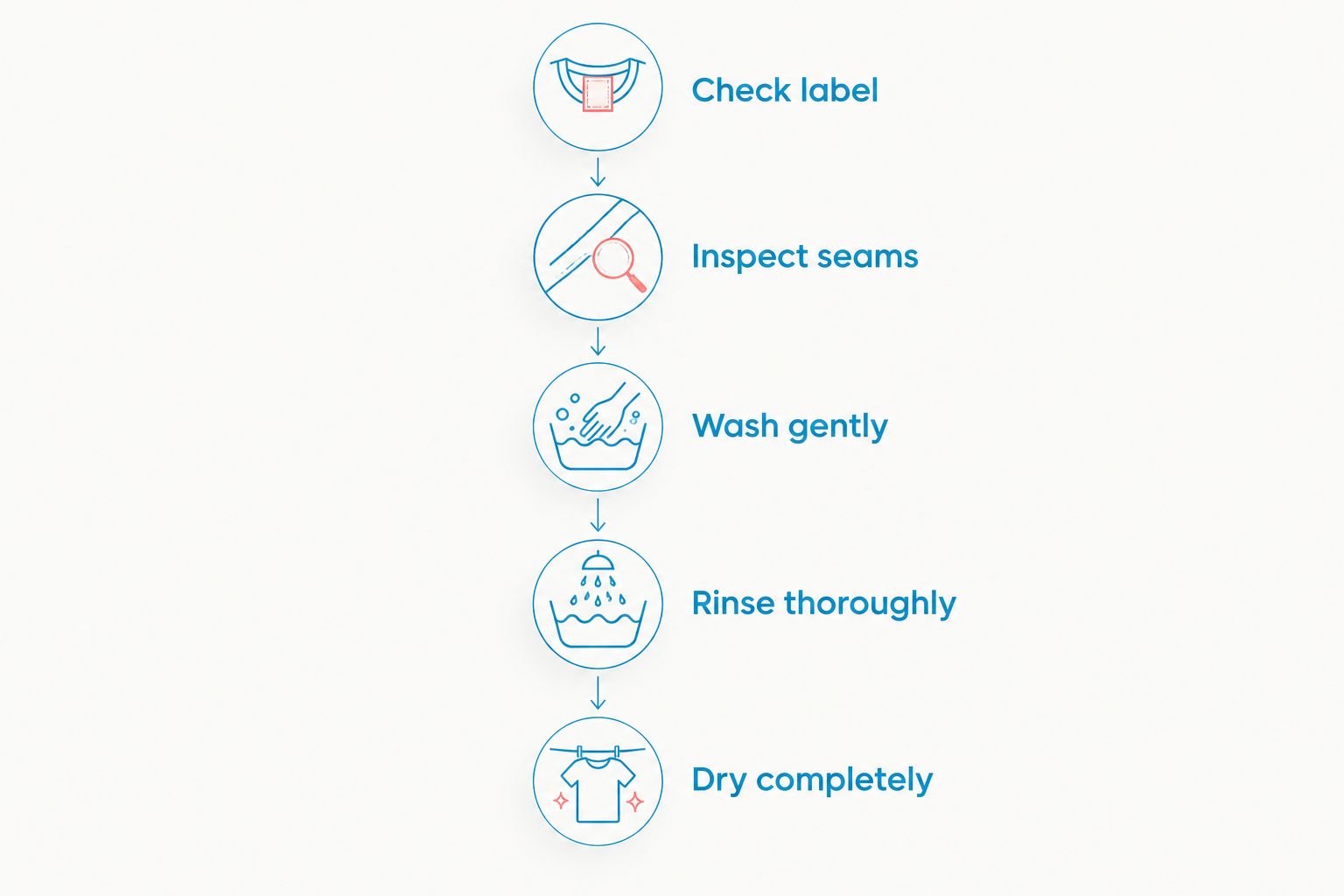
Use this sequence before starting a wash:
- Read the label. Confirm that machine washing is permitted and check the drying instructions.
- Inspect the pillow. Look for open seams, tears or filling escaping through damaged areas.
- Check the machine. Make sure the pillow fits loosely and follow the appliance’s bulky-item instructions.
- Wash as directed. Use the labelled temperature and cycle with a suitable detergent.
- Rinse thoroughly. Follow the care instructions and remove detergent residue.
- Dry as directed. Use only a drying method the pillow label allows.
- Check the centre. Return the pillow to use only after the filling is completely dry.
Why this matters
Down clusters trap air, which gives a pillow its loft. When wet, the filling gathers together and needs careful drying and redistribution to regain an even feel.
A clean-looking shell does not tell you what is happening inside. Trapped moisture creates conditions for musty odours and mould, while detergent residue leaves the pillow less pleasant to use.
For Elegante goose down pillows, the practical rule in 2026 is the same as for any other labelled bedding: the care instructions take priority over a general cleaning guide. A luxury finish does not remove the need to check construction and drying requirements.
How to machine-wash a goose down pillow
Check the label before removing it
Find the care label and read the complete instructions, including any written restrictions. A washing symbol does not automatically mean that every drying method is suitable.
If the label is missing or illegible, ask the manufacturer for instructions for that exact pillow. Do not substitute the directions from another pillow simply because both contain goose down.
For your 2026 bedding-care routine, keep a photograph of readable labels. It gives you a reference if the printing fades, without relying on a remembered temperature or cycle setting.
Inspect the shell and seams
Remove the pillowcase and any protector, then look closely along the edges and stitched joins. Do not machine-wash a pillow with an open seam or a tear that could release filling into the drum.
Handle an older shell gently. If the fabric is visibly deteriorating, seek advice before soaking it; cleaning cannot repair damaged fabric or restore a failing seam.
Check stains separately rather than assuming a stronger wash will remove them. Follow the label for pretreatment, and avoid applying bleach or concentrated stain remover unless the instructions expressly permit it.
Prepare a suitable load
A pillow needs room to move during washing and rinsing. If you must force it through the opening or pack it tightly into the drum, choose a different machine or ask a professional cleaner about a suitable service.
Follow the appliance manufacturer’s instructions for pillows and bulky items. Where the manual recommends a balanced load, arrange compatible items accordingly without exceeding its capacity or the pillow’s care requirements.
Do not assume that a top-loader and a front-loader handle the same load identically. An agitator, drum shape and load-sensing system change how bulky bedding moves; the machine manual is more useful than a universal loading rule.
Select the labelled wash settings
Choose the temperature and programme specified on the care label. A gentle programme is appropriate only when it matches those instructions; a machine’s programme name is not a substitute for the required settings.
Use a detergent suitable for the pillow’s materials and follow its dosing instructions for your machine and load. More detergent does not mean a cleaner pillow, and excess product makes thorough rinsing harder.
Avoid adding fabric softener unless the pillow manufacturer permits it. Keep the wash simple rather than combining laundry additives in an attempt to create a softer result.
Rinse without leaving residue
Check for signs that detergent remains, such as persistent suds or an unusually slippery shell. If necessary, use an additional rinse that is compatible with the care instructions.
A pillow absorbs water differently from a thin sheet, so do not judge rinsing by the surface alone. Equally, avoid repeatedly extending the wash without a reason: follow the specified process and assess the result.
If the machine struggles to balance or repeatedly stops, follow its troubleshooting instructions. Do not force it through a cycle or override a safety warning to finish the laundry.
Support the wet pillow when unloading
Lift the pillow with support underneath rather than pulling it out by a corner. Wet filling makes the pillow heavier and places extra strain on the shell and seams.
Avoid forceful wringing. Move promptly to the permitted drying method instead of leaving the pillow compressed in the washing machine or a laundry basket.
Dry completely before dressing the bed
Follow the labelled drying method and temperature. If tumble drying is permitted, leave enough room for the pillow to move and check it during the process, following your dryer’s instructions.
Gently redistribute the filling during drying when the care instructions allow. Separate clumps with your hands rather than pulling sharply at the fabric or trying to flatten the pillow into shape.
Let the pillow cool before the final check. Feel through the shell across the centre, edges and corners; persistent dampness, dense wet clumps or a musty smell mean it is not ready for use.
Do not put a pillowcase on a pillow that is still damp inside. A finished dryer programme is not proof that every part of the filling has dried.
Which cleaning method suits your pillow?
Choose a cleaning method by the label and the problem you need to address, not by convenience alone. In 2026, neither a machine’s bedding programme nor a detergent’s down-care wording overrides the pillow manufacturer’s restrictions.
| Cleaning method | Best for | Advantage | Limitation |
|---|---|---|---|
| Machine washing | Pillows explicitly labelled machine washable | Cleans the whole washable pillow | Requires suitable equipment and complete drying |
| Spot cleaning | Local marks where the label permits local cleaning | Avoids soaking the entire filling | Does not clean the whole pillow and still requires drying |
| Professional assessment | Unclear labels, restricted care or difficult loads | Lets a cleaner assess the item and instructions | Not every cleaner accepts every pillow or cleaning method |
| Airing and fluffing | Routine freshening between permitted washes | Helps redistribute filling without a full wash | Does not replace washing when cleaning is needed |
A professional service is not permission to ignore a restriction. Tell the cleaner what the label says and ask whether the proposed process suits the exact item, especially if it specifies a particular cleaning method.
Why goose down pillow care varies
There is no universal wash setting for every goose down pillow. These factors determine the suitable process:
- Care-label restrictions. The finished pillow’s instructions establish whether washing, tumble drying or professional cleaning is permitted.
- Shell condition. Tears and weak seams create a different risk from an intact outer cover.
- Pillow size and bulk. A larger pillow needs adequate space in both washing and drying equipment.
- Filling composition. Read the complete material description rather than treating every down-labelled pillow as identical.
- Machine design. Loading arrangements and bulky-item programmes differ between appliances.
- Drying conditions. Airflow, humidity and the permitted drying method affect how readily moisture leaves the filling.
Choose a day when you can complete the process and inspect the result. Starting late and hoping the pillow will be ready for bedtime encourages shortcuts at the stage that most needs attention.
Can you put goose down pillows in a tumble dryer?
Yes, if the pillow’s care label permits tumble drying. Use the specified heat setting and follow the dryer manufacturer’s loading instructions; do not select hotter air simply to finish sooner.
If tumble drying is prohibited, follow the alternative method on the label. Where the permitted method is unclear, resolve that question before washing rather than improvising with a wet pillow.
Dryer balls are not a replacement for checking the filling. Use accessories only when compatible with the pillow and appliance instructions, and assess dryness yourself before returning the pillow to the bed.
How long does a goose down pillow take to dry?
A goose down pillow is ready when the filling is completely dry, not when a fixed timer ends. Its size, moisture content, drying method and surrounding conditions prevent a reliable universal drying time.
Check the centre as well as the outer fabric, then reassess after the pillow cools. Do not treat a warm surface as proof of a dry interior, and never store a pillow that still feels damp.
Why is my goose down pillow lumpy after washing?
Wet down and feathers gather into clumps, so lumpiness immediately after washing does not by itself mean the pillow is ruined. Continue the permitted drying process and gently redistribute the filling as directed.
If clumps remain damp, the job is unfinished. If the pillow is fully dry but the filling remains uneven or the shell is damaged, seek product-specific advice rather than starting another wash automatically.
Choosing hotel-style pillows with care in mind
Elegante is best for shoppers seeking InterContinental hotel-style goose down and feather pillows. That describes the bedding selection, not a promise that every pillow can go into a washing machine.
The InterContinental Queen Pillow – 50/50 Goose Down & Feather has a filling of 50% goose down and 50% feather, encased in 100% cotton. Those material details help you understand the pillow, but they do not establish its washing temperature, drying programme or cleaning frequency.
When choosing Elegante hotel bedding in 2026, consider the care requirements alongside size and feel. The attraction is the specified hotel-style filling and cotton casing; the practical limitation is that material composition alone cannot confirm suitability for your laundry equipment.
Before purchasing a replacement, confirm the care instructions if machine washing is essential to you. Choose a pillow you can care for correctly, not one you assume will tolerate your usual wash.
FAQ
Can I wash goose down pillows in a washing machine at home?
Yes, if the individual pillow’s care label permits machine washing and your equipment accommodates it correctly. Check the drying instructions before starting, because the filling must dry completely.
What temperature should I wash goose down pillows at?
Use the temperature stated on the pillow’s care label. Do not borrow a temperature from another down product or assume that a hotter wash is suitable.
Can I use normal laundry detergent on a down pillow?
Use a detergent compatible with the pillow’s care instructions and materials. Follow the detergent’s dosing guidance, and avoid additives the pillow manufacturer does not permit.
Can I wash feather and down pillows together?
Wash pillows together only when their care instructions are compatible and the machine manual allows the resulting load. The pillows must have room to move without crowding the drum.
Can I air-dry a goose down pillow instead of tumble drying it?
Air-dry a goose down pillow only when that method is consistent with its care instructions. Allow complete drying throughout the filling rather than judging the outer cover alone.
How often should I wash a goose down pillow?
Follow the manufacturer’s cleaning guidance and address soiling when it occurs. Wash removable pillowcases and protectors according to their separate labels rather than treating every bedding layer as the same item.
Are Elegante goose down pillows automatically machine washable?
No, the goose down filling description does not establish machine washability. Follow the care label on your exact Elegante pillow or request product-specific instructions before washing.
One last thing
Plan the drying before you start the washing. A machine-washable label is useful only when you can also complete the permitted drying process and keep the pillow out of use until its centre is dry.
Before loading the machine, put a spare pillow on the bed. That simple preparation removes the pressure to sleep on a pillow that feels dry outside but still holds moisture within.



Comments (0)
There are no comments for this article. Be the first one to leave a message!