

Yes, some floor lamps can be hardwired instead of plugged in, but only when the specific lamp is suitable for conversion and a licensed electrician confirms a compliant installation. For an Australian home in 2026, keep the original plug intact until that assessment: removing it does not turn a portable lamp into an approved fixed light, and a nearby power point often solves the styling problem without modifying the lamp.
- Can floor lamps be hardwired instead of plugged in? Yes, subject to model-specific suitability and licensed electrical work.
- Keep Elegante floor lamps unmodified unless the manufacturer and electrician confirm suitability for fixed connection.
- A nearby power point preserves a floor lamp’s mobility while reducing visible cord.
- Choose purpose-designed fixed lighting when permanent placement and wall-switch control are your priorities.
Why this matters
A cleaner-looking room does not require a converted lamp. Before changing an electrical connection, identify whether you want less visible cable, easier switching or genuinely permanent lighting. Each calls for a different solution.
Elegante sells designer lighting and homewares, but a decorative finish is not evidence of hardwiring compatibility. A brass stem, marble base or substantial silhouette tells you about appearance and construction, not whether the electrical assembly permits conversion.
Australian household electricity is nominally 230 V at 50 Hz. Treat a proposed connection change as electrical work, not a furniture adjustment, and leave installation decisions to a licensed electrician.
Can floor lamps be hardwired instead of plugged in?
Some can, but there is no blanket approval for floor lamps as a category. The manufacturer’s instructions, electrical construction and proposed installation determine whether a particular conversion is acceptable.
Hardwiring means connecting equipment to the fixed electrical installation rather than supplying it through its usual plug and socket. It does not simply mean concealing the plug behind a sofa.
| Approach | Best for | Main benefit | Main limitation |
|---|---|---|---|
| Keep the original plug | Rooms you rearrange | Preserves the intended connection and portability | Requires a suitable socket and safe cord route |
| Add a nearby power point | A settled furniture layout with visible cabling | Shortens the visible route without modifying the lamp | Requires electrical installation work |
| Assess a hardwired conversion | A specific lamp intended to remain in place | Can remove the plug-and-socket connection if suitable | Requires model-specific approval and loses easy portability |
| Choose purpose-designed fixed lighting | Permanent wall or ceiling lighting | Starts with equipment intended for fixed installation | Changes the fitting and often the room layout |
For a 2026 room refresh, assess socket placement before considering lamp conversion. It addresses the visible-cable problem while leaving the lamp’s electrical design unchanged.
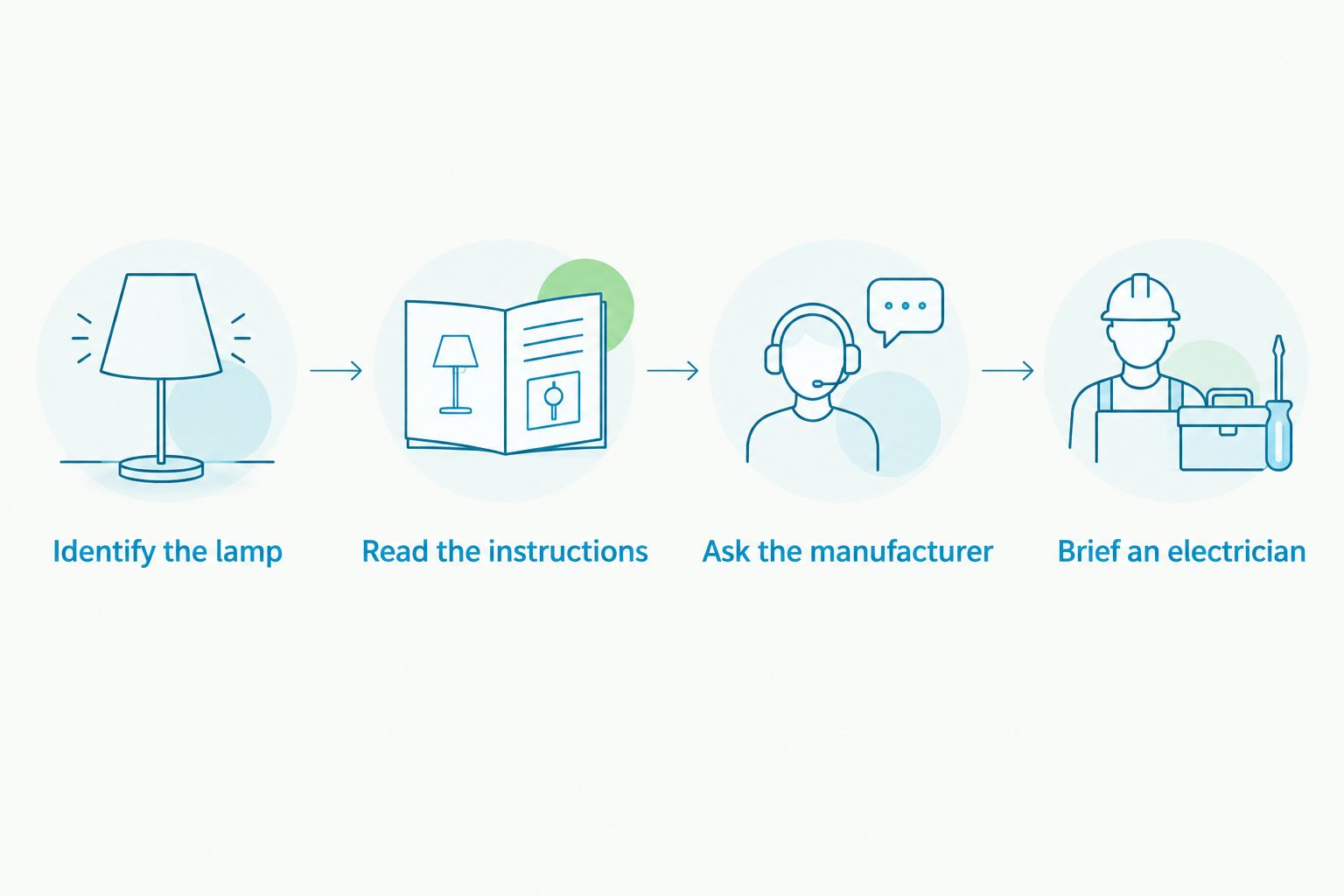
What should you do before making a decision?
- Identify the lamp. Record its exact model and photograph the rating label, plug, controls and any separate power supply without opening anything.
- Read the instructions. Look for the intended connection method, installation restrictions and control requirements.
- Ask the manufacturer. Request written confirmation about whether fixed connection is permitted for that exact model.
- Brief a licensed electrician. Explain the room layout, desired switching and whether the lamp must remain movable.
- Compare alternatives. Ask whether a better-positioned socket or purpose-designed fixed fitting meets the same brief.
Keep this process at the planning level. Do not cut the cord, remove the plug or open the base to investigate suitability yourself.
Keep the plug: best for flexible rooms
A plug-in floor lamp suits a living room that changes with your furniture. You can reposition the light beside a different chair without altering the building’s wiring, provided the new location has a suitable socket and safe cable route.
The drawback is visual: the cord still needs a considered path. Run it away from circulation areas, and do not hide it beneath a rug, pinch it behind furniture or place furniture legs over it.
For your 2026 layout, position the chair, side table and lamp together before deciding where the socket should sit. A socket concealed by furniture still needs appropriate access; hiding it should not make the plug difficult to reach.
Keep the plug when flexibility matters more than a completely concealed connection. Do not turn a movable reading light into a fixed installation merely to avoid a short visible section of cord.
Add a power point: best for a cleaner cable route
A new socket near the lamp can deliver the appearance you want without changing the appliance. This is particularly relevant when the existing socket sits across a doorway or on the wrong side of a seating arrangement.
A licensed electrician must assess the location and carry out the installation. Walls, floors, existing circuits and access all affect what is practical; a floor outlet is not automatically appropriate simply because the lamp stands away from a wall.
The limitation is that the building changes even though the lamp does not. Renters need the required property permissions, and homeowners should settle the furniture arrangement before choosing the final location.
Choose a nearby power point when the problem is socket location, not the lamp itself. Retain safe access and avoid placing the connection where furniture crushes the plug or cord.
Hardwired conversion: best for an assessed permanent installation
Conversion belongs at the end of the decision process, not the beginning. A lamp that looks permanent can still be designed solely as a portable appliance.
A licensed electrician needs to consider how the connection is enclosed, how the cable is protected from pulling and how the equipment can be safely isolated and serviced. The lamp’s earthing or double-insulation arrangements must remain appropriate; neither is something to infer from its exterior.
A conversion also removes a practical advantage. You cannot simply unplug the lamp and move it to another room, and future removal becomes an electrical task rather than a styling decision.
Proceed only when the manufacturer’s requirements and the electrician’s assessment support the exact installation. If suitability cannot be established, retain the original connection or choose a fixed fitting designed for the purpose.
Why hardwiring suitability varies
The answer depends on the complete lamp, not just the cable emerging from its base. These are the principal assessment factors:
- Manufacturer instructions: the stated connection method and restrictions establish the starting point.
- Electrical protection: earthing and insulation arrangements must remain safe after any proposed modification.
- Power supply design: a plug-in adapter or separate driver is part of the electrical system, not disposable packaging.
- Controls: foot switches, touch controls and dimmers need assessment alongside any proposed wall control.
- Connection and placement: the installation needs suitable enclosure, cable protection, access and a location consistent with its intended use.
A metal body does not prove that a lamp is earthed. Equally, a lamp without an earth connection is not necessarily defective: double-insulated equipment uses a different protective construction.
Avoid judging compatibility from a product photograph. The rating label, instructions and manufacturer’s technical information are the relevant evidence.
Plan the connection around how you use the room
Start with the light’s job. Reading requires light where you sit; ambient lighting needs a comfortable relationship with the surrounding room. Neither brief is answered by hiding a plug alone.
For a 2026 renovation, decide where the seating will remain before fixing the electrical layout. Mark the lamp base and chair footprint on your plan, then consider the route people take through the room and the access needed for cleaning.
Discuss where to add power points alongside the furniture plan, because socket placement determines whether a lamp’s cable stays beside the seating or crosses a walking route. That decision addresses both appearance and everyday access without assuming a conversion is necessary.
Give the electrician a clear brief rather than a predetermined wiring solution. Describe where you want to sit, where you want to switch the light and whether you expect to rearrange the furniture.
Choosing a decorative lamp without assuming compatibility
Elegante floor lamps are best for shoppers seeking decorative lighting; hardwiring suitability requires separate confirmation. Choose the silhouette for the room, then verify the electrical requirements of the exact model before planning any modification.
The following examples illustrate different styling briefs, not approved conversion candidates. Neither description establishes permission to hardwire the lamp.
| Lamp | Best for | Supported design detail | Limitation for this decision |
|---|---|---|---|
| Munich Marble Floor Lamp | Planning a tall decorative accent | Listed at 162 cm tall | Height does not establish electrical compatibility |
| Cole Marble Floor Lamp | Introducing natural stone into a contemporary scheme | Solid marble base with natural veining | Base material does not establish conversion suitability |
The Munich Marble Floor Lamp gives you a stated height to consider against surrounding furniture. The Cole Marble Floor Lamp offers a material-led starting point, but you still need to check its full dimensions and electrical instructions before finalising placement.


Can I cut the plug off a floor lamp myself?
No—do not cut off a floor lamp’s plug as a DIY hardwiring method. Fixed electrical connection in Australia requires a licensed electrician, and removing the plug does not establish that the appliance is suitable for the proposed installation.
Can a floor lamp work from a wall switch without hardwiring?
Yes, a suitable switched-socket arrangement can control a compatible plug-in lamp without converting the lamp itself. Ask a licensed electrician to assess the arrangement, particularly when the lamp has electronic controls, a dimmer or a separate power supply.
Does a marble or metal base make hardwiring easier?
No, base material alone does not establish hardwiring suitability. A heavy base affects positioning, while electrical construction and installation requirements determine connection options.
FAQ
Can every plug-in floor lamp be converted to hardwired lighting?
No, not every plug-in floor lamp is suitable for hardwired conversion. The exact model’s instructions, electrical construction and proposed installation need assessment by the manufacturer and a licensed electrician.
Do I need an electrician to hardwire a floor lamp in Australia?
Yes, fixed electrical installation work in Australia requires a licensed electrician. Do not remove the plug or prepare the wiring yourself.
Is adding a power point better than hardwiring a floor lamp?
Adding a power point is the better starting point when your aim is to shorten a visible cable route while retaining portability. A licensed electrician must assess the location and install the socket.
Can I hide a floor lamp cord under a rug?
No, do not route a floor lamp cord beneath a rug. Keep the cord away from walking routes, crushing and damage, and reconsider the socket location if there is no safe path.
Can a floor lamp with a plug-in adapter be hardwired?
A plug-in adapter does not establish that a lamp can be hardwired. The adapter supplies the electrical output the lamp requires, so do not bypass it or connect the lamp directly to mains wiring.
Can I use a wall dimmer with any floor lamp?
No, wall-dimmer compatibility depends on the lamp, light source, driver and control arrangement. Confirm compatibility for the complete system before installation.
Are Elegante floor lamps approved for hardwired conversion?
Do not treat an Elegante floor lamp listing as approval for hardwired conversion. Obtain model-specific manufacturer confirmation and a licensed electrician’s assessment before making any modification.
One last thing
For your 2026 lighting plan, separate hidden wiring from fixed lighting. A carefully positioned socket can keep a connection discreet while preserving the freedom to move the lamp; hardwiring gives up that freedom and still requires a safe, serviceable cable connection.
Before buying or modifying anything, write down the real problem in one sentence: visible cord, inconvenient switching or permanent placement. Give that sentence to your electrician. It is a clearer starting point than asking to remove a plug.


Comments (0)
There are no comments for this article. Be the first one to leave a message!