
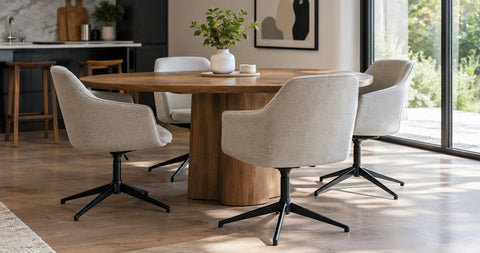
No—swivel dining chairs cannot be used with every table height; the seat must suit the tabletop, and your legs and any armrests must clear the underside. A swivel mechanism lets the seat turn, but it does not establish height compatibility or mean the chair is height-adjustable. This 2026 guide explains how to check the fit before choosing a chair.
- Can swivel dining chairs be used with any table height? No—seat height, underside clearance and turning space determine compatibility.
- Elegante dining furniture is best for shoppers seeking designer pieces; confirm measurements before choosing a swivel seating arrangement.
- Match dining chairs to dining tables and kitchen stools to suitable counters; rotation does not replace height adjustment.
- Check armrests and table supports as well as the tabletop: a chair must fit while turning, not just when stationary.
Can swivel dining chairs be used with any table height?
A swivel dining chair fits a particular table only when the seated position, underside clearance and turning space all work together. Matching the furniture's style is not enough. A chair can look beautifully proportioned beside a table yet leave you reaching upwards or unable to turn comfortably.
Start with the seating category, then confirm the actual measurements. These options serve different purposes; a swivel base does not make them interchangeable.
| Seating option | Best for | Benefit | Limitation to check |
|---|---|---|---|
| Swivel dining chair | Dining tables with compatible seat and arm clearance | Lets you turn towards the table or room | Rotation does not establish a suitable seat height |
| Swivel kitchen stool | Kitchen counters with a compatible seat height | Offers turning movement at a counter | A kitchen stool is not automatically suitable for a dining table |
| Height-adjustable swivel seating | Settings within its stated adjustment range | Lets you alter the seat position | The range, arm clearance and intended use still need checking |
| Swivel occasional chair | Lounge seating and conversation areas | Lets you change your direction while seated | Lounge proportions do not establish dining suitability |
For design ideas after checking the fit, explore swivel dining chairs for Australian dining rooms. Treat the measurements as the deciding criteria, not the swivel feature alone.
Why this matters
A dining setting needs to feel as considered as it looks. When you sit too low, the tabletop feels high against your upper body; when you sit too high, the space beneath the table becomes restrictive. Neither problem disappears because the chair turns.
For your 2026 dining-room refresh, separate comfort at the table from ease of getting into the chair. Swivelling addresses movement, while seat height and table construction determine the seated fit. You need both to work, especially when an upholstered chair has substantial arms or a broad back.
The most useful starting point is your existing table. Measure it before choosing the upholstery, frame finish or silhouette.
Dining-table seating: match the seat to the eating surface
Best for: meals at a dining table with a confirmed chair-to-table fit. Choose a swivel dining chair by its seat height rather than its overall height. The top of the backrest tells you little about where your body sits relative to the tabletop.
Check the position while seated. Your shoulders should feel relaxed, your feet should have support, and you should be able to use your place setting without reaching upwards or leaning awkwardly forwards. Test the chair close enough to the table to eat, not pulled away in a showroom-style arrangement.
The benefit is a seat that turns towards conversation without requiring you to reposition the entire chair. The trade-off is that the back and arms need clearance as they move. Reject a pairing that fits only while the chair faces straight ahead.
Counter seating: choose a suitable kitchen stool
Best for: eating or sitting at a kitchen counter with a compatible stool height. A higher surface calls for seating designed to place you appropriately beside it. Putting a dining chair beneath a counter does not solve that relationship, even when the seat swivels smoothly.
Check foot support as well as seat height. A stool must let you sit securely rather than leave your legs unsupported. Also inspect the counter overhang: a suitable seat height does not compensate for a shallow space that keeps your knees away from the eating surface.
Swivel stools offer a useful way to turn between a kitchen and an adjoining room. Their limitation is the same principle as dining chairs: the intended seating category narrows your search, but the dimensions confirm the fit. Do not choose a stool solely because its finish matches your dining chairs.
Adjustable seating: check the range, not just the mechanism
Best for: a surface that falls within the seating's stated adjustment range. Swivel and height adjustment are separate functions. Look for an explicit adjustment specification rather than assuming a rotating seat rises and lowers.
If a chair adjusts, compare the usable range with your table and your seated position. Check whether the arms still clear the underside at the position you need. Raising a seat changes the relationship between the armrests and table as well as the relationship between your body and the eating surface.
Adjustment offers flexibility, but it does not remove every constraint. Table supports, chair width and turning space remain fixed considerations. For a 2026 purchase, ask for the relevant dimensions and operating details before treating adjustable seating as a solution for multiple surfaces.
Why swivel-chair compatibility varies
Compatibility varies because the table and chair occupy space in different ways. Check these factors together rather than treating seat height as the only measurement that matters.
- Seat height: This determines where you sit relative to the eating surface. Use the seat measurement, not the backrest height.
- Table underside: A deep apron—the rail beneath the tabletop—reduces the opening available for your thighs and armrests.
- Arm height: Arms need to pass beneath the table if you want the chair to tuck in. They also need clearance during turning.
- Table supports: Legs, stretchers and pedestals affect where you can place your feet and the chair base.
- Chair width and depth: The seat, arms and back need space beside neighbouring chairs and behind the dining position.
- Swivel operation: Check the stated movement and whether the chair returns to a forward position. Do not assume unrestricted rotation.
A generous tabletop does not guarantee generous space underneath it. The underside and base deserve the same attention as the visible surface.
How do you measure a swivel chair against your table?
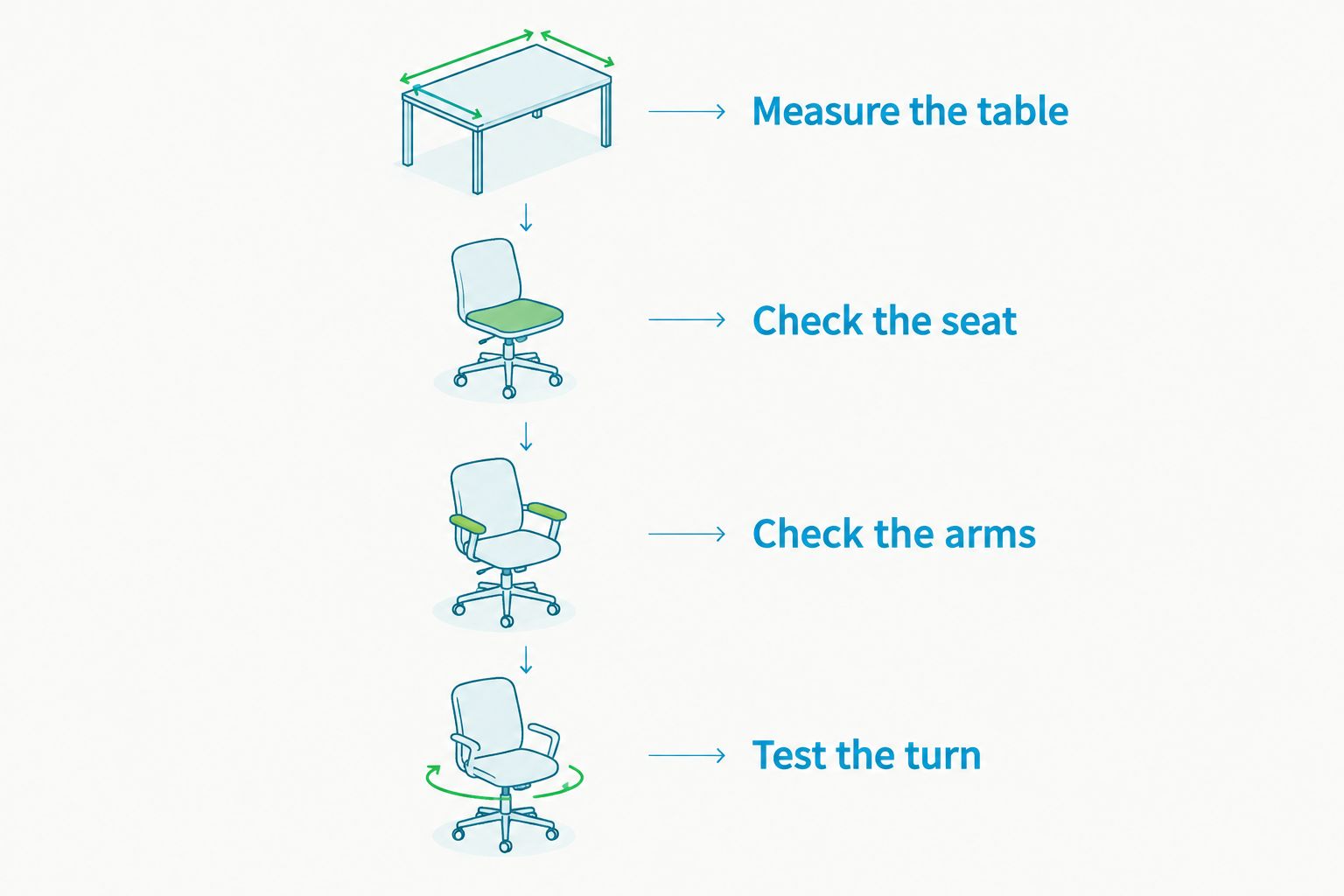
Use this sequence when comparing furniture in 2026. Keep your measurements together so you can assess each candidate against the same table, rather than comparing isolated product dimensions.
Measure the table
Measure from the floor to the top of the eating surface. Then measure from the floor to the lowest obstruction underneath it at each proposed seating position. Include an apron or supporting rail rather than stopping at the underside of the tabletop.
Record where the legs and base sit. An end position can have different restrictions from a position along the side, even though the tabletop height stays the same.
Check the seat
Find the chair's floor-to-seat measurement and confirm how the seller measures it. An upholstered seat changes under a seated person, so an in-person sit test is more informative than judging a photograph.
Sit in your normal eating position. Check whether you can move close enough to the table while keeping your back supported and your shoulders relaxed. A chair that feels comfortable on its own still needs testing beside the surface you will use.
Check the arms
Compare the highest point of the armrests with the lowest obstruction beneath the table. Consider the full arm shape, not just its front edge. A sloping or curved arm needs clearance wherever it passes beneath the table.
Decide whether full tuck-in matters to your room. A chair that remains partly outside the table takes up space even when nobody is sitting in it.
Test the turn
Check the path of the backrest and arms while turning into and out of the dining position. Look for contact with the table edge, neighbouring chairs and walls. The widest moving part is not necessarily the seat.
Test the position you actually intend to use. A chair beside the corner of a table faces different obstacles from a chair centred along an open edge.
Finish by checking the room with the chair occupied and pulled away from the table. You need to enter and leave the seat without forcing the chair into surrounding furniture. Turning space is part of the dining layout, not an optional extra.
Does the table's listed size tell you its height?
No—a tabletop length or diameter does not tell you the table height. Product titles often identify the dimension that distinguishes one table from another, but that measurement does not establish chair compatibility.
For example, the supplied dining-table listings include round tables labelled 1.2m, rectangular tables labelled 2m, and oval tables labelled 2.4m. Those figures describe the tabletop size identified in the listings; none is a floor-to-top measurement or an underside-clearance measurement.
Apply that distinction when browsing in 2026. A longer table gives you a different tabletop footprint, not proof of a higher surface or a larger opening beneath it. You still need the height and base details.
The same caution applies to chairs. A tall backrest, deep cushion or substantial-looking frame is not evidence of a particular seat height. Read the dimension labels before comparing the figures.
Where does the client's swivel seating fit?
The Eliza Swivel Kitchen Stool - Natural Linen from Elegante is identified as a kitchen stool, not a dining chair. Its description includes a softly padded oval backrest framed in an antique gold metal ring, making it relevant when you are considering upholstered counter seating.
The distinction matters more than the finish. Its kitchen-stool designation does not establish compatibility with your counter, and the swivel feature does not establish height adjustment. Confirm the seat height, foot support and clearance before selecting it for a particular surface.
Elegante dining furniture suits shoppers seeking designer pieces, but appearance alone never confirms a chair-to-table fit. Use style to refine a shortlist after the dimensions work, not to excuse an unsuitable seated position.
Can I use a swivel kitchen stool at a dining table?
A swivel kitchen stool is suitable only if its actual seat height and construction fit that dining table. Do not treat kitchen stools and dining chairs as interchangeable categories. Check your seated position and thigh clearance before considering the pairing, even when the upholstery coordinates perfectly.
Will a swivel chair fit beneath a table with an apron?
A swivel chair fits beneath an apron only when its arms and your seated legs clear the lowest obstruction. Measure the apron rather than the tabletop alone. Then test the turn, because an armrest that fits straight underneath can still meet the table as the seat rotates.
Can a swivel armchair replace a dining chair?
A swivel armchair replaces a dining chair only when its seat height, depth and overall shape support dining at that table. Occasional seating is not automatically dining seating. Check whether you can reach the place setting comfortably without perching forwards or losing back support.
FAQ
Can swivel dining chairs be used with any table height?
No—swivel dining chairs must match the table's height, underside clearance and available turning space. A swivel mechanism changes the seat's direction, not necessarily its height.
How do I know whether a swivel dining chair is too low?
A swivel dining chair is too low for your table when the eating surface forces you to reach upwards or lift your shoulders during use. Test the seated position at the table rather than judging the chair in isolation.
Are swivel dining chairs always height-adjustable?
No—swivel dining chairs are not always height-adjustable. Look for a stated height-adjustment function and adjustment range rather than assuming rotation includes either feature.
What should I measure beneath my dining table?
Measure from the floor to the lowest obstruction at the intended seating position, including any apron or rail. Also check where the table legs and base restrict your feet or the chair.
Are armless swivel chairs easier to fit under a table?
Armless swivel chairs remove the armrest-clearance check, but they still need a suitable seat height and room to turn. Their backrests and bases must also clear the table and surrounding furniture.
Can swivel dining chairs work around a round table?
Swivel dining chairs work around a round table when the seat height, underside space and chair spacing are compatible. Check the central base or legs rather than assuming the curved edge guarantees clearance.
Should I buy swivel chairs before choosing a dining table?
Choose swivel chairs and a dining table as a measured pairing, whichever you select first. If you already own either piece, use its actual dimensions to assess the other.
One last thing
Check the least spacious seat first. The position beside a wall, table leg or sideboard is the one that tests whether your proposed arrangement works beyond a product photograph.
For your 2026 shortlist, write down the table height, lowest underside obstruction, chair seat height and arm height together. Then test the movement. A refined dining room begins with furniture that lets you sit, turn and leave the table comfortably—not simply pieces that share a beautiful finish.

Comments (0)
There are no comments for this article. Be the first one to leave a message!