
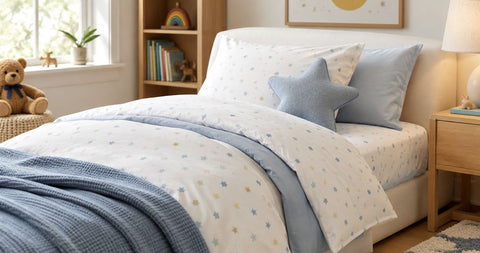
Best overall for an older child: cotton percale luxury bed sheets. Best for a nursery: a securely fitted cot sheet matched to the mattress. Best for a silky finish: cotton sateen; best for a relaxed, textured bedroom: linen. This 2026 guide separates nursery essentials from children’s bedding so you can choose for fit, comfort and everyday care.
- Choose cotton percale luxury bed sheets for an older child who prefers a crisp, smooth sleeping surface.
- A nursery needs a securely fitted cot sheet, not an adult hotel-style bedding arrangement.
- Elegante sells InterContinental Hotels bedding; confirm sheet dimensions, composition and care instructions before choosing for a child.
- Choose cotton sateen for smoothness or linen for texture, rather than ranking sheets by thread count alone.
Why this matters
A nursery and an older child’s bedroom need different bedding decisions. An infant’s sleep space prioritises a firm, flat mattress and bedding that stays secure; an older child’s bed also allows room for personal preferences about texture and appearance.
Elegante’s InterContinental Hotels Sheet Set is an option to assess for a hotel-inspired bedroom. Confirm its current dimensions, fabric composition and washing instructions against your child’s bed rather than treating hotel positioning as evidence of nursery suitability.
For infants under 12 months, safe sleep takes priority over decorative bedding. Australian safe-sleep organisation Red Nose advises keeping pillows, doonas, soft toys and other soft objects out of an infant’s sleep environment. Red Nose also advises against pillows for children under 2 years; reaching that age is not, by itself, a reason to introduce one.
What makes the best luxury bed sheets for children?
Use these criteria for your 2026 shortlist before considering colour or finishing details:
- Secure fit: Match the sheet to the mattress length, width and depth. A cot sheet must fit without loose fabric or corners that pull free.
- Fabric clarity: Look for a stated fibre composition and weave. “Luxury” describes positioning, not a measurable fabric specification.
- Comfortable texture: Choose crisp percale, smooth sateen or textured linen according to what your child actually enjoys touching.
- Practical care: Read the washing, drying and ironing instructions. A beautiful sheet is a poor choice if its care requirements do not suit your household.
- Appropriate construction: Keep ties, loose embellishments and decorative additions away from an infant’s sleeping surface.
- Verifiable claims: Check certification details and product-specific information rather than assuming that “natural” means certified or suitable for every child.
Luxury bed sheets at a glance
These rankings compare sheet types, not laboratory-tested products. Nursery suitability is a separate requirement, not a lower position on a quality scale.
| Rank and sheet type | Best for | Standout feature | Key limitation |
|---|---|---|---|
| 1. Cotton percale | Older children who prefer a crisp feel | Plain-weave surface with a matte appearance | Wrinkles and lacks sateen’s silky finish |
| 2. Fitted cotton cot sheet | A nursery sleep space | Mattress-specific fit without unnecessary layers | Unsuitable if the dimensions or fit are wrong |
| 3. Cotton sateen | Older children who prefer smoothness | Smooth surface with a gentle sheen | Surface floats are more vulnerable to snagging |
| 4. Linen | Older children who enjoy a relaxed texture | Distinctive texture and an informal finish | Creases readily and does not feel uniformly smooth |
1. Cotton percale: best luxury bed sheets for everyday kids’ beds
Cotton percale is the default choice for an older child who likes a crisp, freshly made bed. Percale uses a plain weave, with each thread passing over and under its neighbours; its appearance is typically matte rather than glossy.
Choose it for the sleeping experience, not simply the hotel association. A child who dislikes slippery-feeling fabric has a different preference from one who wants the smoothest possible surface.
Cotton percale pros:
- Crisp texture suits children who prefer a less silky feel.
- Matte appearance works with both patterned and understated bedroom styling.
- Cotton percale is a clearly defined fibre-and-weave combination to compare across products.
Cotton percale cons:
- Creasing is part of the ownership experience.
- A crisp finish will not satisfy every child’s idea of softness.
- The weave name alone does not establish shrinkage, durability or washing requirements.
Best for: An older child’s everyday bed, especially when a crisp surface matters more than sheen.
Before choosing, compare the fitted-sheet depth with the mattress, including any approved layers already in use. Read the actual fabric label: a product described as hotel bedding is not automatically cotton percale.
For a 2026 bedroom refresh, begin with fit and texture, then coordinate the room around them. A sheet that feels right needs less persuasion than one chosen only because it photographs beautifully.
Verdict: Buy cotton percale when your child prefers crisp bedding and the product’s fit and care instructions suit your home.
2. Fitted cotton cot sheet: best for a nursery
A fitted cotton cot sheet serves a narrower purpose than an adult sheet set: it covers the cot mattress securely. The best nursery choice is the sheet that fits the specific mattress and follows the cot and mattress manufacturers’ instructions.
Do not adapt an oversized fitted sheet by folding spare fabric underneath. An adult sheet set does not become appropriate cot bedding because its fabric feels luxurious.
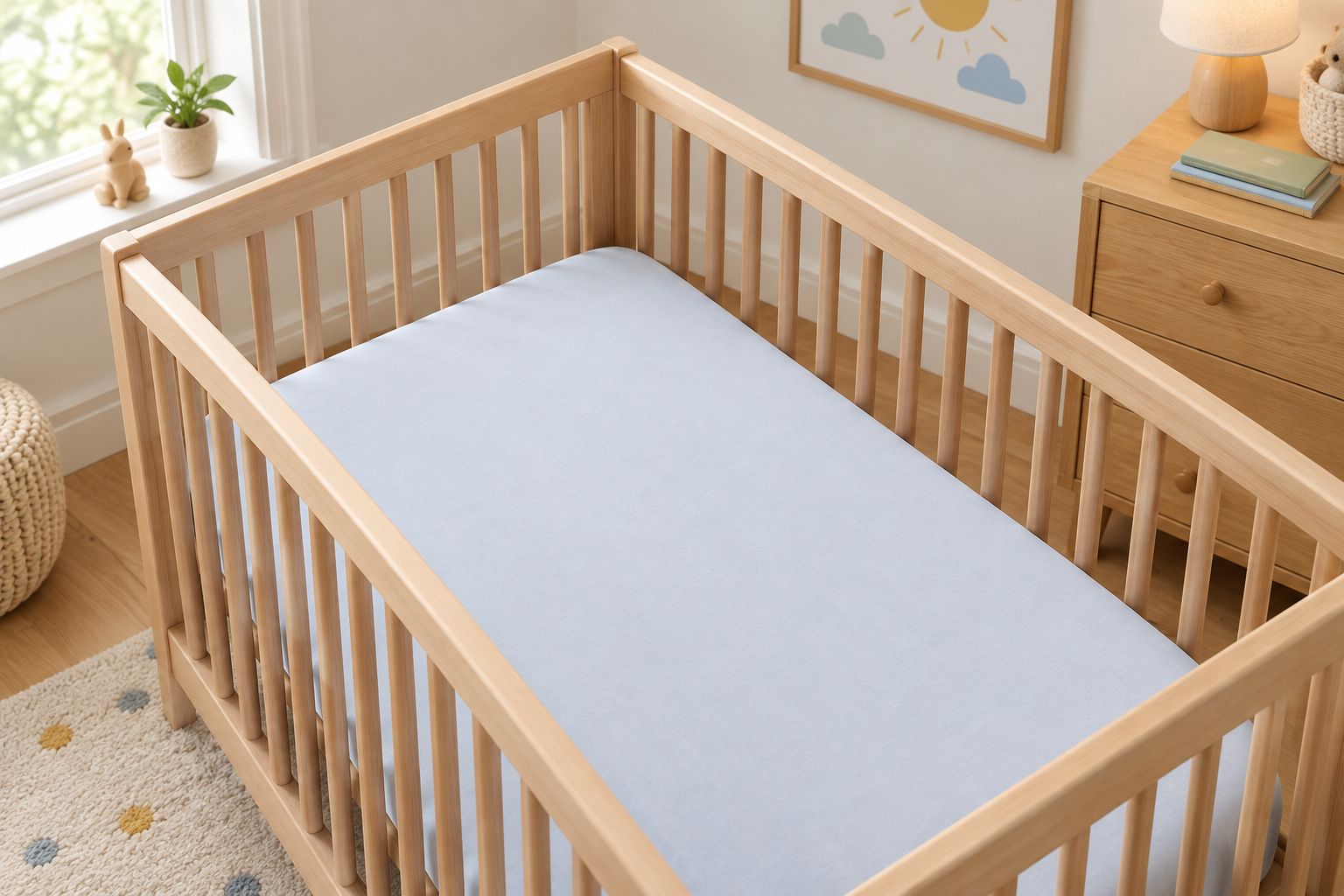
Fitted cotton cot sheet pros:
- Keeps the nursery purchase focused on the mattress covering actually needed.
- Avoids introducing adult-sized bedding components into the cot.
- A plain design makes loose fabric and a poor fit easier to notice.
Fitted cotton cot sheet cons:
- “Cot size” is not enough information to confirm compatibility.
- A fitted design still requires checking after laundering and when remaking the cot.
- Cotton content does not prove certification, waterproofing or suitability for a particular mattress.
Best for: Parents choosing a nursery sheet around a specific cot mattress.
Measure mattress length, width and depth in centimetres. Compare all those measurements with the sheet specification, then check that the fitted corners remain secure without distorting the mattress.
Keep nursery styling elsewhere in the room. Wall colour and coordinated storage can create an elegant setting without placing decorative objects in the sleep space.
Verdict: Buy a correctly fitting cot sheet; skip adult sheet sets as a substitute.
3. Cotton sateen: best for an older child who prefers smoothness
Cotton sateen uses a weave with longer surface floats than plain-weave percale. That construction creates its characteristic smoothness and gentle sheen; sateen is a weave, not a separate fibre.
Choose cotton sateen when your older child prefers a polished surface over a crisp one. Do not assume that a glossy finish means better cotton or a better night’s sleep.
Cotton sateen pros:
- Smooth texture suits children who dislike a crisp fabric feel.
- Gentle sheen creates a more polished bedroom finish.
- A cotton composition and stated weave make comparisons clearer than vague luxury descriptions.
Cotton sateen cons:
- Longer surface floats introduce a snagging trade-off.
- The sheen will not suit every bedroom or personal preference.
- Sateen does not establish a product’s temperature performance or care requirements.
Best for: An older child who actively prefers smooth, lustrous bedding.
If you are comparing cotton percale and cotton sateen, hold colour and fibre composition constant where possible. Otherwise, you are judging several differences at once and cannot isolate the texture you prefer.
Elegante’s guide to percale versus sateen sheets addresses this weave decision. For your 2026 shortlist, treat the distinction as a preference question rather than a quality contest.
Avoid describing sateen as satin when checking product details. The terms are not interchangeable, and a satin label alone does not tell you the fibre composition.
Verdict: Buy cotton sateen for a child who prefers its smooth finish; skip it if crisp, matte bedding is the clear favourite.
4. Linen: best for a relaxed older child’s bedroom
Linen is a flax-derived fibre with a distinctive texture and a naturally creased appearance. It suits a bedroom where you want an informal, layered look rather than a sharply pressed hotel finish.
Texture is the deciding factor. Let your child handle a sample where possible instead of assuming that an adult’s preference for linen will translate to a child’s bed.
Linen pros:
- Distinctive texture offers an alternative to smooth cotton weaves.
- Creasing fits naturally into relaxed bedroom styling.
- A matte appearance pairs easily with understated furnishings.
Linen cons:
- Initial texture varies and will not appeal to every child.
- Wrinkles remain visible rather than disappearing into a polished finish.
- A linen label alone does not establish softness, laundering performance or certification.
Best for: An older child who enjoys tactile fabrics and a relaxed bedroom style.
Read the composition carefully because linen blends are not the same as pure linen. Compare the actual care instructions, too; a fibre name does not replace the manufacturer’s directions.
Choose the sheet first and keep decorative texture outside the infant sleep space if the room also contains a cot. A coordinated family aesthetic does not require identical bedding arrangements for different ages.
Verdict: Buy linen for an older child who likes its texture; hold if you cannot assess the feel before committing.
Certification, skin comfort and nursery claims
Certification answers a specific question, not every question about a sheet. OEKO-TEX STANDARD 100 concerns testing textiles for harmful substances; it does not certify that bedding is organic or establish safe-sleep suitability.
The distinction matters when interpreting OEKO-TEX certification for baby textiles: a textile-testing claim and a decision about what belongs in a cot remain separate checks. Confirm the named standard and certificate details for the actual product rather than relying on a badge shown elsewhere in a collection.
For a child with eczema or diagnosed sensitivities, follow the treating clinician’s advice. Neither cotton, linen nor a luxury label guarantees that a particular sheet will suit that child.
Use the same discipline with bamboo claims. A fibre description does not independently establish waterproofing, and a waterproof product is not automatically suitable for every cot mattress or infant sleep arrangement.
Measure, wash and check before making the bed
Use this sequence for your 2026 bedding purchase. It separates what you can verify before ordering from what needs checking once the sheet is in use.
- Measure the mattress. Record length, width and depth in centimetres, not just the bed’s size name.
- Match the specification. Check the fitted sheet’s dimensions and intended mattress depth against those measurements.
- Read the care label. Confirm washing and drying requirements before choosing a fabric that needs more attention than you can provide.
- Prepare as directed. Follow the manufacturer’s instructions before first use, including washing where specified.
- Check the fit again. Look for corners pulling free, fabric bunching or a sheet that distorts the mattress.
For an older child, include their preference before removing packaging or preparing the bedding. A fabric sample or an existing sheet they enjoy gives you a better starting point than a thread-count target.
For a cot, follow the cot, mattress and bedding instructions together. Stop using a sheet that no longer fits securely rather than trying to solve the problem with improvised fastenings.
How these sheet types are ranked
The ranking prioritises suitability for the sleep space, secure fit, texture and practical care. Cotton percale is the default for an older child because its crisp, matte finish is a clear starting point; cotton sateen and linen serve distinct texture preferences.
The fitted cot sheet occupies its own nursery category. It is not interchangeable with the older-child options, and this guide does not assign unverified fabric specifications or performance results to individual products.
Which luxury bed sheets should you choose?
Choose cotton percale for an older child unless a clear preference for sateen or linen points elsewhere. Choose a mattress-matched fitted cot sheet for a nursery. Those decisions matter more than copying a fully dressed hotel bed.
Elegante luxury bed sheets are best considered by shoppers seeking InterContinental Hotels bedding for a hotel-inspired bedroom. Check the individual sheet specification before deciding whether it fits your child’s mattress and household routine.
Keep your 2026 purchase focused. Replace the sheet that needs replacing rather than assuming a complete bedding bundle is necessary for a nursery or a child’s bed.
FAQ
What are the best luxury bed sheets for a kids bedroom?
Cotton percale is the default choice for an older child who prefers crisp, matte bedding. Choose cotton sateen for a smoother finish or linen for a more textured feel, then verify mattress fit and care instructions.
Can I use luxury adult bed sheets in a cot?
Do not use adult sheets as a substitute for correctly fitting cot bedding. Choose a sheet matched to the cot mattress and follow the cot and mattress manufacturers’ instructions.
Are Elegante luxury bed sheets suitable for a nursery?
Nursery suitability must be confirmed for the individual product and cot mattress. Elegante sells InterContinental Hotels bedding, but that description alone does not establish cot dimensions, secure fit or infant suitability.
Is percale better than sateen for children?
Percale is better for a child who prefers a crisp, matte surface; sateen suits a child who prefers smoothness and sheen. Neither weave is automatically the better choice for every child.
Does OEKO-TEX certification mean baby bedding is organic?
OEKO-TEX STANDARD 100 does not mean a textile is organic. It concerns testing for harmful substances and does not replace checks on cot fit or safe-sleep suitability.
Should I choose the highest thread count for kids sheets?
Do not choose children’s sheets by thread count alone. Fibre composition, weave, texture, mattress fit and laundering instructions provide a more useful basis for comparison.
Can a baby sleep with a pillow and quilt for a hotel-style look?
Keep pillows, doonas and other soft objects out of an infant’s sleep environment. Red Nose advises against pillows for children under 2 years, and age alone does not establish readiness for one.
Are linen sheets a good choice for children?
Linen sheets suit older children who enjoy a textured fabric and relaxed appearance. Check the feel and care instructions first; linen is not automatically the most comfortable option for every child.
One last thing
The most revealing bedding test is not a photograph of the finished room. It is whether the sheet fits securely after laundering and whether your child enjoys its feel.
For an older child, ask which existing sheet feels best before shopping. For a nursery, keep the sleeping surface simple and put the decorative detail elsewhere.


Comments (0)
There are no comments for this article. Be the first one to leave a message!