

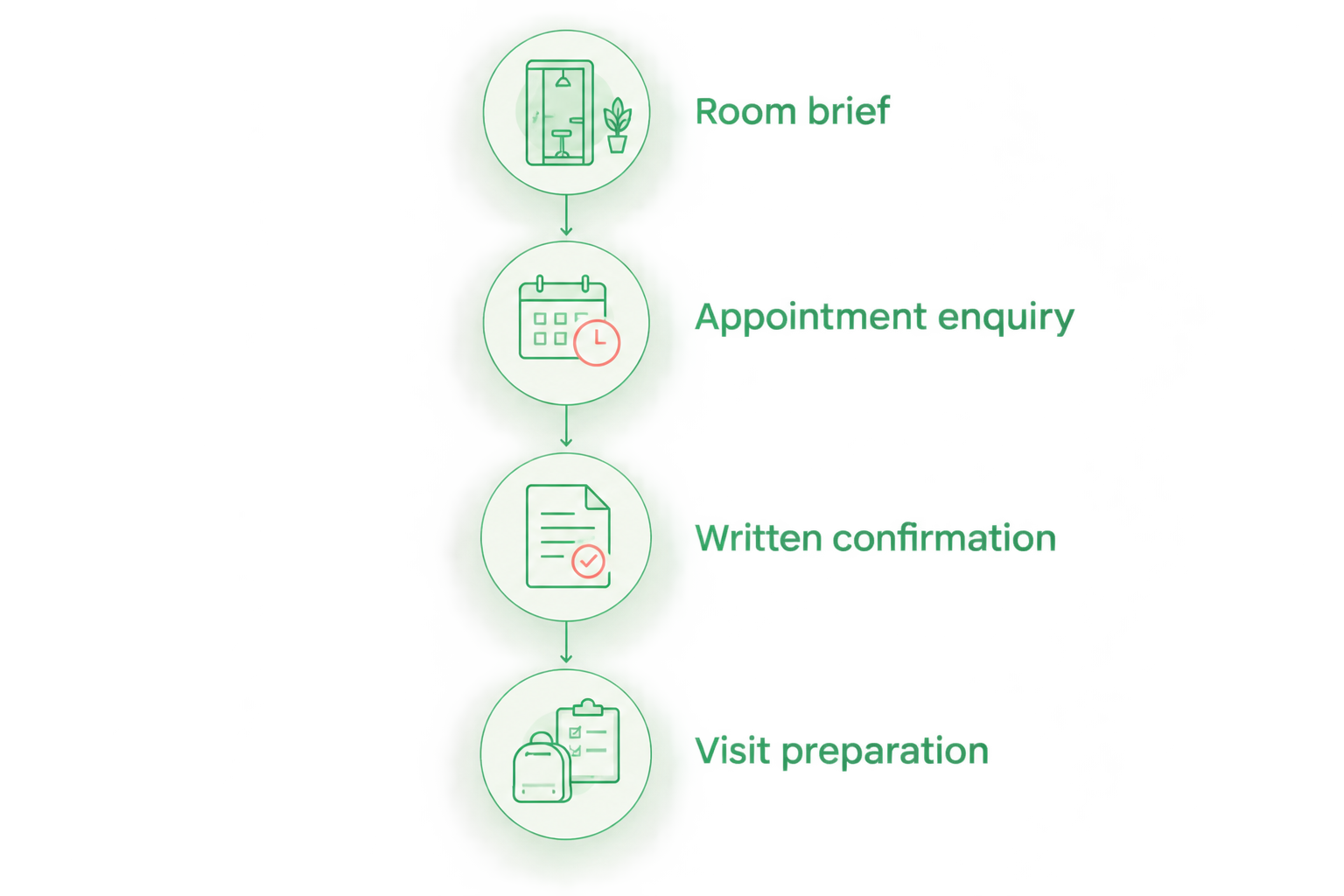
Instead of arranging travel around an assumed styling service, start your Elegante showroom appointment enquiry by asking whether a private session is offered, then request written confirmation before making plans. Use the workflow below to prepare your room brief, explain what you want to compare and establish the appointment details before you travel.
- Start an Elegante showroom appointment enquiry by confirming whether private styling sessions are offered.
- Prepare room photographs, measurements and a focused hotel bedding shortlist before requesting advice.
- Request written confirmation of the location, date, session format and scope before arranging travel.
- A product enquiry is an alternative when you need bedding guidance rather than an in-person styling session.
Why this matters
An appointment request is not a confirmed appointment. Before planning a showroom visit in 2026, establish whether the retailer offers the service you want and whether the proposed session covers your particular project.
Start with Elegante and use the contact information currently published on the website. Ask about a private styling session rather than assuming that a showroom, booking calendar or interior design service is part of the shopping experience.
Elegante suits Australian shoppers seeking luxury hotel bedding, including InterContinental hotel bedding. Its retail range also includes designer furniture, lighting and homewares; a question about buying those products is different from a request for a room-design service.
This distinction keeps your enquiry precise. You need to establish what help is offered before deciding how to prepare for it.
Before you start
- Prepare your room materials. Gather 3 photographs: the whole room, the area you want to change and a close-up of existing colours or textures. Record relevant measurements in centimetres rather than relying on bed-size names or visual estimates.
- Prepare your contact and scheduling details. Have an email address you check, your suburb and 2 preferred dates ready. Include your local time zone when discussing a remote conversation or travelling interstate.
- Confirm the service before arranging the visit. Ask whether private styling sessions are offered, where they take place and what they cover. Do not assume that an online product listing means you can inspect that item in person.
Keep these materials together in a single note or document. You can reuse the same brief when answering follow-up questions instead of reconstructing your requirements each time.
Your room brief
A useful styling enquiry describes a decision, not simply a look. For example, explain that you want to coordinate new bedding with an existing upholstered bedhead, rather than asking for a generally luxurious bedroom.
Define the outcome
- Write a short description of the room and who uses it. Distinguish an everyday bedroom from a guest room because your priorities can differ.
- Identify the main decision: bedding coordination, pillow sizing, quilt selection, furniture proportions or lighting placement.
- List what stays. Include existing furniture, bedding and finishes that the new pieces must work with.
- Separate essential requirements from aesthetic preferences. Put fit and practical use ahead of decorative details.
Expected result: you have a brief that explains what you need to decide and which existing pieces constrain that decision.
Record the measurements
Measure the item or space involved rather than supplying a room label alone. For bedding, note mattress width, length and depth in centimetres; include any topper when recording the overall depth that fitted bedding must accommodate.
For furniture, record the intended footprint and nearby doorways, drawers or walking routes. These measurements help you explain the space; they do not replace checking the dimensions of a specific item before purchasing.
Label each measurement clearly. A note reading ‘bed width’ is more useful than an unexplained figure beside a photograph.
Choose your enquiry focus
Use the following comparison to decide what to put first in your request. These are enquiry approaches, not promises about the services a retailer provides.
| Enquiry focus | Best for | Advantage | Limitation |
|---|---|---|---|
| Bedding-focused enquiry | Coordinating pillows, sheets, quilts and covers | Keeps the discussion close to a defined purchasing decision | Does not resolve furniture layout or lighting design |
| Furniture-focused enquiry | Assessing a particular piece against your room measurements | Makes proportions and finishes the priority | Photographs cannot establish physical comfort |
| Whole-room styling request | Explaining how several categories should work together | Gives context for a coordinated scheme | Requires confirmation that this scope of advice is offered |
For a bedding refresh, start with the bedding decision rather than a whole-room brief. Expand the scope only when another element genuinely affects your choice.
Your appointment enquiry
For a 2026 enquiry, use the contact method currently published by the retailer. Keep the request clear enough that the reply can establish whether a visit is appropriate without another round of basic questions.
- State that you are asking whether a private styling session is offered. Specify an in-person visit if that is what you want.
- Summarise the room and your main decision. Mention relevant product names only when you have identified the exact item.
- Offer your photographs and measurements. Ask how the retailer would prefer to receive them before sending large attachments.
- Suggest your preferred dates and ask for the location, session format and scope to be confirmed.
- Ask what preparation is required and whether the session carries any purchase obligation or other conditions.
Expected result: you receive either the information needed to arrange a session or a clear alternative for obtaining product advice.
A message you can adapt
Use this as your own enquiry, replacing the descriptive details with your actual project. It is a suggested customer message, not a statement of the retailer’s booking process.
I am interested in arranging a private styling session, if this service is offered. I am updating a bedroom and would like help coordinating hotel-style bedding with the pieces I already own. I can provide room photographs, mattress measurements and a product shortlist. Please confirm whether an in-person session is possible, where it would take place, what it covers and what I should prepare. I can also suggest preferred dates once the session format is clear.
Add specific practical requirements where relevant. For example, ask about step-free access before agreeing to a location rather than leaving that question until arrival.
Your written confirmation
Treat an Elegante showroom appointment as arranged only after the retailer confirms it. A sent message, automated acknowledgement or discussion of possible dates does not establish the final appointment details.
- Check the confirmed date, start time and time zone. For a 2026 visit, save the full calendar date rather than a note such as ‘next Thursday’.
- Confirm the exact address and arrival instructions. Use the details supplied for your appointment, not an old screenshot or an unrelated business listing.
- Confirm whether the session is private, what categories it covers and how much time has been allocated.
- Ask whether the specific items or materials you want to assess can be viewed during the visit. Keep product advice separate from an assumption that everything is displayed.
- Save the confirmation and the method for notifying the retailer if your plans change.
Expected result: your calendar entry contains the agreed location, timing and purpose, with no unresolved assumption about what the visit includes.
What the confirmation should resolve
You should know whether you are attending a dedicated styling conversation, discussing selected products or visiting for another agreed purpose. Those formats are not interchangeable.
If the reply confirms a visit but does not mention privacy, ask directly. Likewise, request clarification if your original brief involved furniture and the response discusses bedding only.
Do not add services to the confirmation yourself. A retail appointment does not establish that home visits, installation, room drawings or ongoing design work are included.
Your visit preparation
Prepare for the agreed scope rather than bringing every idea you have collected. A focused shortlist makes it easier to compare relevant details and record useful answers.
- Save your room photographs and measurements somewhere accessible without relying on mobile reception.
- Bring your product shortlist with exact names or saved page details. Note the question beside each item.
- Include existing fabric or colour references when practical, but ask before bringing bulky bedding or furniture components.
- Write down your essential questions about dimensions, materials, care and coordination.
- Record the answers against each item during or immediately after the conversation.
Expected result: you leave with a clearer purchasing decision and a record of anything that still requires checking.
For bedding, distinguish appearance from fit. A coordinated pillow arrangement still needs correctly sized pillowcases, while a layered bed still needs sheets that accommodate the mattress and any topper.
For furniture, distinguish appearance from use. A chair can suit the room visually without meeting your comfort preferences or fitting the intended position.
When your room brief changes
Update an existing enquiry whenever a material detail changes. A different bed size, replacement bedhead or revised furniture layout can make an earlier shortlist less useful.
Reply through the established conversation and explain the change first. Attach revised measurements or photographs only where they replace something previously supplied, and identify which information is current.
For a project continuing through 2026, keep a dated version of your brief. This is particularly useful when you are furnishing a room in stages and your original photographs no longer reflect the space.
Expected result: both sides work from the same room details rather than mixing an earlier plan with a new shortlist.
A product enquiry instead of a visit
Best for a specific product question: request written clarification when you only need a dimension, material detail or care instruction confirmed. The advantage is a focused answer you can refer to later; the limitation is that written advice cannot reproduce the experience of handling a material or trying a piece of furniture.
Ask about another way to discuss your brief if an in-person session is not offered. Do not assume that telephone, video or remote styling appointments are provided—request the options directly.
Troubleshooting
You cannot find a booking calendar
Use the published contact information to ask whether appointments are offered. Do not substitute a newsletter subscription, order note or unrelated form for an appointment confirmation.
You receive an acknowledgement but no agreed date
Reply to clarify whether the enquiry has progressed to an appointment. Keep travel plans separate until you have a confirmed date, time and location.
The appointment scope does not match your request
Restate the decision you need help with and ask whether it falls within the proposed session. A bedding discussion is not a substitute for furniture-layout advice when layout is your main concern.
Your chosen item cannot be assessed during the visit
Ask what information or relevant materials can be discussed instead. Decide whether that meets your purpose before travelling; do not assume another item will answer the same questions.
You need to change the appointment
Use the contact method in your confirmation and request acknowledgement of the revised arrangements. Update your calendar only after the replacement date has been agreed.
Customise your workflow
Build the enquiry around your main purchase, then add related decisions in order. For a hotel-style bedroom, that means establishing the bedding fit and intended feel before choosing decorative layers.
Elegante’s hotel bedding range gives you a starting point for a product shortlist, but a shortlist is not a specification. Check the details for each item rather than extending one product’s materials, dimensions or care instructions to another.
Use the same approach for a broader room update: establish the practical requirement, identify the piece and then consider coordination. Keep unresolved questions visible instead of treating an attractive combination as a finished plan.
FAQ
How do I request an Elegante showroom appointment?
Use the contact information currently published on Elegante’s website to ask whether private styling sessions are offered. Describe your project and request confirmation of the location, timing and scope before arranging travel.
Can I assume a private styling session is offered?
No—confirm that the service is offered before planning a visit. An online retail range does not establish that private appointments or an in-person showroom service are provided.
What should I prepare before asking for a styling appointment?
Prepare room photographs, relevant measurements and a focused description of the decision you need help with. Add a product shortlist and explain which existing pieces you intend to keep.
Do I need an account to request an appointment?
Ask the retailer what information is required to make an appointment enquiry. Do not create an account solely because you assume it is part of the booking process.
Can I inspect every product during a showroom visit?
Confirm the specific items you want to assess before agreeing to a visit. An online product listing does not establish what can be viewed at a physical location.
Can I ask for bedding advice without visiting in person?
You can send a product enquiry through the retailer’s published contact method. Ask which forms of advice are offered rather than assuming that telephone, video or remote styling sessions are provided.
How do I change a confirmed styling appointment?
Contact the retailer using the method supplied with your confirmation and request a revised arrangement. Keep the original appointment separate from the proposed replacement until the change is acknowledged.
One last thing
Photograph what you intend to keep, not just what you want to replace. Existing bedheads, flooring, curtains and bedside furniture define the room that new purchases must suit.
For your 2026 room update, make a short ‘keep’ list before collecting more inspiration. It turns a broad wish for a luxury bedroom into a practical brief with clear boundaries.

Comments (0)
There are no comments for this article. Be the first one to leave a message!