

There is no single break-in time that applies to every new sofa; use the manufacturer's guidance for your particular model rather than a fixed countdown. Normal use can change how cushioning feels, but a sofa that feels too firm is different from one with damaged or uneven support. This 2026 guide explains how to assess that difference and settle your sofa in without forcing it.
- How long does it take to break in a sofa? Follow model-specific guidance, not a universal deadline.
- New sofa cushions need normal use, not jumping, heat or deliberate overloading.
- Elegante suits shoppers seeking designer furniture and luxury homewares; assess each sofa's construction separately.
- Report sudden sinking, instability or damaged seams rather than treating them as ordinary settling.
How long does it take to break in a new sofa?
A sofa's break-in period depends on its construction and use, not simply the time since delivery. Ask the seller what change in firmness is expected for the exact model and what care the cushions require. Do not interpret a general assurance that it will soften as a promise that its seat depth, height or overall support will change.
If you are browsing Elegante, distinguish the upholstery description from the cushion specification. A fabric described as soft tells you about its surface; it does not establish how firm the seat underneath will feel.
Use these observations to decide what to do next:
| What you notice | What to check | Next move |
|---|---|---|
| Even firmness across the seats | Whether the model is designed to feel supportive rather than sink-in soft | Ask about expected settling and use normally |
| Loose cushions look compressed after sitting | Whether the care instructions require plumping or reshaping | Follow the specified cushion-care routine |
| A sudden dip in a particular seat | Cushion position, visible damage and support beneath the seat | Photograph the change and contact the seller |
| Rocking or movement at the base | Floor level and the assembly instructions | Check the setup before further use |
| Discomfort despite intact cushioning | Seat depth, back angle and your sitting position | Assess fit rather than assuming more time will solve it |
The table is a troubleshooting guide, not a diagnosis. A photograph or description alone cannot establish whether internal cushioning or suspension is faulty.
Why this matters
Waiting for a sofa to soften makes sense only when the expected change matches the problem. A firm cushion and a seat that leaves your feet unsupported are different issues. Breaking in the cushion does not shorten the frame.
For a sofa bought in 2026, keep the order details, care instructions and photographs from delivery together. This gives you a clear record if you need to discuss a change with the seller, without relying on memory.
Judge comfort and condition separately. You can dislike an undamaged sofa's firmness, and a visually elegant sofa can still need attention if its support becomes uneven.
Foam cushioning: assess support as well as softness
Foam cushioning compresses under load, but the word foam does not tell you the finished seat's firmness or expected change with use. Cushion thickness, construction and the support beneath it all contribute to the sitting experience.
Notice where the resistance comes from. Is the surface firm as you first sit down, or do you sink through the cushion and feel something hard underneath? Describe that distinction when asking the seller for advice.
The benefit of a more structured seat is a defined sitting surface. The trade-off is that it will not necessarily deliver the relaxed, enveloping feel you prefer. Do not buy a deliberately firm sofa on the assumption that break-in will transform its character.
Also avoid equating softness with quality. The relevant question is whether the complete seat supports you comfortably, not whether you can press a deep impression into it with your hand.
Feather-and-foam cushioning: separate settling from maintenance
A feather-and-foam cushion combines materials with different roles. The foam contributes structure, while the loose filling contributes to the cushion's surface feel and shape. Follow the model's instructions for maintaining that combination.
If plumping is specified, treat it as ongoing care rather than a temporary break-in exercise. Reshaping redistributes loose filling; it is not a repair for damaged foam or failing support.
The advantage is a cushioning construction that combines loose fill with a structured component. The limitation is that you need to understand its maintenance requirements before choosing it. Ask whether the seats, backs or both contain loose filling, because their care instructions need not be identical.
Do not assume every removable-looking cushion is reversible. Zips, fabric panels and shaped edges do not establish permission to flip it.
Why sofa break-in varies
The useful factors are physical, not calendar-based. When assessing a sofa in 2026, ask about these details rather than relying on an advertised style name:
- Cushion filling: Foam, loose fill and mixed constructions respond differently to pressure and maintenance. Identify what is actually inside the seat.
- Frequency of use: A regularly occupied seat experiences more repeated compression than an occasional-use seat. Elapsed time alone does not describe that use.
- Seating habits: Repeatedly choosing the same position concentrates use there. Use the sofa's seating positions normally rather than deliberately loading one spot.
- Cushion care: Plumping, rotation and reversal are different actions. Follow only those permitted for the model.
- Underlying support: The frame and suspension contribute to the feel beneath the cushion. Surface softness does not tell the whole story.
- Upholstery construction: The cover and its fit affect the surface you sit on. Do not remove, stretch or wash it unless the instructions permit that treatment.
None of these factors gives you a reliable deadline by itself. Together, they help you ask a more useful question: what should change on this particular sofa, and what should remain stable?
How do you settle a new sofa in safely?
Use a simple sequence: Check setup, Use normally, Record changes. These 3 checks help you distinguish assembly, everyday settling and a developing concern without trying to force the furniture to soften.
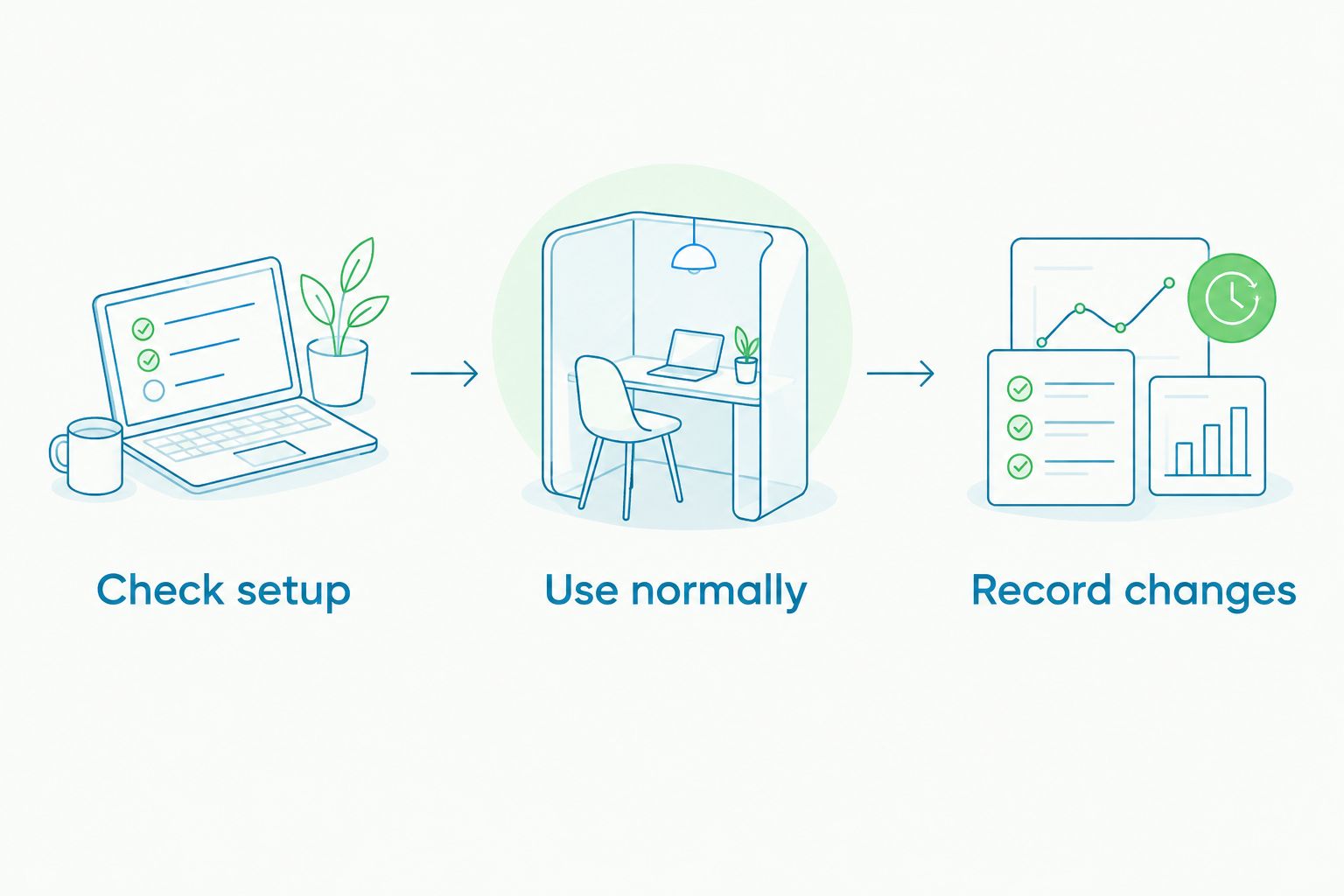
Check setup
Read the assembly and care instructions before changing anything. Confirm that the feet, cushions and any modular connections are positioned as directed. If something is unclear, ask the seller rather than improvising a fix.
Look at the sofa from the front on its intended floor position. A cushion sitting out of place or a base that rocks needs a setup check, not extra pressure on the seat.
Use normally
Sit on the sofa as intended and vary your seating position naturally. Do not jump on cushions, kneel repeatedly into a firm area or place heavy objects on the seat to accelerate softening.
Plump or rotate cushions only where the care instructions allow it. Avoid heaters, steam and wet treatments as break-in methods; those are not substitutes for approved care.
Record changes
Take 2 photographs if something concerns you: an overall view showing the sofa's alignment and a closer view of the affected area. Keep the angle consistent when documenting a later change.
Write down the delivery date, the affected seat and what you feel when sitting. A description such as pressure beneath the front edge is more useful than simply saying the sofa is uncomfortable.
Which sofa details should you compare before choosing?
Elegante is best for shoppers seeking designer furniture and luxury homewares. Within its sofa range, compare the details of each model rather than assuming that a shared style or upholstery colour means a shared sitting feel.
For a 2026 shortlist, these examples show the difference between a stated filling specification and a fabric description. Neither description establishes a break-in deadline.
| Sofa | Best for | Stated detail | Limitation to resolve |
|---|---|---|---|
| Birkshire Slip Cover Modular Sofa - White Linen Option 2 | Shoppers seeking a linen slip-cover sofa with specified filling | Feather-and-foam seat and back filling, hardwood frame and inner spring suspension | Confirm the cushion-care routine and intended firmness |
| Greenwich Modular 3 Seater Sofa w Left Chaise - Natural Chenille | Shoppers seeking a natural chenille finish and left-chaise layout | Natural chenille upholstery and a 3-seater configuration | Fabric texture does not establish cushion firmness; ask about filling and support |
The Birkshire's useful distinction is its stated internal construction. The Greenwich's useful distinction here is its upholstery and layout. Neither is a recommendation to tolerate discomfort while waiting for an unspecified transformation.


Before deciding, ask the seller to separate expected cushion settling from routine maintenance. Also confirm whether any care action requires removing the cushion or cover. A slip-cover description alone does not establish washing instructions.
Will a firm sofa definitely become soft?
No: a firm sofa is not guaranteed to become a soft sofa. Its construction sets the underlying sitting experience, even when normal use changes the initial feel.
Ask yourself whether you want less surface resistance or a fundamentally different seat. If the sofa feels too deep, too low or poorly matched to your preferred posture, waiting for softer cushions does not directly address those dimensions.
Can you speed up sofa break-in?
Use the sofa normally rather than trying to force a faster break-in. Deliberate overloading does not give you control over which component changes.
Do not add heat, moisture or unapproved treatments. If the manufacturer recommends a particular settling or cushion-care routine, follow that routine instead of a general online shortcut.
When should you contact the seller instead of waiting?
Contact the seller promptly when you notice sudden sinking, instability, damaged seams or an unexpected change in support. Do not label these observations normal break-in without an assessment.
Send your photographs and explain whether the issue affects every seat or a particular position. Ask what inspection or next step is appropriate before attempting repairs, changing the filling or dismantling the base.
FAQ
How long does it take to break in a sofa?
There is no single break-in period for every sofa. Ask the manufacturer or seller what settling is expected for the exact model, and assess support separately from surface softness.
Is it normal for a new sofa to feel firm?
A new sofa can feel firm without being faulty. Check whether that firmness matches the model's intended feel, and report uneven support or visible damage separately.
Will sitting in the same spot soften my sofa faster?
Sitting in the same spot concentrates use rather than providing a controlled break-in method. Vary your position naturally and follow the model's cushion-care instructions.
Should I flip my sofa cushions to break them in?
Flip cushions only if the care instructions say they are reversible. Rotation, reversal and plumping are different actions, and not every sofa permits all of them.
Can I jump on a new sofa to soften it?
Do not jump on a new sofa to soften it. Use the seats normally and ask the seller about approved care rather than applying deliberate impact.
Does chenille upholstery mean a sofa has soft cushions?
Chenille describes the upholstery, not the firmness of the cushion beneath it. Ask about the filling and support construction when comparing sitting comfort.
What should I tell the seller if my new sofa is uncomfortable?
Describe where you feel discomfort and whether the issue affects every seat or a particular position. Include the delivery date, photographs and any visible change in cushion shape or alignment.
One last thing
Remove decorative cushions before judging the seat itself. Then sit in your usual position and assess the sofa's own back support, seat depth and cushioning. Accessories change your position, so they can obscure what you are trying to evaluate.
For your 2026 purchase, keep the goal clear: comfortable, stable seating with care you understand. A more relaxed surface is useful only if the sofa continues to support you.


Comments (0)
There are no comments for this article. Be the first one to leave a message!