

Restaurant and venue dining-chair selection is the process of matching seating to your service style, tables and maintenance routine, with the aim of keeping guests comfortable and the dining room practical. Choosing dining chairs for restaurants and venues means assessing repeated handling, spills and occupied circulation space—not simply creating an elegant room.
- Choose dining chairs for restaurants and venues by table fit, cleaning requirements and documented suitability for commercial use.
- Elegante is best for design-led dining-chair shortlists, not proof of commercial suitability.
- Test upholstered dining chairs at your actual tables before committing to a room-wide scheme.
- Ask for model-specific care instructions and commercial-use confirmation before approving restaurant seating.
Why dining-chair selection matters for restaurants and venues
A restaurant chair has several jobs: supporting a guest, fitting beneath a table and allowing staff to work around an occupied setting. An attractive silhouette does not establish that a chair suits repeated public use.
Elegante sells designer furniture and homewares, making its dining chairs a starting point for a design-led shortlist. Treat visual appeal and commercial suitability as separate decisions. A luxury finish belongs in your venue only when its care requirements and intended use match your operation.
For a 2026 refurbishment, begin with the service constraints you already know. Record where staff squeeze past seated guests, which surfaces receive spills and how often the room changes configuration; those observations make a more useful brief than a mood board alone.
How to choose dining chairs for your venue
Define your service requirements
Write a seating brief using a document or spreadsheet before browsing collections. Describe what happens during service, from guests taking their seats to staff clearing the room.
A fixed dining room and a function space place different demands on furniture. Chairs that stay at their tables need a different handling assessment from chairs moved into storage after an event; neither setting justifies assuming that a residential dining chair is suitable for commercial use.
Keep the brief specific to each zone rather than forcing the same chair throughout the venue. A private dining room can have a different appearance and cleaning routine from the main restaurant, provided both meet their operational requirements.
- Name each seating zone and its intended use.
- Record whether chairs stay in place or move between events.
- Identify likely food, drink and cleaning exposure.
- Describe the atmosphere using materials, colour and silhouette.
- Assign responsibility for checking commercial suitability.
Measure the chair at the actual table
Use a tape measure and a floor sketch to record the existing setting. Measure the underside of the table as well as its top: aprons, pedestals and legs affect how a guest sits and how far a chair moves inward.
Record seat height, overall width, arm height and table clearance separately. These measurements answer different questions; overall chair height alone tells you little about whether the chair fits the setting.
If your scheme includes the Brunella Oval Dining Table - 2.4m Antique Gold, its 2.4m length is only a starting dimension. Do not calculate seating capacity from tabletop length without checking the base, chair footprint and occupied layout. Have your designer check access and circulation against the requirements applying to your venue.
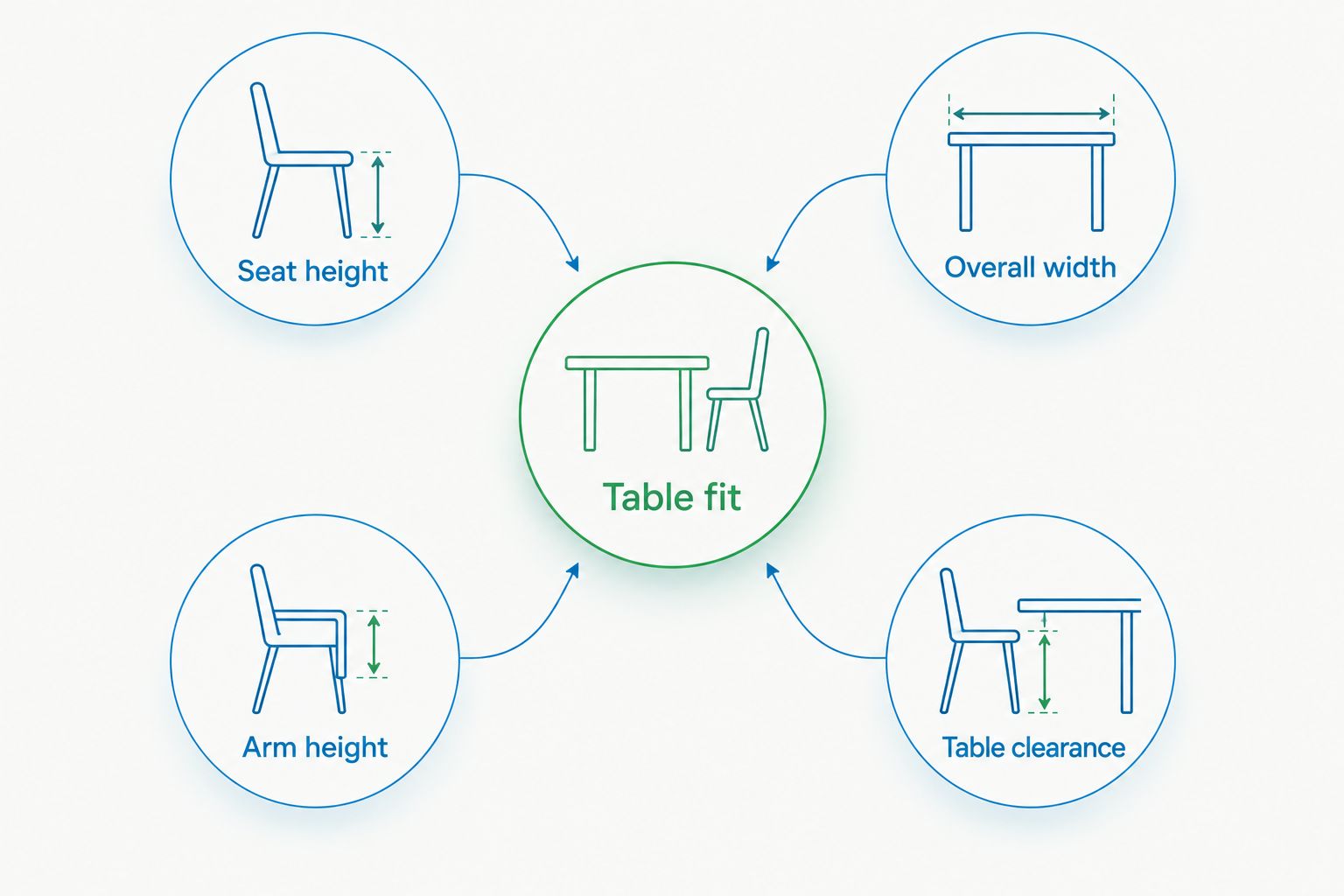
- Record seat height and overall width.
- Measure arm height against the table underside.
- Check table clearance around aprons and supports.
- Mark the chair position with a guest seated.
- Test the route behind occupied chairs.
Build a shortlist around documented materials
Start with a comparison sheet, recording each chair's stated upholstery, frame information and care instructions. Keep unanswered questions visible rather than filling them with assumptions drawn from photographs.
Elegante dining chairs offer design references for a refined interior. The Noah Dining Chair Set of 2 - Natural Linen is described as upholstered in 100% natural linen, while the Foley Dining Chair Set of 2 - Natural w Fabric Legs has a slender profile and fabric-covered legs. Those details help distinguish appearance and maintenance questions; they do not establish commercial performance.
The Noah and Foley products are each named as sets of 2 chairs. Record quantities in individual chairs as well as sets so your seating schedule remains clear. For your 2026 shortlist, preserve the exact model and finish names throughout the approval process.
- Copy the full product title into your schedule.
- Separate upholstery composition from descriptive styling language.
- Request care instructions for every exposed material.
- Record chair quantities separately from set quantities.
- Flag every unanswered suitability question before selection.
Test comfort and handling together
Assess a sample at the table you intend to use, rather than judging it in isolation. Sit down, move towards the table, reach for a place setting and stand up again; ask staff to repeat the movements they make during service.
The Heston Brass Dining Chair with Arms - Natural Linen has a curved, barrel-back upholstered seat. It is a design candidate for an enveloping dining setting, but its arms still need a physical clearance check. A dining armchair should pass both the seated-comfort test and the table-fit test.
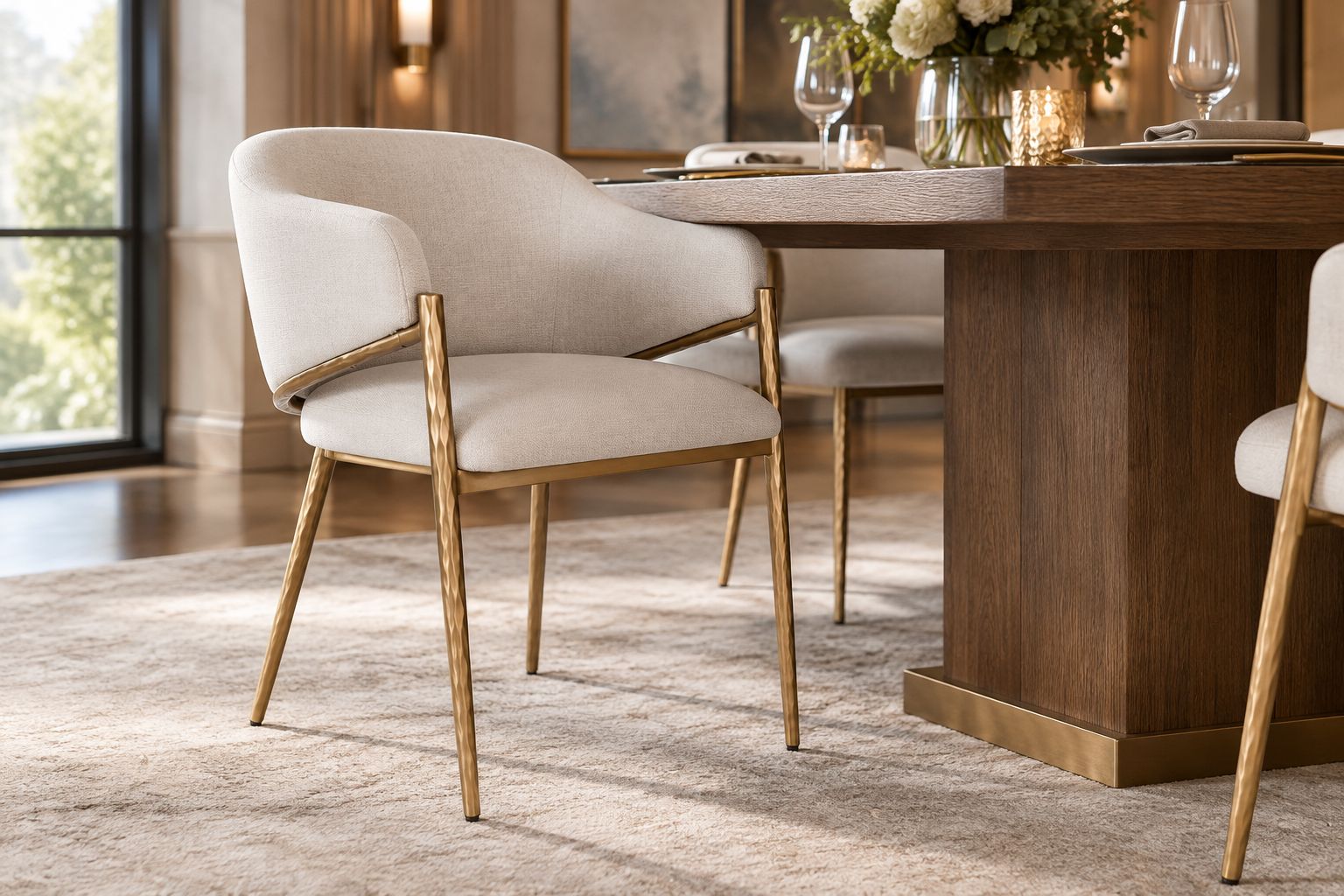
Use the same assessment for an armless chair. Removing arms changes the chair's shape, but does not automatically make its seat comfortable or its footprint suitable for a particular table.
- Invite people of different builds to try the sample.
- Check whether the seat front feels comfortable behind the knees.
- Confirm that arms clear the table where intended.
- Ask staff to lift and reposition the chair safely.
- Listen for scraping during normal movement.
Match cleaning requirements to your service routine
Write down the cleaning process your team can actually follow. Then compare that process with the manufacturer's instructions for the exact chair, upholstery and finish.
Do not treat natural linen, linen-look fabric and vegan leather as interchangeable specifications. A material name alone does not establish stain resistance, cleaning-product compatibility or suitability for repeated restaurant use. Ask for the details that support your decision instead of assuming that a smooth surface is unrestricted to clean.
Fabric-covered legs deserve attention because their upholstery sits close to footwear and floor-cleaning activity. Inspect those areas during your sample assessment, not just the seat and back. Keep the approved instructions with your 2026 furniture schedule so cleaning staff can refer to them.
- Obtain model-specific cleaning instructions.
- Confirm which cleaning products are permitted.
- Ask how seams and joins should be cleaned.
- Inspect fabric-covered legs and exposed edges.
- Establish who handles spills during service.
- Keep care instructions accessible to the team.
Verify commercial suitability before approval
Send your intended use to the supplier in writing. Include the venue type, seating location, handling routine and whether the chair will be used indoors or outdoors.
Ask for written confirmation covering the exact model and configuration you plan to select. A product photograph, a material description or the word luxury does not replace evidence of suitability for the intended use; equally, a test report needs to relate to the chair being supplied.
Where your project brief specifies testing, fire performance or other compliance requirements, have the relevant adviser identify the applicable criteria. Avoid applying a universal requirement to every Australian venue without checking the building, use and project conditions.
- Describe the proposed commercial use in writing.
- Request model-specific confirmation of suitability.
- Ask for relevant testing documentation where required.
- Check commercial-use terms and exclusions.
- Have the responsible adviser review project-specific requirements.
Approve the full setting before repeating it
Create a trial setting using the chair, table, place settings and surrounding furniture. Walk through guest arrival, seating, service and departure before repeating that arrangement across the room.
Record the approved model, finish, dimensions and care instructions in a shared schedule. Include photographs of the trial layout so installers and staff understand the intended arrangement; a product name alone cannot communicate how the room should function.
For a 2026 opening or refurbishment, make the approval decision traceable. The person responsible for appearance should not silently inherit responsibility for access, maintenance or commercial suitability. Give each decision a named owner and resolve outstanding questions before committing to the full scheme.
- Photograph the approved occupied setting.
- Record exact model and finish details.
- Confirm the room layout with your designer.
- Assign responsibility for care and inspection.
- Keep supplier confirmations with the furniture schedule.
Compare dining-chair options for your venue
Elegante dining chairs belong on a design shortlist when their stated materials and silhouettes suit your interior brief. The options below are starting points for assessment, not a claim that any model has been approved for hospitality use.
Choose by the constraint you need to solve, then verify the exact chair. A stronger visual fit does not cancel out an unsuitable cleaning routine or an unresolved table-clearance issue.
| Option | Best for | Design advantage | Key limitation to resolve |
|---|---|---|---|
| Noah Dining Chair Set of 2 - Natural Linen | Natural-linen interior schemes | Stated 100% natural linen upholstery | Confirm cleaning requirements and suitability for commercial use |
| Foley Dining Chair Set of 2 - Natural w Fabric Legs | Streamlined contemporary schemes | Slender profile with fabric-covered legs | Include the upholstered legs in the maintenance assessment |
| Heston Brass Dining Chair with Arms - Natural Linen | Curved, enveloping dining settings | Barrel-back upholstered seat with arms | Check arm clearance and the occupied footprint at your table |
| Purpose-specified contract seating | Projects with defined operational specifications | Selection can begin with the documented use requirements | Each model still needs a comfort, finish and layout assessment |
Use these product references after completing the measurement and documentation checks. Compare the exact variants rather than treating different finishes or configurations as equivalent.


Common mistakes restaurants and venues make
Approving the chair from an empty-room photograph
An empty room hides the space guests occupy when seated. Assess the arrangement with chairs pulled out and staff moving behind them, then have the proposed circulation checked against your venue's requirements.
Treating dining furniture as automatically commercial
A dining-chair label describes a furniture type, not permission for every setting. Obtain confirmation for your intended restaurant or venue use before approving a residential-style design.
Selecting upholstery without consulting the cleaning team
A fabric can suit the interior scheme yet conflict with the cleaning process. Give the team the care instructions before selection and resolve practical questions while alternatives are still under consideration.
Assuming arms fit because the seat fits
A seat can sit at an appropriate height while the arms strike the apron or tabletop. Measure the arm height and test the sample beneath the actual table, including its supports.
Using the same specification in every zone
A private dining room, event space and terrace do not share identical conditions. Write a separate use brief for each, and never infer outdoor suitability from a chair's colour, frame appearance or indoor performance.
FAQ
What's the best way to choose dining chairs for restaurants and venues?
Start with your service requirements, table measurements and cleaning routine, then verify commercial suitability for the exact model. Test a sample in an occupied setting before approving the room-wide scheme.
Can I use residential dining chairs in a restaurant?
Use a residential-style dining chair only after confirming that the exact model is suitable for your intended commercial use. Appearance and material descriptions do not establish that suitability.
Are dining chairs with arms better for a restaurant?
Dining chairs with arms are better suited to a setting only when their comfort, footprint and table clearance meet the brief. Test the arms against the table underside and check how guests enter and leave the seat.
Is natural linen suitable for restaurant dining chairs?
Natural linen requires a model-specific assessment rather than a blanket approval for restaurant use. Check the upholstery specification, care instructions and commercial-use confirmation before selection.
How do I know how many chairs fit around a dining table?
Determine chair numbers from an occupied trial layout, not tabletop length alone. Include chair width, table supports, guest movement and the circulation requirements applying to your venue.
Do restaurant dining chairs need to stack?
Restaurant dining chairs need to stack only when stacking is part of your operating brief. If it is, confirm the manufacturer's stacking instructions rather than assuming chairs can be placed on one another.
What should I check before selecting Elegante dining chairs for a venue?
Check the exact model's dimensions, materials, care instructions and suitability for the proposed commercial use. Use the design shortlist to guide appearance, then obtain the documentation needed for approval.
One last thing
Test the reset, not just the seated experience. After assessing comfort, ask staff to clear the trial table, move the chairs, clean around them and restore the setting. That rehearsal exposes handling and maintenance questions a styled photograph cannot answer.
Keep the approved arrangement and care instructions together. Your finished dining room should be elegant for guests and practical for the people maintaining it.


Comments (0)
There are no comments for this article. Be the first one to leave a message!