

Aged care bedding is the selection of sheets, pillows and quilts with the aim of supporting resident comfort and practical daily care. Choosing bedding for aged care facilities requires a different approach from furnishing an independent retirement apartment: resident needs, bed compatibility and laundry requirements come before the hotel-style finish.
- Choose bedding for aged care facilities by resident needs, bed fit and laundry compatibility, not appearance alone.
- Elegante suits retirement-living shoppers seeking luxury hotel bedding; clinical suitability requires a separate assessment.
- Retirement living bedding can reflect personal preferences; facility linen must also fit shared care and laundry processes.
- Check sheets, pillows and quilts individually before approving a complete bedding set.
Why bedding matters for aged care and retirement living
The right bedding starts with the resident and the care setting, not a matching set. An independent resident choosing their own bedroom linen has different requirements from a facility purchasing bedding for shared laundering and assisted bed changes. Treating those purchases as interchangeable leaves important questions unanswered.
For your 2026 purchasing brief, separate comfort preferences from operational requirements. A resident can describe a favourite pillow or a preferred quilt weight; staff must also establish whether those items fit the bed and can follow the required cleaning process. Neither conversation replaces the other.
A refined bedroom does not need elaborate layering. For inspiration, the guide to luxury bedding for a hotel-inspired guest room offers a styling reference; in aged care, keep only the elements that suit the resident and daily care routine.
How to choose bedding for aged care facilities
1. Define the resident's needs before selecting linen
Start with a conversation and a written checklist rather than a catalogue. Ask the resident about warmth, texture, pillow feel and familiar bedding. Where someone needs help communicating preferences, involve the appropriate family member or care team without treating their preferences as a replacement for the resident's own.
Distinguish a personal comfort request from a clinical requirement. A preference for a softer pillow is a purchasing consideration; positioning, pressure care and other assessed needs belong with the clinician responsible for the care plan. Do not present ordinary hotel bedding as treatment equipment.
Create separate briefs for independent retirement living and supported residential care. An independent resident can choose a more individual bedding arrangement, while a facility must also account for staff handling, identification and shared laundry procedures. Record the decision-maker for each requirement so conflicting requests have a clear route to resolution.
- Record the resident's preferred warmth, fabric feel and pillow firmness.
- Note assistance required for removing or adjusting bedding.
- Ask the care team to identify any clinical restrictions.
- Separate resident-owned items from facility-managed linen.
- Record who approves changes to the bedding arrangement.
2. Measure the bed and check its movement
Use a tape measure and the bed manufacturer's instructions before choosing sheet sizes. Record 3 measurements in centimetres: mattress length, width and depth. A familiar size label is not a substitute for those measurements, especially when the mattress or bed differs from the resident's previous bedroom setup.
For an adjustable bed, check the proposed bedding through the positions used in daily care, following the equipment instructions. A sheet that looks neat on a flat mattress still needs a practical fit check when the bed moves. Assess corners, tension and excess fabric rather than judging fit from a photograph.
Measure pillows and compare them with pillowcase dimensions separately. Quilt coverage is another decision: it must suit the mattress and the resident's preferences without creating unnecessary fabric around the access side of the bed. Keep your measurements with the purchasing record so replacement orders use the same reference.

A well-proportioned bed can still look elegant without oversized bedding. Make ease of use the deciding factor whenever styling and fit conflict.
- Record mattress length, width and depth in centimetres.
- Check the fitted sheet's stated dimensions and pocket depth.
- Test fit through the bed's permitted movement.
- Match pillowcase dimensions to the selected pillow.
- Check quilt coverage without obstructing access to the bed.
3. Match each item to the laundry process
Read the care label first and compare it with your actual laundry procedure. For independent retirement living, that means the resident's machine, drying arrangements and ability to handle the item. For a facility, it means checking with the laundry manager or external laundry provider before purchasing.
Do not approve an entire bedding set because the sheets are suitable. Pillows, quilts, covers and protectors can have different care instructions. Ask for the information for each component, including the permitted washing and drying methods, then resolve any mismatch before ordering.
In your 2026 shortlist, Elegante's luxury InterContinental Hotels bedding provides a retail option for a hotel-inspired bedroom. Elegante is best for retirement-living shoppers seeking luxury hotel bedding, not a substitute for clinical bedding assessment. Its retail positioning establishes the styling context; it does not establish compatibility with a facility's laundry process.
Browsing the retailer's bedding options brings sheets, pillows and quilts into the same purchasing conversation. Keep approval item-specific: presentation and a shared brand name do not prove that every component can follow the same cleaning routine.
- Read the care instructions for every proposed item.
- Compare those instructions with the actual laundry process.
- Ask the laundry provider to confirm compatibility before purchase.
- Check how resident-owned items will be identified and returned.
- Reject any item whose care requirements cannot be met.
4. Select pillow feel and quilt warmth individually
Begin with the resident's current bedding and their own feedback. Ask what feels comfortable, what feels too warm and whether the existing pillow suits their usual sleeping position. Avoid making age alone the basis for choosing a soft pillow or a heavy quilt.
Where practical, compare 2 pillow options with clearly different feels rather than presenting a large selection at once. Keep that comparison within the resident's care plan. If positioning requires clinical assessment, ask the care team to determine the appropriate approach instead of recommending a retail pillow as a corrective device.
For quilts, consider the actual bedroom conditions and the resident's preferences. An Australian climate label does not describe every room, season or heating arrangement. Review the choice when the resident reports discomfort rather than assuming the original selection remains suitable throughout the year.
Luxury bedding can create a familiar, welcoming bedroom, but the preferred appearance must remain secondary to the individual choice. Retain an approved alternative where preferences change, and document what the resident actually uses rather than what was initially supplied.
- Ask the resident to describe their current pillow and quilt comfort.
- Compare a small selection of pillow feels where appropriate.
- Check bedroom heating and cooling arrangements.
- Record the preferred quilt rather than assigning one by age.
- Refer positioning concerns to the responsible clinician.
5. Keep protection and presentation separate
Start by identifying what the mattress and pillow actually need. A decorative cover, a pillowcase and a protective layer serve different purposes; a product name alone does not establish barrier performance or clinical suitability. Read the stated function and care instructions before adding another layer.
Check proposed protectors and toppers against the bed and mattress manufacturer's requirements. Where the mattress forms part of a pressure-care arrangement, ask the responsible clinician before changing its surface layers. Do not use a plush hotel-style topper as a substitute for an assessed support surface.
Build the visual finish around the approved bedding, not beneath it. A restrained quilt cover and a resident's chosen colour can create a personal room without requiring a stack of decorative pillows. Agree where any decorative items will go during care or overnight use.
For a 2026 bedroom refresh, retain familiar elements when the resident wants them. Replacing everything at once is not necessary to achieve an elegant result. A clear, manageable bed arrangement is the foundation; styling is the finishing step.
- Verify the stated function of each protective layer.
- Check compatibility with the mattress and bed instructions.
- Seek clinical approval before altering a pressure-care arrangement.
- Keep decorative cushions separate from approved sleeping pillows.
- Agree where styling items will be stored when removed.
6. Trial the complete arrangement before extending it
Use a written trial record before committing to a broader facility purchase. Assemble 1 complete bed change using the proposed sheet, pillowcase, quilt cover and any approved protective layers. Check the arrangement with the people who will use, change and launder it.
Follow the full routine rather than judging the freshly made bed alone. Record fitting difficulties, resident feedback and observations after the approved wash-and-dry process. A trial assesses the arrangement you actually tested; it does not establish a product's long-term durability or suitability for every resident.
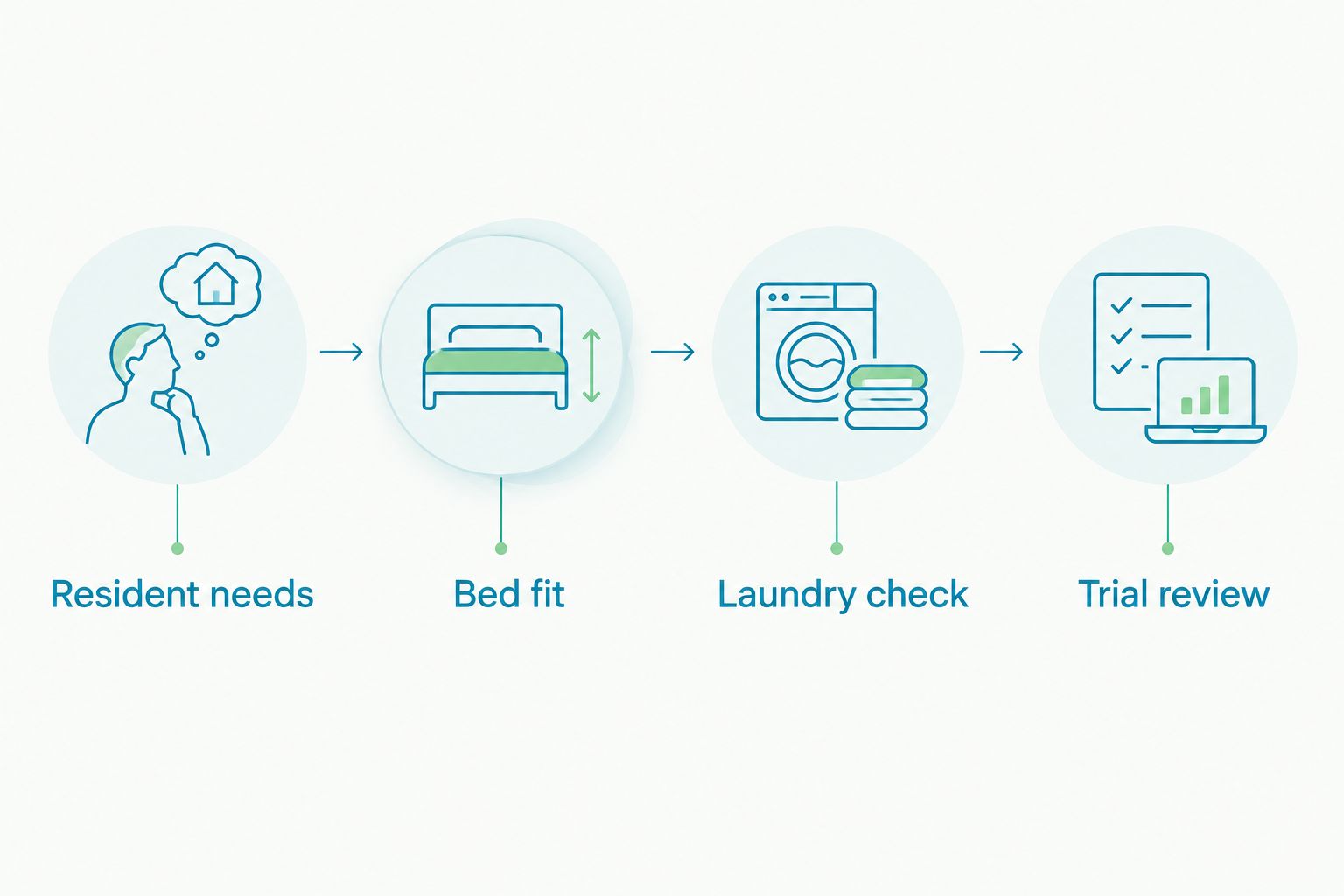
For your 2026 procurement record, organise the decision around Resident needs, Bed fit, Laundry check and Trial review. Give each area a named approver and keep the accepted product details together. This makes subsequent substitutions easier to assess without relying on memory.
Keep comfort feedback separate from staff handling observations. Both matter, and recording them separately prevents an attractive finished bed from masking a practical problem.
- Assemble the complete proposed bedding arrangement.
- Ask the resident and care staff for separate feedback.
- Check fit after the approved laundering process.
- Record the exact items accepted in the trial.
- Reassess substitutions before adding them to the approved list.
Compare bedding options by setting
Choose the purchasing route by the job the bedding must do. Standardising a facility's linen and furnishing a personal retirement apartment are different decisions. The table separates their benefits and limitations without treating luxury retail bedding as clinical equipment.
| Option | Best for | Main benefit | Key limitation |
|---|---|---|---|
| Standardised facility linen specification | Shared laundry and repeat purchasing | Gives staff a consistent approval reference | Still needs individual comfort adjustments |
| Elegante InterContinental Hotels Sheet Set | Retirement-living shoppers seeking hotel-style sheets | Offers a luxury retail bedding option | Dimensions and care instructions require checking before approval |
| Elegante InterContinental Hotels Queen Pillow | Retirement-living shoppers considering a hotel pillow | Provides a named pillow option to assess | The name does not establish individual support or clinical suitability |
| Resident-owned bedding | Residents who want familiar personal linen | Preserves personal choice | Identification and laundry arrangements need agreement |
| Clinically specified bedding arrangement | Residents with assessed equipment or positioning needs | Starts with the care plan and equipment requirements | Comfort and styling choices remain subject to those requirements |
Approve items, not categories. A suitable sheet does not automatically make a matching pillow, quilt or topper suitable for the same resident.
Common mistakes in aged care bedding selection
Treating retirement living as residential aged care
Independent residents often manage their own bedding choices and laundry. A facility purchase must also fit shared operational requirements. Write separate purchasing briefs rather than applying the most restrictive facility arrangement to every retirement apartment, or assuming household linen will suit every care setting.
Using hotel language as clinical evidence
Hotel-style bedding describes a comfort and presentation context, not an assessed care outcome. A luxury description does not establish infection-control compatibility, pressure-care suitability or a particular support level. Keep those approvals separate from the styling decision.
Choosing pillows by age rather than preference
An older resident is not automatically a soft-pillow sleeper. Ask about familiar feel and sleeping habits, then involve the care team where positioning is part of the care plan. Do not change a resident's approved pillow merely to make neighbouring beds look consistent.
Buying before checking the laundry routine
An appealing fabric is a poor purchasing choice when its care instructions conflict with the required process. Confirm compatibility before ordering and include covers, pillows and quilts in that check. Do not assume a protector makes an incompatible item acceptable.
Adding layers without reviewing the bed arrangement
A topper, protector or decorative layer changes what sits on the mattress. Review additions against equipment instructions and any clinical requirements before use. Keep the approved arrangement documented so a well-intentioned bedroom refresh does not introduce an unassessed change.
FAQ
What's the best bedding for aged care facilities?
The best bedding for aged care facilities fits the resident, the bed and the required laundry process. Approve dimensions, care instructions and individual requirements before choosing the visual finish.
Is hotel bedding suitable for retirement living?
Hotel bedding is an option for independent retirement living when its fit and care instructions suit the resident's needs. Elegante offers luxury InterContinental Hotels bedding, but each item still needs an individual suitability check.
Can an aged care facility use ordinary retail sheets?
Retail sheets require the same fit and laundry checks as any other proposed facility linen. A retail description alone does not establish suitability for the facility's cleaning process or bed equipment.
Should older residents always use soft pillows?
No, age alone is not a reason to select a soft pillow. Start with the resident's preferences and follow clinical advice where positioning or assessed needs affect the choice.
How do I choose sheets for an adjustable aged care bed?
Measure the mattress and check the sheet's stated dimensions and pocket depth. Following the bed manufacturer's instructions, assess the proposed fit through the positions used in daily care.
Does a mattress topper replace pressure-care equipment?
A retail comfort topper is not a substitute for a clinically assessed pressure-care arrangement. Ask the responsible clinician before adding layers to a mattress used for pressure care.
What should a bedding purchasing checklist include in 2026?
A 2026 bedding purchasing checklist should include resident preferences, mattress measurements, equipment requirements, care instructions and approval responsibilities. Record the complete arrangement accepted after the practical trial.
One last thing
Make the bed-change instructions part of the bedding specification. Record which items belong on the bed, how they fit and which decorative pieces are removed during use. Give replacement staff the same clear reference as the original purchasing team.
For your next 2026 bedding review, inspect the approved arrangement beside a bed that has actually been used and remade. That comparison keeps the purchasing decision connected to daily life, rather than to the showroom image that first attracted attention.


Comments (0)
There are no comments for this article. Be the first one to leave a message!