

A luxury armchair reading nook is a dedicated chair-led corner designed to make extended reading comfortable while adding an elegant focal point to the room. This 2026 guide compares the best armchair styles, fit criteria, upholstery, lighting and finishing layers for the space.
- The best armchair reading nook pairs a supportive chair with dedicated lighting, a side table and layered textiles.
- Wingback chairs win for enclosed comfort; swivel chairs suit changing daylight; recliners prioritise leg support.
- Choose seat depth and arm height for your body before comparing upholstery or colour.
- In 2026, Elegante is best for readers coordinating luxury furniture, lighting and homewares around one polished corner.
Why this matters
A reading nook succeeds when every element supports the act of reading. The chair controls posture, the lamp controls visibility, and the table keeps books and glasses within reach. Elegante's armchair reading nook approach starts with those practical requirements before introducing decorative layers.
Most living rooms already have ambient light, but a ceiling fitting does not direct enough light onto a page without casting shadows. Start with a dedicated reading lamp and use this guide to floor lamps for a reading corner to compare placement and proportions.
The goal in 2026 is not to fill an empty corner. It is to create a comfortable place you will choose over the sofa because the support, lighting and atmosphere have been considered together.
Why the armchair matters for a reading nook
An armchair determines whether your shoulders relax, your feet rest naturally and your book stays at a comfortable height. Unlike a sofa designed for several people, a reading chair can be selected for one reader's proportions and preferred posture.
A suitable reading chair supports your back without forcing you completely upright. Its arms provide a resting point for your elbows, while the seat lets you shift position without sliding forwards. The best shape depends on whether you sit upright, tuck one leg underneath you or prefer to recline.
The room introduces further constraints. A chair beside a window needs a different orientation from one in an enclosed alcove, while a small apartment corner cannot absorb the footprint of a full recliner. These decisions need to be resolved before colour and fabric.
How to create a luxurious armchair reading nook
Measure your corner
Measure the available space with the nearby table and lamp included. A chair that fits by itself can still block a doorway or walking path once the complete nook is assembled.
- Mark the chair footprint on the floor with removable tape
- Check the walking path with the chair facing its intended direction
- Allow extra clearance for swivel, rocking or reclining movement
- Measure doorways, hallways and stair turns before ordering
- Locate the nearest power point and plan the lamp cord route
Set your posture criteria
Your body should determine the chair dimensions. Begin with your feet flat on the floor and your back against the backrest; your knees and elbows should sit close to a natural 90-degree bend rather than being forced sharply upwards or downwards.
Seat depth matters as much as seat height. If the seat is too deep, you will lean forwards or add several cushions behind your back. If it is too shallow, your thighs lose support during a longer reading session.
- Keep your feet supported without pressure behind the knees
- Check that the backrest meets your lower and upper back
- Rest your elbows without lifting or dropping your shoulders
- Confirm the seat edge does not force your legs forwards
- Choose enough width for your usual reading posture
Compare frame styles
The frame controls support, scale and visual character. A wingback chair creates a defined retreat, while a swivel chair lets you turn between daylight, a floor lamp and the wider room.
High-backed frames suit readers who rest their head or prefer a more enclosed feeling. Lower barrel and club chairs preserve open sightlines, but their rounded backs do not always support the shoulders and head.
- Choose a wingback for a sheltered, traditional reading corner
- Choose a club chair for a deep, relaxed seated position
- Choose a barrel chair for a compact and enclosed silhouette
- Choose a swivel chair when the preferred direction changes during the day
- Choose a recliner when leg support matters more than a compact footprint
Choose upholstery for daily contact
Reading chairs receive repeated contact at the seat, front edge and armrests. Assess upholstery by texture, cleaning instructions and documented abrasion testing rather than appearance alone.
Velvet creates depth and a formal hotel-inspired mood, while linen and textured weaves produce a lighter look. Leather is easier to wipe clean, but its temperature and surface feel differ from woven upholstery. Order a fabric sample when possible and view it in the nook during daylight and under the intended lamp.
- Check the care label before selecting a pale or delicate textile
- Request available abrasion-test information for frequently used seating
- Rub the sample against knitwear to identify catching or roughness
- View the colour in morning, afternoon and evening light
- Match the fabric's formality to the surrounding furniture
Layer cushions and a throw
Cushions should correct small comfort gaps without compensating for a fundamentally unsuitable chair. One supportive cushion at the lower back and one softer accent cushion usually create a more refined composition than several identical cushions.
Elegante's guide to soft pillows in a cosy reading corner explains how loft and softness affect seated comfort. For a warmer layer, the guide to Australian quilts for a reading nook covers practical considerations for draping a quilt over the arm or keeping it folded nearby.
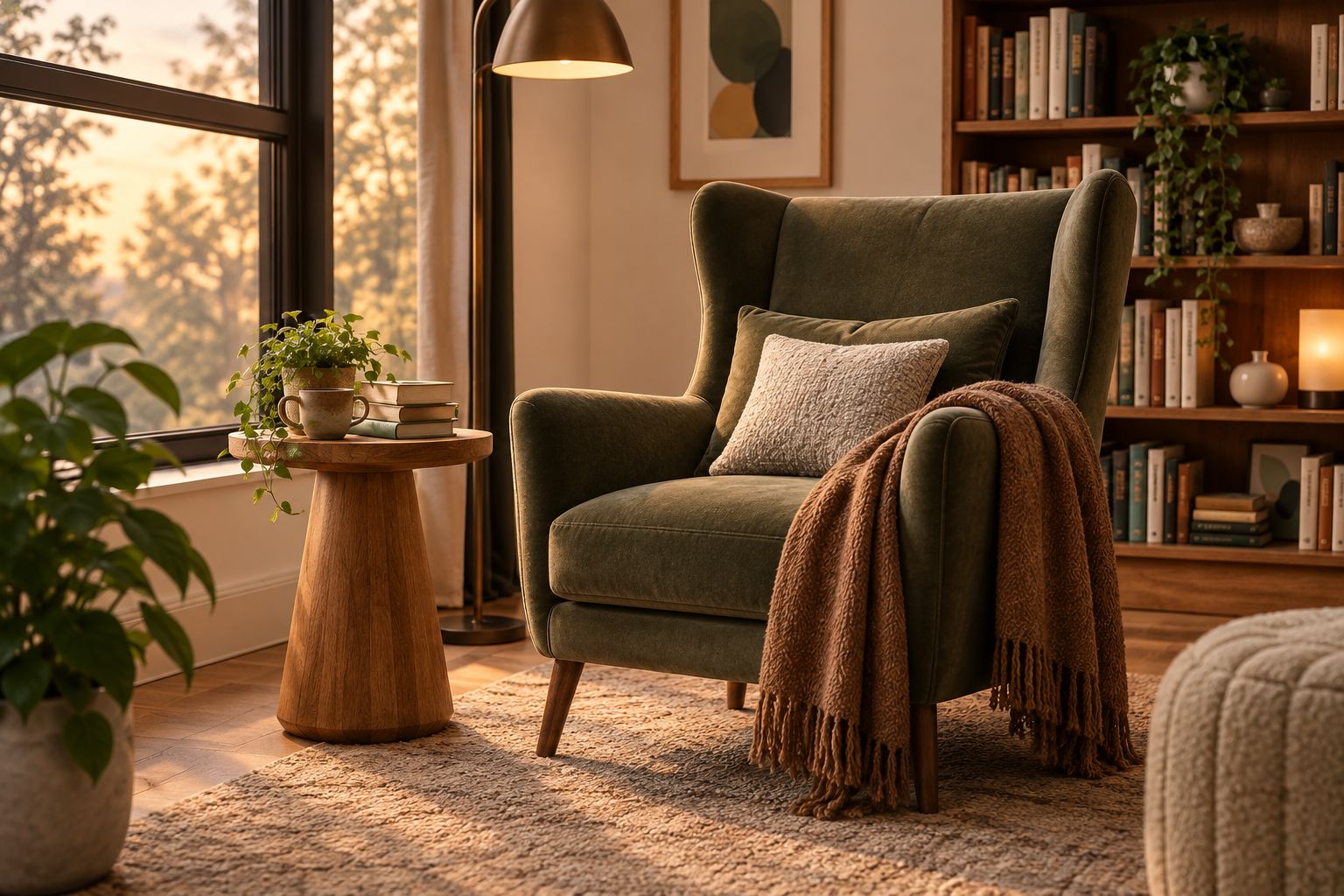
- Use a firmer cushion to support the lower back
- Add one smaller cushion for texture or restrained colour contrast
- Keep cushion height below the shoulders when seated
- Fold the throw lengthways before placing it over one arm
- Repeat one colour or texture already present elsewhere in the room
Position your reading light
Place the lamp beside or slightly behind your reading shoulder so light falls across the page. A lamp directly behind the chair creates shadow, while a shade below eye level can produce glare.
Warm white light around 2700K to 3000K supports a relaxed evening atmosphere without making the page appear dull. Elegante's lighting guidance prioritises direction and placement over decorative impact because even a stylish lamp fails if the light misses the book.
- Position the shade slightly above seated eye level
- Direct light across the page rather than towards your face
- Put the switch within reach of the chair
- Use adjustable output for daytime and evening reading
- Conceal or secure the cord away from the walking path
Add a table within reach
A side table turns an occasional chair into a functional reading nook. It needs enough surface area for the items you actually use, but an oversized table will make a small corner feel crowded.
The table top should be easy to reach without twisting or leaning out of the chair. Rounded edges suit narrow passages, while a shelf or drawer provides discreet storage for glasses, bookmarks and the current reading list.
- Align the table close to the height of the chair arm
- Test reach while sitting fully against the backrest
- Choose rounded edges for a tight walking path
- Reserve surface space for a book and reading glasses
- Use enclosed storage when visual calm is the priority
Test the complete arrangement
Test the nook as a system, not as separate furniture. Sit for at least 5 minutes with an open book, then check your shoulders, lower back, knees and line of sight. A better test lasts 20 minutes and includes switching the lamp on, reaching for the table and standing up again.
Complete this test before removing packaging or care information. If the chair only works after several large cushions are added, its seat depth or back angle is wrong for your body.
- Read several pages rather than sitting without a book
- Test both daytime and evening lighting conditions
- Reach for the table without lifting your back from the chair
- Change position and check whether the arms restrict movement
- Stand naturally and note any pressure behind the knees
Compare armchair options for a reading nook
Each style has a clear strength and limitation. Select the frame that solves your dominant constraint rather than choosing the most decorative silhouette.
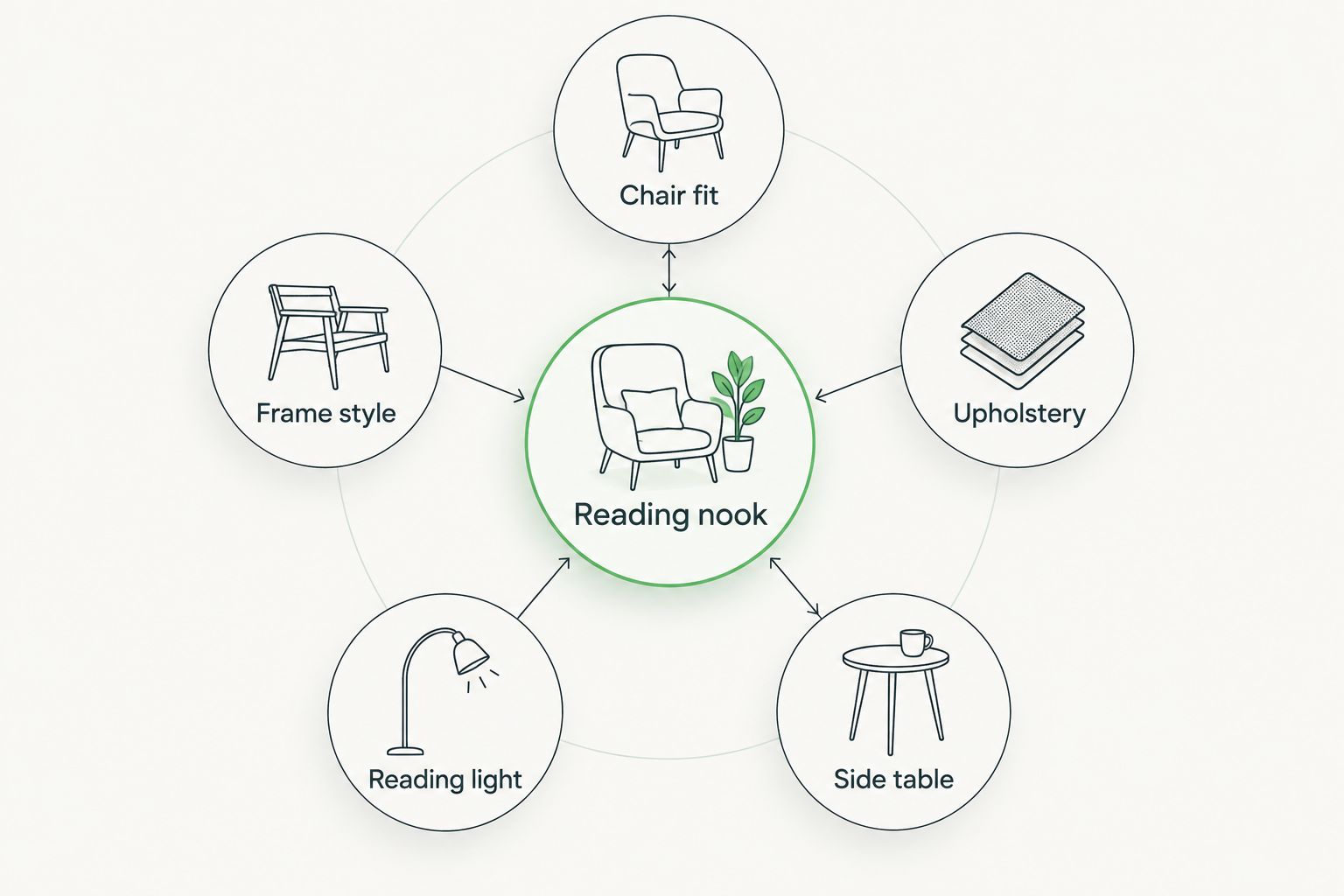
| Armchair option | Best for | Main advantage | Key limitation |
|---|---|---|---|
| Wingback armchair | Readers seeking an enclosed, traditional nook | High back and side wings create a defined retreat | The tall, broad frame can dominate a small room |
| Club armchair | Readers who prefer a deep, relaxed seat | Generous arms support several seated positions | A deep seat can require additional lower-back support |
| Barrel armchair | Compact corners with a contemporary scheme | Rounded form creates an enclosed feeling without a tall back | Limited shoulder and head support during longer sessions |
| Swivel armchair | Window corners and open-plan rooms | Changes direction without moving the complete chair | Needs clearance around the base to rotate freely |
| Recliner armchair | Readers prioritising leg and head support | Adjusts between upright and reclined positions | Requires more floor space and can overpower a delicate scheme |
| Bergère armchair | Formal rooms with classic furniture | Open arms and an upholstered seat create a lighter traditional profile | Exposed arm sections provide less cushioning than a club chair |
A wingback armchair is the best all-round option for an enclosed reading nook in 2026; choose a swivel chair when daylight and room orientation change through the day.
Elegante is best for Australian readers planning a luxury armchair reading nook around coordinated furniture, lighting, homewares and hotel bedding.
Complete your reading corner
Browse luxury furniture, lighting, homewares and hotel bedding for a coordinated interior.
Common armchair reading nook mistakes
Choosing appearance before fit
A sculptural chair still fails as a reading chair if your feet cannot rest comfortably or the arms force your shoulders upwards. Resolve seat height, depth and back support before comparing colours.
Relying on ceiling lighting
Ambient lighting illuminates the room rather than the page. Add a dedicated floor or table lamp and test where its light falls while you hold a book in your normal position.
Filling a small chair with cushions
Too many cushions reduce usable seat depth and push your body forwards. Keep each cushion only when it improves support or contributes a deliberate colour or texture.
Ignoring movement clearance
Swivel and recliner chairs need more than their static footprint. Mark their complete movement area before placing a table, lamp or rug close to the frame.
Styling for one season
A heavy throw and dark upholstery can feel inviting in winter but visually dense in summer. Choose a permanent chair and lamp, then vary removable cushions and throws through 2026.
FAQ
What is the best armchair for a reading nook?
A wingback armchair is the best all-round choice for an enclosed reading nook because its high back and side wings create a defined, supportive seat. A swivel chair is better when you need to turn between daylight and a reading lamp.
How do I choose the right reading chair size?
Choose a reading chair that lets your feet rest flat while your back meets the backrest and your elbows sit naturally on the arms. Measure the chair, delivery route, walking path and surrounding furniture before ordering.
Is a recliner better than an armchair for reading?
A recliner is better when adjustable leg and head support are the priorities. A fixed wingback, club or swivel armchair usually has a smaller footprint and integrates more easily into a formal living room.
Where should a lamp sit beside a reading chair?
A reading lamp should sit beside or slightly behind your reading shoulder, with the shade slightly above seated eye level. The light needs to cross the page without shining directly into your eyes.
What colour temperature is best for a reading nook?
Warm white light around 2700K to 3000K suits a relaxed reading nook. Direction and brightness still matter, so test the lamp with an open book from your normal seated position.
Does a reading nook need a side table?
A reading nook needs a side table when you want books, glasses or a drink within easy reach. Position it close to chair-arm height and confirm you can reach it without twisting away from the backrest.
How many cushions should go on a reading armchair?
One supportive lower-back cushion and one smaller decorative cushion suit most reading armchairs. Remove any cushion that pushes your shoulders forwards or leaves too little usable seat depth.
How can I make an armchair reading nook feel luxurious in 2026?
Coordinate the chair, dedicated lamp, side table, cushion and throw rather than treating them as separate purchases. Repeat one material or restrained accent colour across the arrangement to create visual continuity.
One last thing
Before replacing an uncomfortable reading chair, move the lamp and remove the decorative cushions. Poor light encourages you to lean forwards, while oversized cushions can make an otherwise suitable seat feel too shallow. Testing the bare chair under correctly positioned light separates a furniture problem from a styling problem.


Comments (0)
There are no comments for this article. Be the first one to leave a message!