

Occasional chairs do not have a fixed lifespan with daily use: keep yours while the frame remains stable, the seat supports you and the upholstery remains serviceable. For a chair you use every day in 2026, condition is a better replacement guide than age alone. Worn fabric or flattened cushioning also needs a different response from a loose joint or damaged frame.
- How long do occasional chairs last with daily use? Judge stability, seat support and upholstery condition, not age alone.
- Elegante offers occasional chairs in different upholstery finishes; material names alone do not establish durability.
- Repairable upholstery wear does not automatically mean you need a new chair.
- Stop using an occasional chair with structural movement or a damaged base until it has been assessed.
For a luxury interior, longevity should inform your choice as much as appearance. Elegante sells designer furniture and homewares; use the checks below to distinguish a chair that needs attention from one that needs replacing.
How long do occasional chairs last with daily use?
An occasional chair lasts as long as its structure, support and upholstery remain fit for your everyday use. A calendar-based replacement rule overlooks the difference between a chair used briefly each evening and a favourite reading chair occupied throughout the day.
Assess these parts separately. A faded cover does not prove that the frame has failed, and attractive upholstery does not prove that the structure underneath is sound.
| Part to assess | Signs it remains serviceable | Signs that need attention | Next move |
|---|---|---|---|
| Frame and joints | The chair sits squarely without unexpected movement | Wobbling, visible separation or movement at a joint | Stop use if unstable; arrange an assessment |
| Seat support | The seat holds you without an obvious unsupported area | Persistent sinking, uneven support or contact with a hard edge beneath | Have the cushion and underlying support checked |
| Upholstery and seams | Fabric remains intact and seams stay closed | Open seams, holes, thinning or persistent soiling | Check cleaning, repair or recovering options |
| Legs or base | Contact with the floor is secure and even | Cracks, looseness or unexpected movement | Check the floor, then seek repair advice if the fault remains |
For a 2026 purchase, ask about construction, care and intended use before relying on a general lifespan estimate. Those details help you assess suitability; a fabric name or sculptural silhouette cannot do that alone.
Why this matters
Replacing a chair because its fabric looks tired can mean discarding a serviceable frame. Keeping a chair because it still looks elegant can mean overlooking weakened support or an unstable base.
Separate appearance, comfort and safety before deciding what to do. Each calls for a different response: cleaning addresses soiling, upholstery work addresses covering or cushioning, and structural faults require assessment rather than decorative fixes.
Daily suitability matters, too. A chair that looks beautiful in a bedroom corner still needs to support the way you actually sit, read and rise from it.
Why occasional-chair lifespan varies
Daily use describes frequency, not the full demands placed on a chair. These factors explain why chairs of the same age need different attention:
- Frame construction: The frame, joints and connections carry the load. Check construction information rather than treating the outer shape as evidence of strength.
- Cushion and seat support: Filling affects the feel of the seat, while the support underneath also matters. A soft surface and a supportive seat are not opposites.
- Upholstery construction: Fibre content, weave, backing and seams all inform fabric suitability. Terms such as linen, velvet and bouclé describe different characteristics, not a universal durability ranking.
- How you use the chair: Sitting centrally, perching on an edge and leaning on an arm place demands on different areas. Choose for your actual habits, not an imagined occasional use.
- Room conditions: Direct sunlight and repeated contact with nearby furniture affect where wear appears. Assess the chair in its intended position.
- Care and repair access: Following the care instructions and addressing faults keeps maintenance targeted. Confirm whether covers, cushions or components are removable before planning repairs.
Choose the construction and care requirements you can live with. An elegant finish is only useful if the chair also suits its place in your routine.
How do you check whether an occasional chair is worn out?
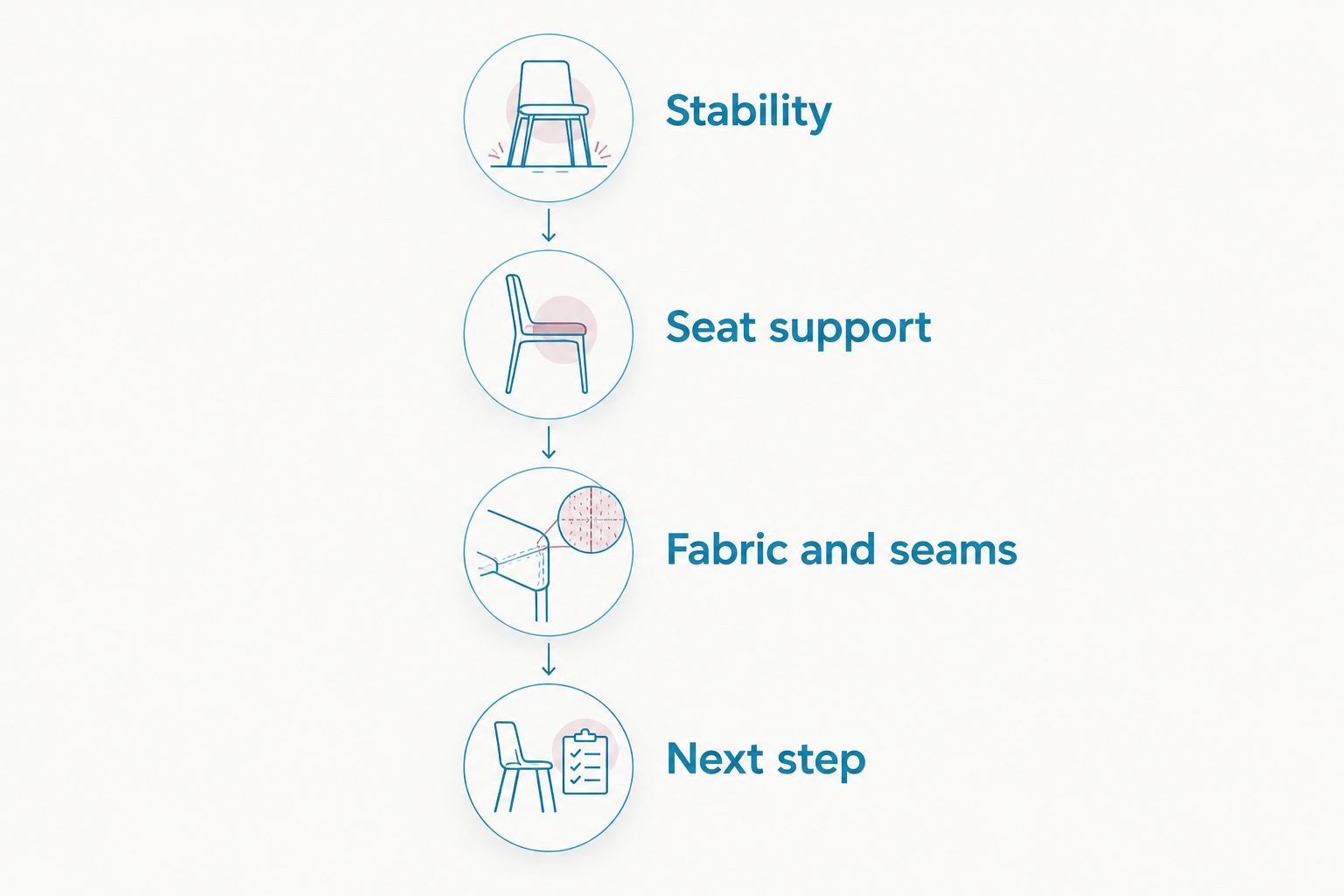
Assess an occasional chair systematically rather than sitting down and deciding whether it feels old. For your 2026 furniture review, inspect the structure first, then the support and covering.
Start with stability
Place the chair on a level surface and inspect its legs or base. Look for visible cracks, separated joints and loose connections without forcing or dismantling anything.
An uneven floor can explain rocking, so rule that out before diagnosing a chair fault. If movement remains or a component looks damaged, stop using the chair and arrange an assessment.
Check seat support
If the chair is structurally stable, sit in your usual position and notice whether the seat supports you evenly. Distinguish the intended softness from a pronounced hollow, an uneven seating position or a hard component pressing through.
Where cushions are removable, inspect them according to the care instructions. Do not assume that turning a cushion over fixes a problem underneath it.
Examine fabric and seams
Look closely at the seat front, arm contact areas and seams. Compare surface changes with actual damage: a change in appearance needs a different response from an opening seam or worn-through fabric.
Check the care label before applying a cleaner. Avoid treating an unfamiliar fabric with a household product simply because it worked on another chair.
Choose the next step
Keep using a stable, supportive chair with serviceable upholstery. Arrange cleaning or repair for an isolated, treatable problem, and seek a structural assessment for movement or damage.
Which occasional-chair features deserve closer attention?
Start with documented features, then identify what you still need to establish for daily use. The following Elegante occasional chairs illustrate different design choices, not a tested lifespan ranking.
Elegante occasional chairs are best for buyers seeking decorative seating with clearly identified upholstery choices. For everyday use, assess each model's construction and care requirements separately; the finish alone does not establish service life.
| Chair | Best for | Documented features | Trade-off or decision limit |
|---|---|---|---|
| Birkshire Slip Cover Modular Occasional Chair - White Linen | Buyers seeking an armless linen chair | White linen slip cover, feather and foam fill, solid hardwood frame | The armless design does not provide armrests; confirm cover-care instructions |
| Beau Occasional Chair - White Boucle | Buyers seeking curved seating with textured upholstery | Curved form and white bouclé upholstery | The upholstery description does not establish frame construction or abrasion performance |
Birkshire: an armless linen option
The Birkshire Slip Cover Modular Occasional Chair - White Linen has a solid hardwood frame and feather and foam fill. Those are useful construction details when you are comparing seats for regular use.
The armless form is a clear limitation if you want armrests while reading or assistance when rising. A slip cover also does not automatically mean machine washable: follow the product's specific care instructions. Best for an armless seating arrangement, not a buyer who needs arm support.
Beau: a curved bouclé option
The Beau Occasional Chair - White Boucle offers a curved form and textured white upholstery. Choose it for that visual character rather than assuming bouclé guarantees a longer service life.
For a 2026 daily-use purchase, establish the frame, support and cleaning details before deciding. Its appearance answers a styling question; those additional details answer the practical one. Best for a sculptural accent, with daily-use suitability checked separately.


How do you care for an occasional chair used every day?
Follow the chair's care instructions rather than a generic upholstery routine. A removable cover, textured fabric and loose cushion each raise different care questions.
Use this practical approach:
- Remove loose dust using the method permitted by the care instructions, including an appropriate upholstery attachment where specified.
- Attend to spills promptly using the recommended method; avoid scrubbing or introducing an unapproved cleaning solution.
- Rotate or turn cushions only when their construction and instructions allow it.
- Keep the chair clear of furniture edges that rub against its upholstery.
- Review its position if one side receives sustained direct sunlight.
- Lift and move the chair using the manufacturer's instructions rather than dragging it by an arm or backrest.
Do not let maintenance become a substitute for assessment. Fluffing a cushion does not repair failed support, and placing a rug beneath a chair does not resolve a damaged leg.
Can an occasional chair be used as your main reading chair?
An occasional chair can serve as your main reading chair when its support, proportions and intended use suit you. The category name alone does not confirm suitability for extended sitting.
Check whether you can sit back comfortably, place your feet securely and rise without strain. If you need armrests, make that a selection requirement rather than an afterthought.
Plan the surrounding space as well. Keep reading materials and lighting within comfortable reach so you are not continually leaning across or twisting out of the seat.
Is it better to repair or replace an occasional chair?
Repair an occasional chair when a qualified assessment identifies a contained fault and confirms that the remaining structure is serviceable. Consider replacement when damage, unsuitable support or impractical repair work prevents the chair from meeting your needs.
Cleaning and recovering have a clear advantage: they retain a chair you already like. Their limitation is equally clear: neither resolves an unassessed structural problem.
Ask an upholsterer or furniture repairer to separate the work into frame, seat support, filling and covering. That makes the decision more useful than a single recommendation based on appearance.
FAQ
How long do occasional chairs last with daily use?
Occasional chairs have no fixed daily-use lifespan; judge the frame, seat support and upholstery separately. Keep using a chair while those parts remain safe and serviceable, and investigate changes rather than replacing it by age alone.
Does a hardwood frame guarantee a longer-lasting occasional chair?
A hardwood frame does not guarantee a particular lifespan. Joint construction, seat support, use and care also matter, so assess the complete chair rather than the frame material alone.
Is bouclé better than linen for an everyday occasional chair?
Bouclé is not automatically better than linen for everyday use. Compare the actual fabric specifications, care instructions and chair construction instead of treating the fabric name as a durability rating.
Can I machine wash an occasional chair's slip cover?
Machine wash a slip cover only when its care instructions explicitly permit it. A removable cover is not proof that the fabric, lining or finish is suitable for machine washing.
Does a sagging seat mean I need a new chair?
A sagging seat needs assessment, not automatic replacement. The cause can involve the cushion, underlying support or structure, and the appropriate repair depends on which part has deteriorated.
Should I keep using an occasional chair that wobbles?
Stop using a chair that remains unstable on a level surface until the cause has been assessed. Do not hide structural movement with a cushion, rug or improvised support.
What should I check before buying an Elegante occasional chair for daily use?
Check the Elegante chair's dimensions, construction, support and care instructions against your intended use. Confirm any requirement that matters to you, including arm support or removable covers, rather than inferring it from photographs.
One last thing
Before replacing a chair in 2026, describe the problem without using the word old. Is it unstable, unsupportive, torn, stained or simply no longer suited to your room?
Name the fault before choosing the remedy. That small distinction helps you preserve a worthwhile piece without keeping one that no longer serves you.



Comments (0)
There are no comments for this article. Be the first one to leave a message!